Topic summary
Trimean
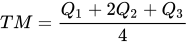
In statistics the trimean (TM), or Tukey's trimean, is a measure of a probability distribution's central tendency defined as a weighted average of the distribution's quartiles:
It gives twice as much weight to the median or second quartile than the first and third quartiles.

This is equivalent to the arithmetic mean of the median and the midhinge:
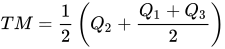
The foundations of the trimean were part of Arthur Bowley's teachings, and later popularized by statistician John Tukey in his 1977 book which has given its name to a set of techniques called exploratory data analysis.
Like the median and the midhinge, but unlike the sample mean, it is a statistically resistantL-estimator with a breakdown point of 25%. This beneficial property has been described as follows:
An advantage of the trimean as a measure of the center (of a distribution) is that it combines the median's emphasis on center values with the midhinge's attention to the extremes.
— Herbert F. Weisberg, Central Tendency and Variability