Topic summary
Fluxion
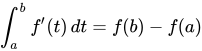
Historical mathematical concept; form of derivative Newton's introduction of the notions "fluent" and "fluxion" in his 1736 bookA fluxion is the instantaneous rate of change, or gradient, of a fluent (a time-varying quantity, or function) at a given point. Fluxions were introduced by Isaac Newton to describe his form of a time derivative (a derivative with respect to time). Newton introduced the concept in 1665 and detailed them in his mathematical treatise, Method of Fluxions. Fluxions and fluents made up Newton's early calculus. Example If the fluent y {\displaystyle y} is defined as y = t 2 {\displaystyle y=t^{2}} (where t {\displaystyle t} is time) the fluxion (derivative) at t = 2 {\displaystyle t=2} is: y ˙ = Δ y Δ t = ( 2 + o ) 2 − 2 2 ( 2 + o ) − 2 = 4 + 4 o + o 2 − 4 2 + o − 2 = 4 o + o 2 o {\displaystyle {\dot {y}}={\frac {\Delta y}{\Delta t}}={\frac {(2+o)^{2}-2^{2}}{(2+o)-2}}={\frac {4+4o+o^{2}-4}{2+o-2}}={\frac {4o+o^{2}}{o}}} Here o {\displaystyle o} is an infinitely small amount of time. So, the term o 2 {\displaystyle o^{2}} is second order infinite small term and according to Newton, we can now ignore o 2 {\displaystyl