Topic summary
Bijective

Extracted from the Wikipedia article Bijection.
More mathematical examples
- For any set X, the identity function1X: X → X, 1X(x) = x is bijective.
- The multiplicative inverse function gives a bijection of the unit interval (0, 1) with the semi-infinite interval (1, +∞).
- The function f: R → R, f(x) = 2x + 1 is bijective, since for each y there is a unique x = (y − 1)/2 such that f(x) = y. More generally, any linear function over the reals, f: R → R, f(x) = ax + b (where a is non-zero) is a bijection. Each real number y is obtained from (or paired with) the real number x = (y − b)/a.
- The function f: R → (−π/2, π/2), given by f(x) = arctan(x) is bijective, since each real number x is paired with exactly one angle y in the interval (−π/2, π/2) so that tan(y) = x (that is, y = arctan(x)). If the codomain (−π/2, π/2) was made larger to include an integer multiple of π/2, then this function would no longer be onto (surjective), since there is no real number which could be paired with the multiple of π/2 by this arctan function.
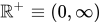
- The exponential function, g: R → R, g(x) = e, is not bijective: for instance, there is no x in R such that g(x) = −1, showing that g is not onto (surjective). However, if the codomain is restricted to the positive real numbers , then g would be bijective; its inverse (see below) is the natural logarithm function ln.
- The function h: R → R, h(x) = x is not bijective: for instance, h(−1) = h(1) = 1, showing that h is not one-to-one (injective). However, if the domain is restricted to , then h would be bijective; its inverse is the positive square root function.
- By Schröder–Bernstein theorem, given any two sets X and Y, and two injective functions f: X → Y and g: Y → X, there exists a bijective function h: X → Y.