 Independent and identically distributed random variablesIn probability theory and statistics, a collection of random variables is independent and identically distributed (i.i.d., iid, or IID) if each random variable has the same probability distribution as the others and all are mutually independent. IID was first defined in statistics and finds application in many fields, such as data mining and signal processing. IntroductionStatistics commonly deals with random samples.
 Random variableVariable representing a random phenomenonA random variable (also called random quantity, aleatory variable, or stochastic variable) is a mathematical formalization of a quantity or object which depends on random events.
 Categorical variableIn statistics, a categorical variable (also called qualitative variable) is a variable that can take on one of a limited, and usually fixed, number of possible values, assigning each individual or other unit of observation to a particular group or nominal category on the basis of some qualitative property. In computer science and some branches of mathematics, categorical variables are referred to as enumerations or enumerated types.
 Dependent and independent variablesA variable is considered dependent if it depends on (or is hypothesized to depend on) an independent variable. Dependent variables are the outcome of the test they depend on, by some law or rule (e.g., by a mathematical function). Independent variables, on the other hand, are not seen as depending on any other variable in the scope of the experiment in question. Rather, they are controlled by the experimenter.
 State variableA state variable is one of the set of mathematical variables that are used to describe the "state" of a system, e.g. of a dynamical system or a thermodynamical system.
 Propositional variableIn mathematical logic, a propositional variable (also called a sentence letter,sentential variable, or sentential letter) is an input variable (that can either be true or false) of a truth function. Propositional variables are the basic building-blocks of propositional formulas, used in propositional logic and higher-order logics.Free variables and bound variablesIn mathematics, and in other disciplines involving formal languages, including mathematical logic and computer science, a variable may be said to be either free or bound. Some older books use the terms real variable and apparent variable for free variable and bound variable, respectively. A free variable is a notation (symbol) that specifies places in an expression where substitution may take place and is not a parameter of this or any container expression.Complex analysisComplex analysis, traditionally known as the theory of functions of a complex variable, is the branch of mathematical analysis that studies complex-valued functions of one or more complex variables. It is used in many branches of mathematics, including functional analysis, algebraic geometry, number theory, analytic combinatorics, and applied mathematics, as well as in physics, including the branches of hydrodynamics, thermodynamics, quantum mechanics, and twistor theory.Slack variableIn an optimization problem, a slack variable is a variable that is added to an inequality constraint to transform it into an equality constraint. A non-negativity constraint on the slack variable is also added. Slack variables are used in particular in linear programming. As with the other variables in the augmented constraints, the slack variable cannot take on negative values, as the simplex algorithm requires them to be positive or zero.
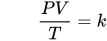 Control variableA control variable (or scientific constant) in scientific experimentation is an experimental element which is constant (controlled) and unchanged throughout the course of the investigation. Control variables could strongly influence experimental results were they not held constant during the experiment in order to test the relative relationship of the dependent variable (DV) and independent variable (IV).
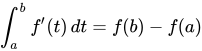 Fluent (mathematics)Time-varying quantity or variable Newton's introduction of the notions "fluent" and "fluxion" in his 1736 book A fluent is a time-varying quantity or variable. The term was used by Isaac Newton in his early calculus to describe his form of a function. The concept was introduced by Newton in 1665 and detailed in his mathematical treatise, Method of Fluxions.Variable and attribute (research)In science and research, an attribute is a quality of an object (person, thing, etc.). Attributes are closely related to variables. A variable is a logical set of attributes. Variables can "vary" – for example, be high or low. How high, or how low, is determined by the value of the attribute (and in fact, an attribute could be just the word "low" or "high").
 VariableRelated word or term.variablesRelated word or term.
*As an Amazon Associate I earn from qualifying purchases.