 Shear thinningIn rheology, shear thinning is the non-Newtonian behavior of fluids whose viscosity decreases under shear strain. It is sometimes considered synonymous with pseudo-plastic behaviour, and is usually defined as excluding time-dependent effects, such as thixotropy. Shear thinning is the most common type of non-Newtonian behavior of fluids and is seen in many industrial and everyday applications.
 Non-Newtonian fluidType of fluid In physical chemistry and fluid mechanics, a non-Newtonian fluid is a fluid that does not follow Newton's law of viscosity; that is, it has variable viscosity dependent on stress. In particular, the viscosity of non-Newtonian fluids can change when subjected to force. Ketchup, for example, becomes runnier when shaken and is thus a non-Newtonian fluid.
 ViscosityResistance of a fluid to shear deformation
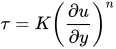 Power-law fluidIn continuum mechanics, a power-law fluid, or the Ostwald–de Waele relationship, is a type of generalized Newtonian fluid. This mathematical relationship is useful because of its simplicity, but only approximately describes the behaviour of a real non-Newtonian fluid. Power-law fluids can be subdivided into three different types of fluids based on the value of their flow behaviour index: pseudoplastic, Newtonian fluid, and dilatant.
 Shear stressShear stress (often denoted by τ, Greek: tau) is the component of stress coplanar with a material cross section. It arises from the shear force, the component of force vector parallel to the material cross section. Normal stress, on the other hand, arises from the force vector component perpendicular to the material cross section on which it acts.Stress (mechanics)Physical quantity that expresses internal forces in a continuous material StressResidual stresses inside a plastic protractor are revealed by polarized light.Common symbolsσSI unitpascalOther unitspsi, barIn SI base unitsPa = kg⋅m−1⋅s−2Dimension L − 1 M T − 2 {\displaystyle {\mathsf {L}}^{-1}{\mathsf {M}}{\mathsf {T}}^{-2}} In continuum mechanics, stress is a physical quantity that describes forces present during deformation.
 Fluid dynamicsAspects of fluid mechanics involving fluid flow Computer generated animation of fluid in a tube flowing past a cylinder, showing the shedding of a series of vortices in the flow behind it, called a von Kármán vortex street.
 KetchupKetchup or catsup is a table condiment with a sweet and sour flavor. Ketchup now typically refers to tomato ketchup, although early recipes for different varieties contained mushrooms, oysters, mussels, egg whites, grapes, or walnuts, among other ingredients. Tomato ketchup is made from tomatoes, sugar, and vinegar, with seasonings and spices.FluidIn physics, a fluid is a liquid, gas, or other material that may continuously move and deform (flow) under an applied shear stress, or external force. They have zero shear modulus, or, in simpler terms, are substances which cannot resist any shear force applied to them.
 GelA gel is a semi-solid that can have properties ranging from soft and weak to hard and tough. Gels are defined as a substantially dilute cross-linked system, which exhibits no flow when in the steady state, although the liquid phase may still diffuse through this system. Gels are mostly liquid by mass, yet they behave like solids because of a three-dimensional cross-linked network within the liquid.
 Special:Search/thixotropyRelated word or term.
*As an Amazon Associate I earn from qualifying purchases.