|
Plants For Human Health Institute
The Plants for Human Health Institute (PHHI) is a North Carolina State University based research and education organization located at the North Carolina Research Campus in Kannapolis, North Carolina, United States. The PHHI researches food crops, like fruits and vegetables, and the potential health-promoting properties they may convey when consumed. The PHHI is part of the university's College of Agriculture and Life Sciences; its staff consists of faculty from the following departments: horticultural science, food, bioprocessing and nutrition sciences; plant and microbial biology, genetics, and agricultural and resource economics. The PHHI has both research and Cooperative Extension components. Mary Ann Lila, a blueberry researcher, is the current director of the PHHI. History N.C. State began operations in Kannapolis in 2007 as the ''Fruit and Vegetable Science Institute''. The university was one of the first organizations to join the biotech hub. The program's ... [...More Info...] [...Related Items...] OR: [Wikipedia] [Google] [Baidu] [Amazon] |
North Carolina State University
North Carolina State University (NC State, North Carolina State, NC State University, or NCSU) is a public university, public Land-grant university, land-grant research university in Raleigh, North Carolina, United States. Founded in 1887 and part of the University of North Carolina system, it is the largest university in the Carolinas. The university forms one of the corners of the Research Triangle together with Duke University in Durham, North Carolina, Durham and the University of North Carolina at Chapel Hill. It is Carnegie Classification of Institutions of Higher Education, classified among "R1: Doctoral Universities – Very high research activity". The North Carolina General Assembly established North Carolina College of Agriculture and Mechanic Arts on March 7, 1887, as a land-grant university, land-grant college. The college underwent several name changes and officially became North Carolina State University at Raleigh in 1965. However, by longstanding convention, the ... [...More Info...] [...Related Items...] OR: [Wikipedia] [Google] [Baidu] [Amazon] |
Anthocyanins
Anthocyanins (), also called anthocyans, are water-soluble vacuolar pigments that, depending on their pH, may appear red, purple, blue, or black. In 1835, the German pharmacist Ludwig Clamor Marquart named a chemical compound that gives flowers a blue color, Anthokyan, in his treatise "''Die Farben der Blüthen''" (English: The Colors of Flowers). Food plants rich in anthocyanins include the blueberry, raspberry, black rice, and black soybean, among many others that are red, blue, purple, or black. Some of the colors of autumn leaves are derived from anthocyanins. Anthocyanins belong to a parent class of molecules called flavonoids synthesized via the phenylpropanoid pathway. They can occur in all tissues of higher plants, including leaves, stems, roots, flowers, and fruits. Anthocyanins are derived from anthocyanidins by adding sugars. They are odorless and moderately astringent. Although approved as food and beverage colorant in the European Union, anthocyanins are not ... [...More Info...] [...Related Items...] OR: [Wikipedia] [Google] [Baidu] [Amazon] |
Systems Biology
Systems biology is the computational modeling, computational and mathematical analysis and modeling of complex biological systems. It is a biology-based interdisciplinary field of study that focuses on complex interactions within biological systems, using a holistic approach (holism instead of the more traditional reductionist, reductionism) to biological research. This multifaceted research domain necessitates the collaborative efforts of chemists, biologists, mathematicians, physicists, and engineers to decipher the biology of intricate living systems by merging various quantitative molecular measurements with carefully constructed mathematical models. It represents a comprehensive method for comprehending the complex relationships within biological systems. In contrast to conventional biological studies that typically center on isolated elements, systems biology seeks to combine different biological data to create models that illustrate and elucidate the dynamic interactions with ... [...More Info...] [...Related Items...] OR: [Wikipedia] [Google] [Baidu] [Amazon] |
Postharvest Physiology
In agriculture, postharvest handling is the stage of crop production immediately following harvest, including cooling, cleaning, sorting and packing. The instant a crop is removed from the ground, or separated from its parent plant, it begins to deteriorate. Postharvest treatment largely determines final quality, whether a crop is sold for fresh consumption, or used as an ingredient in a processed food product. Goals The most important goals of post-harvest handling are to keep the product cool and safe, to avoid moisture loss and slow down undesirable chemical changes, and avoiding physical damage such as bruising, to delay spoilage. Sanitation is also an important factor, to reduce the possibility of pathogens that could be carried by fresh produce, for example, as residue from contaminated washing water. After the field, post-harvest processing is usually continued in a packing house. This can be a simple shed, providing shade and running water, or a large-scale, sophi ... [...More Info...] [...Related Items...] OR: [Wikipedia] [Google] [Baidu] [Amazon] |
Pharmacogenomics
Pharmacogenomics, often abbreviated "PGx," is the study of the role of the genome in drug response. Its name ('' pharmaco-'' + ''genomics'') reflects its combining of pharmacology and genomics. Pharmacogenomics analyzes how the genetic makeup of a patient affects their response to drugs. It deals with the influence of acquired and inherited genetic variation on drug response, by correlating DNA mutations (including point mutations, copy number variations, and structural variations) with pharmacokinetic (drug absorption, distribution, metabolism, and elimination), pharmacodynamic (effects mediated through a drug's biological targets), and/or immunogenic endpoints. Pharmacogenomics aims to develop rational means to optimize drug therapy, with regard to the patients' genotype, to achieve maximum efficiency with minimal adverse effects. It is hoped that by using pharmacogenomics, pharmaceutical drug treatments can deviate from what is dubbed as the "one-dose-fits-all" app ... [...More Info...] [...Related Items...] OR: [Wikipedia] [Google] [Baidu] [Amazon] |
Metabolomics
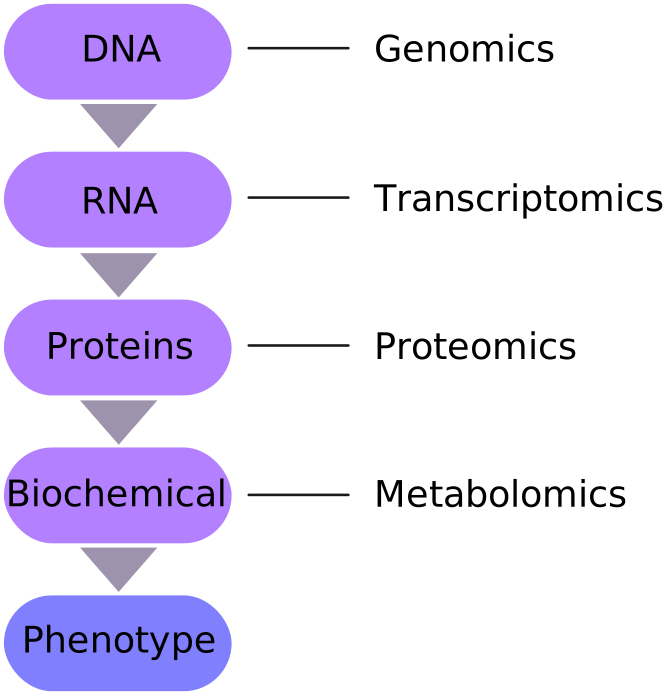
Metabolomics is the scientific study of chemical processes involving metabolites, the small molecule substrates, intermediates, and products of cell metabolism. Specifically, metabolomics is the "systematic study of the unique chemical fingerprints that specific cellular processes leave behind", the study of their small-molecule metabolite profiles. The metabolome represents the complete set of metabolites in a biological cell, tissue, organ, or organism, which are the end products of cellular processes. Messenger RNA (mRNA), gene expression data, and proteomics, proteomic analyses reveal the set of gene products being produced in the cell, data that represents one aspect of cellular function. Conversely, metabolic profiling can give an instantaneous snapshot of the physiology of that cell, and thus, metabolomics provides a direct "functional readout of the physiological state" of an organism. There are indeed quantifiable correlations between the metabolome and the other cellular ... [...More Info...] [...Related Items...] OR: [Wikipedia] [Google] [Baidu] [Amazon] |
Epigenetics
In biology, epigenetics is the study of changes in gene expression that happen without changes to the DNA sequence. The Greek prefix ''epi-'' (ἐπι- "over, outside of, around") in ''epigenetics'' implies features that are "on top of" or "in addition to" the traditional (DNA sequence based) genetic mechanism of inheritance. Epigenetics usually involves a change that is not erased by cell division, and affects the regulation of gene expression. Such effects on cellular and physiological traits may result from environmental factors, or be part of normal development. The term also refers to the mechanism of changes: functionally relevant alterations to the genome that do not involve mutation of the nucleotide sequence. Examples of mechanisms that produce such changes are DNA methylation and histone modification, each of which alters how genes are expressed without altering the underlying DNA sequence. Further, non-coding RNA sequences have been shown to play a key role in the r ... [...More Info...] [...Related Items...] OR: [Wikipedia] [Google] [Baidu] [Amazon] |
Plant Breeding
Plant breeding is the science of changing the traits of plants in order to produce desired characteristics. It is used to improve the quality of plant products for use by humans and animals. The goals of plant breeding are to produce crop varieties that boast unique and superior traits for a variety of applications. The most frequently addressed agricultural traits are those related to biotic and abiotic stress tolerance, grain or biomass yield, end-use quality characteristics such as taste or the concentrations of specific biological molecules (proteins, sugars, lipids, vitamins, fibers) and ease of processing (harvesting, milling, baking, malting, blending, etc.). Plant breeding can be performed using many different techniques, ranging from the selection of the most desirable plants for propagation, to methods that make use of knowledge of genetics and chromosomes, to more complex molecular techniques. Genes in a plant are what determine what type of qualitative or quantitativ ... [...More Info...] [...Related Items...] OR: [Wikipedia] [Google] [Baidu] [Amazon] |
Biochemistry
Biochemistry, or biological chemistry, is the study of chemical processes within and relating to living organisms. A sub-discipline of both chemistry and biology, biochemistry may be divided into three fields: structural biology, enzymology, and metabolism. Over the last decades of the 20th century, biochemistry has become successful at explaining living processes through these three disciplines. Almost all List of life sciences, areas of the life sciences are being uncovered and developed through biochemical methodology and research.#Voet, Voet (2005), p. 3. Biochemistry focuses on understanding the chemical basis that allows biomolecule, biological molecules to give rise to the processes that occur within living Cell (biology), cells and between cells,#Karp, Karp (2009), p. 2. in turn relating greatly to the understanding of tissue (biology), tissues and organ (anatomy), organs as well as organism structure and function.#Miller, Miller (2012). p. 62. Biochemistry is closely ... [...More Info...] [...Related Items...] OR: [Wikipedia] [Google] [Baidu] [Amazon] |