|
Malay Technology Museum
The Malay Technology Museum () is a museum in Kota Batu of Bandar Seri Begawan, Brunei. The museum's main objective is to present early Brunei's technical practices, which provide insight into the way of life of the country's inhabitants, who lived in both the water town and on dry ground. Location The Malay Technology Museum is located in Kota Batu, along Jalan Kota Batu, close to other important historical landmarks including the Tombs of Sultan Sharif Ali, the third sultan, and Sultan Bolkiah, the fifth sultan. Situated on the river delta and slopes of the Brunei River, the museum is a part of a complex of museums that also includes the Brunei Museum and the Brunei Darussalam Maritime Museum. History Sultan Hassanal Bolkiah gave the Malay Technology Museum its formal opening on 29 February 1988. The Royal Dutch Shell Group of Companies funded the museum's construction, which came at a cost of about B$7 million. Building took place on a area of land along the Brun ... [...More Info...] [...Related Items...] OR: [Wikipedia] [Google] [Baidu] [Amazon] |
Kota Batu, Brunei
Kota Batu () is a historical as well as populated area in Bandar Seri Begawan, the capital of Brunei. It is home to the Kota Batu archaeological site, a few of the country's museums and two mausoleums of the earliest Sultans of Brunei. However, the place is still populated and at present it is a neighbourhood of the capital. Name "Kota Batu" is the Malay term which literally means "Stone Fort". History Kota Batu was believed to be the ancient capital of Brunei. During the Castilian War, the Spaniards capture the city on April 16, 1578; the Bruneians retook it in June 26, 1578. The city remained the capital before the emergence of Kampong Ayer, which is further inland, and over the Brunei River, during the Brunei Civil War in the 17th century. According to Brunei source '' Silsilah Raja-Raja Brunei'', Kota Batu was founded by Sultan Sharif Ali. Among the founding workers were Chinese people. The palace, masjid and educational institutions were built in the quickly developing ... [...More Info...] [...Related Items...] OR: [Wikipedia] [Google] [Baidu] [Amazon] |
Free Malaysia Today
Free Malaysia Today (FMT) is an independent, bilingual news online portal with content, in both English and Bahasa Malaysia (Malay), with a focus on Malaysian current affairs, published since 2009."Archived Web Site: Free Malaysia Today" archives of the United States , retrieved 2 February 2020 It is one of 's most accessed news sites with monthly visits of 11.83 million.Lumsden, Linda J. ( |
Dusun People
Dusun is the collective name of an indigenous ethnic group to the Malaysian state of Sabah of North Borneo. Collectively, they form the largest ethnic group in Sabah. The Dusun people have been internationally recognised as indigenous to Borneo since 2004 as per the United Nations Educational, Scientific and Cultural Organization (UNESCO). Other similarly named, but unrelated groups are also found in Brunei and Central Kalimantan, Indonesia. The Dusun in Brunei have distinct traditional beliefs and customs compared to those in Sabah. Bruneian Dusuns share a common origin, language and identity with the Bisaya people of Brunei, northern Sarawak and southwestern Sabah. Despite these differences, both groups are part of the broader Dusunic language family. In Indonesia, the Barito Dusun groups, located throughout the Barito River system, are actually part of the Ot Danum Dayak people, rather than being related to the Dusun of North Borneo. Etymology The Dusuns do not have ... [...More Info...] [...Related Items...] OR: [Wikipedia] [Google] [Baidu] [Amazon] |
Kedayan
The Kedayan (also known as Kadayan, Kadaian or Kadyan) are an ethnic group residing in Brunei, Federal Territory of Labuan, southwest of Sabah, and north of Sarawak on the island of Borneo. According to the Language and Literature Bureau of Brunei, the Kedayan language (ISO 639-3: kxd) is spoken by about 30,000 people in Brunei, and it has been claimed that there are a further 46,500 speakers in Sabah and 37,000 in Sarawak. In Sabah, the Kedayan mainly live in the southern districts of Sipitang and Beaufort, where they are counted as a part of the local Malay populace (and they are often considered as Bruneians owing to assimilation as well as mixed marriage factors). Whilst in Sarawak, the Kedayans mostly reside in the towns of Lawas, Limbang and Miri (especially the Subis area). History The origins of the Kedayans are uncertain. Some of them believe their people were originally from Ponorogo, Java, which they left during the reign of Sultan Bolkiah. Because of ... [...More Info...] [...Related Items...] OR: [Wikipedia] [Google] [Baidu] [Amazon] |
Palm Sugar
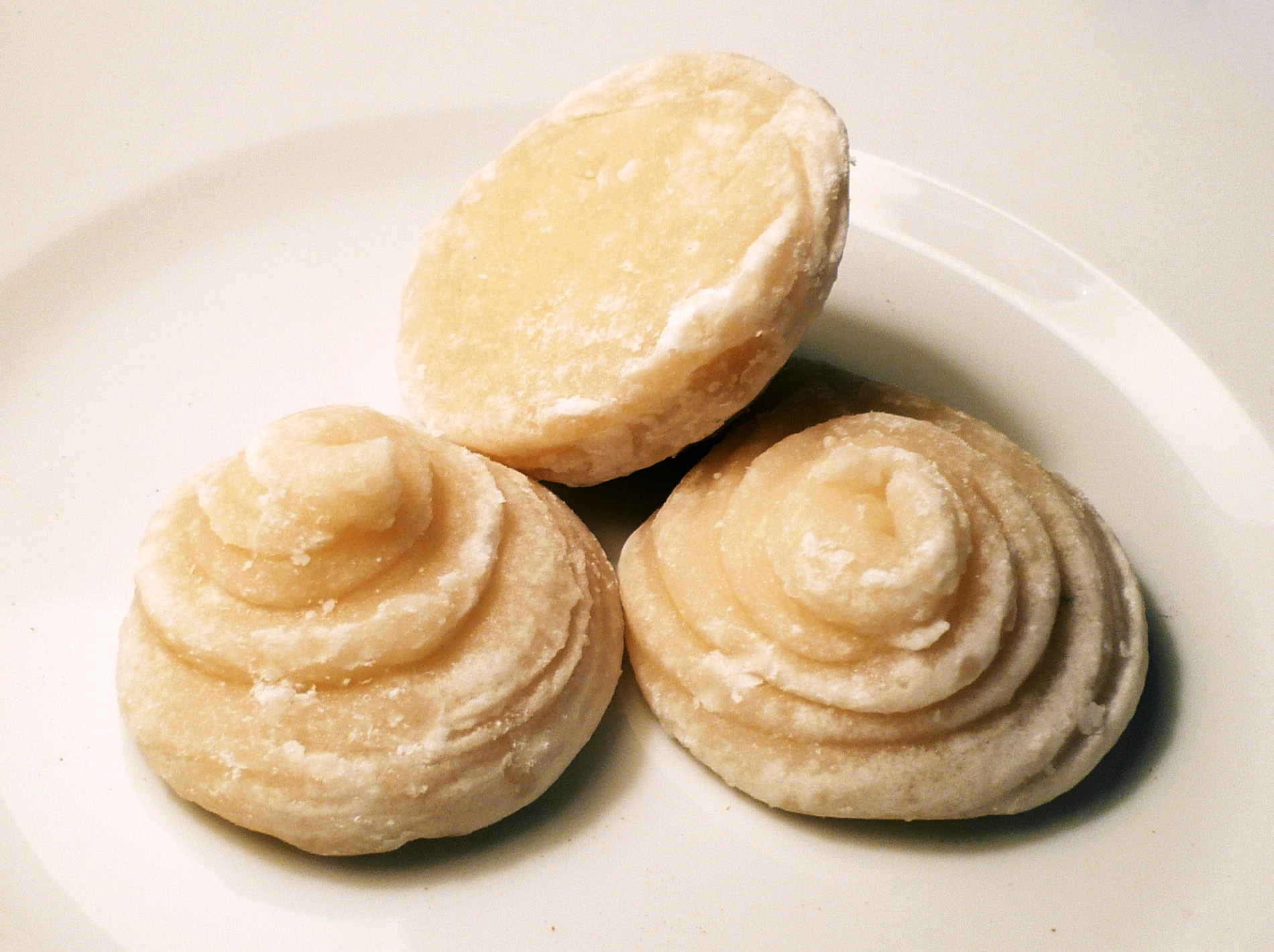
Palm sugar is a sweetener derived from any variety of palm tree. Palm sugar may be qualified by the type of palm, as in coconut palm sugar. While sugars from different palms may have slightly different compositions, all are processed similarly and can be used interchangeably. Types The predominant sources of palm sugar are the Palmyra, date, nipa, aren, and coconut palms. The Palmyra palm (''Borassus'' spp.) is grown in Africa, Asia, and New Guinea. The tree has many uses, such as thatching, hatmaking, timber, a writing material, and in food products. Palm sugar is produced from sap (toddy) from the flowers. There are two species of date palm that produce palm sugar: ''Phoenix dactylifera'' and '' P. sylvestris''. ''P. dactylifera'' is common in the Mediterranean and Middle East, while ''P. sylvestris'' is native to Asia, mainly Pakistan and India. Date palms are cultivated mainly for dates and palm sugar is made from the tree's sap. The nipa palm ('' Nypa fru ... [...More Info...] [...Related Items...] OR: [Wikipedia] [Google] [Baidu] [Amazon] |
Sago
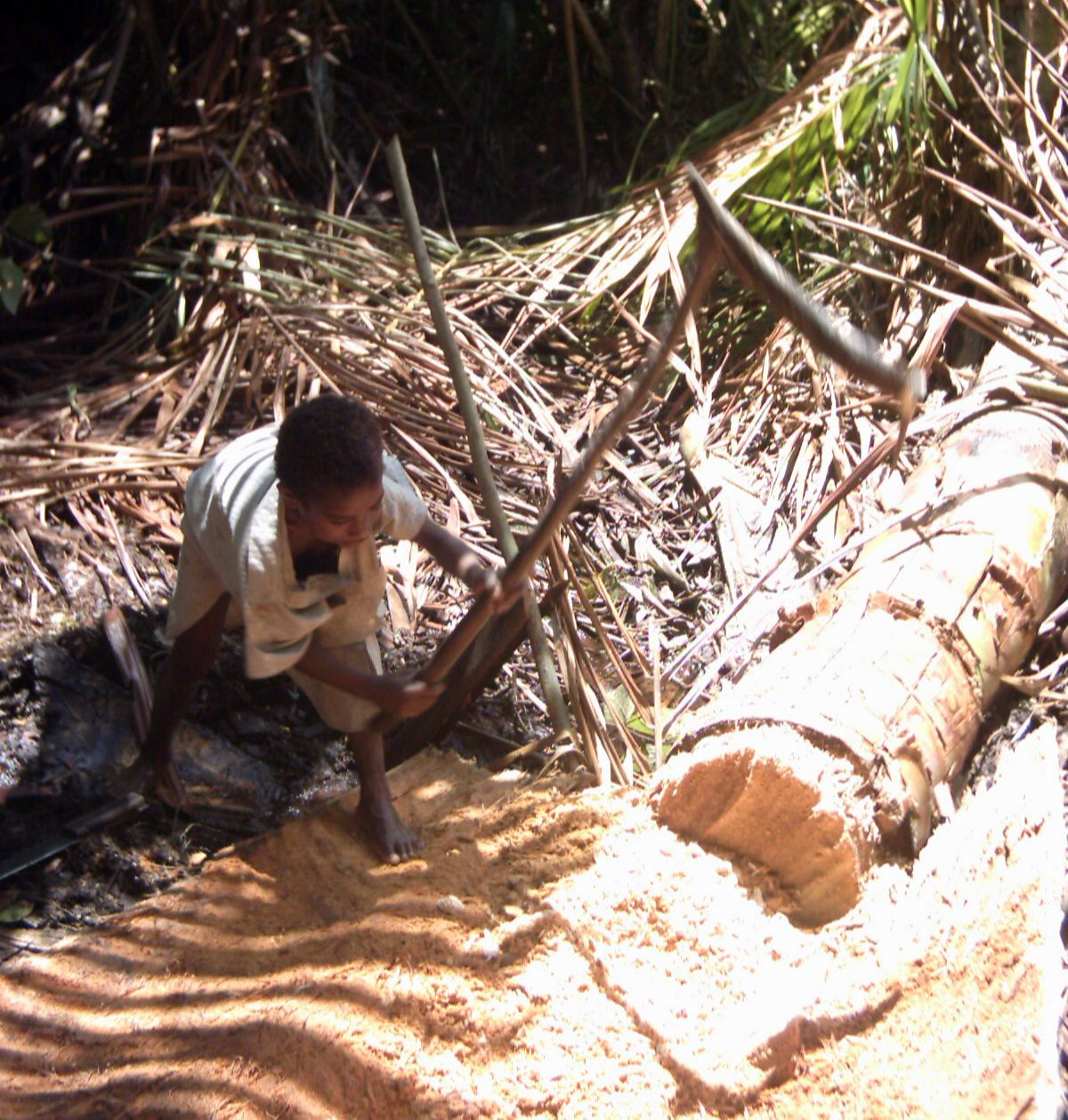
Sago () is a starch extracted from the pith, or spongy core tissue, of various tropical palm stems, especially those of ''Metroxylon sagu''. It is a major staple food for the lowland peoples of New Guinea and the Maluku Islands, where it is called ''saksak'', ''rabia'' and ''sagu''. The largest supply of sago comes from Melanesia region, particularly Eastern Indonesia. Large quantities of sago are sent to Europe and North America for cooking purposes. It is traditionally cooked and eaten in various forms, such as rolled into balls, mixed with boiling water to form a glue-like paste (Papeda (food), papeda), or as a pancake. Sago is often produced commercially in the form of "pearls" (small rounded starch aggregates, partly Starch gelatinization, gelatinized by heating). Sago pearls can be boiled with water or milk and sugar to make a sweet sago pudding. Sago pearls are similar in appearance to the pearled starches of other origin, e.g. cassava starch (tapioca) and potato starch ... [...More Info...] [...Related Items...] OR: [Wikipedia] [Google] [Baidu] [Amazon] |
Ironsmith
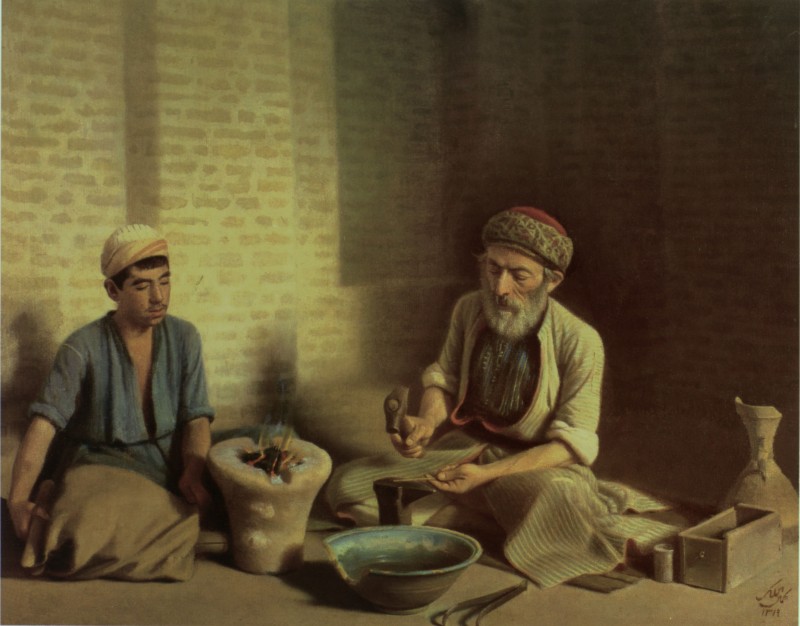
A blacksmith is a metalsmith who creates objects primarily from wrought iron or steel, but sometimes from other metals, by forging the metal, using tools to hammer, bend, and cut (cf. tinsmith). Blacksmiths produce objects such as gates, grilles, railings, light fixtures, furniture, sculpture, tools, agricultural implements, decorative and religious items, cooking utensils, and weapons. There was a historical distinction between the heavy work of the blacksmith and the more delicate operations of a whitesmith, who usually worked in gold, silver, pewter, or the finishing steps of fine steel. The place where a blacksmith works is variously called a smithy, a forge, or a blacksmith's shop. While there are many professions who work with metal, such as farriers, wheelwrights, and armorers, in former times the blacksmith had a general knowledge of how to make and repair many things, from the most complex of weapons and armor to simple things like nails or lengths of chain. Etymolog ... [...More Info...] [...Related Items...] OR: [Wikipedia] [Google] [Baidu] [Amazon] |
Mukim Burong Pingai Ayer
Mukim Burong Pingai Ayer is a mukim in Brunei-Muara District, Brunei. It is located within Kampong Ayer, the traditional stilt settlements on the Brunei River in the capital Bandar Seri Begawan. The population was 1,770 in 2016. Etymology The mukim is named after Kampong Burong Pingai Ayer, one of the villages it encompasses. Over time, several names have altered such as Kampong Sungai Pandan, which was formerly known as Kampong Sungai Kuyuk, which was less popular because ''kuyuk'' in Bruneian dialect means dog. It is unknown where the name came from. Some people hypothesized that there were dogs in the neighborhood scavenging at close-by dumps for trash. Its current name is Sungai Pandan. Most likely the name was changed because of a complaint. Built on a sandbank on the Brunei River, Kampong Bakut China was another settlement that underwent name changes (from the word ''bakut'' for sandbank and the Chinese businessmen who used to conduct trading there). It was once the ... [...More Info...] [...Related Items...] OR: [Wikipedia] [Google] [Baidu] [Amazon] |
Silversmithing
A silversmith is a metalworker who crafts objects from silver. The terms ''silversmith'' and ''goldsmith'' are not exact synonyms, as the techniques, training, history, and guilds are (or were, at least) largely the same but differed in that the end product may vary greatly (as may the scale of objects created). History In the ancient Near East (as holds true today), the value of silver was lower than the value of gold, allowing a silversmith to produce objects and store them as stock. Historian Jack Ogden states that, according to an edict written by Diocletian in 301 A.D., a silversmith was able to charge 75, 100, 150, 200, 250, or 300 '' denarii'' per Roman pound for material produce. At that time, guilds of silversmiths formed to arbitrate disputes, protect its members' welfare, and educate the public of the trade. Silversmiths in medieval Europe and England formed guilds and transmitted their tools and techniques to new generations via the apprentice tradition. Silverwo ... [...More Info...] [...Related Items...] OR: [Wikipedia] [Google] [Baidu] [Amazon] |
Goldsmithing
A goldsmith is a metalworker who specializes in working with gold and other precious metals. Modern goldsmiths mainly specialize in jewelry-making but historically, they have also made silverware, platters, goblets, decorative and serviceable utensils, and ceremonial or religious items. Goldsmiths must be skilled in forming metal through filing, soldering, sawing, forging, casting, and polishing. The trade has very often included jewelry-making skills, as well as the very similar skills of the silversmith. Traditionally, these skills had been passed along through apprenticeships; more recently jewelry arts schools, specializing in teaching goldsmithing and a multitude of skills falling under the jewelry arts umbrella, are available. Many universities and junior colleges also offer goldsmithing, silversmithing, and metal arts fabrication as a part of their fine arts curriculum. Gold Compared to other metals, gold is malleable, ductile, rare, and it is the only solid metall ... [...More Info...] [...Related Items...] OR: [Wikipedia] [Google] [Baidu] [Amazon] |
Weaving
Weaving is a method of textile production in which two distinct sets of yarns or threads are interlaced at right angles to form a fabric or cloth. Other methods are knitting, crocheting, felting, and braiding or plaiting. The longitudinal threads are called the warp and the lateral threads are the weft, woof, or filling. The method in which these threads are interwoven affects the characteristics of the cloth. Cloth is usually woven on a loom, a device that holds warp threads in place while filling threads are woven through them. A fabric band that meets this definition of cloth (warp threads with a weft thread winding between) can also be made using other methods, including tablet weaving, back strap loom, or other techniques that can be done without looms. The way the warp and filling threads interlace with each other is called the weave. The majority of woven products are created with one of three basic weaves: plain weave, satin weave, or twill weave. Woven cl ... [...More Info...] [...Related Items...] OR: [Wikipedia] [Google] [Baidu] [Amazon] |
Zinc (roof)
A metal roof is a roofing system featuring metal pieces or tiles exhibiting corrosion resistance, impermeability to water, and long life. It is a component of the building envelope. The metal pieces may be a covering on a structural, non-waterproof roof, or they could be self-supporting sheets. History Lead and copper have played a significant role in architecture for thousands of years (see: copper in architecture). Lead was one of the first and easiest metals to smelt and with a low melting point, it could be easily formed to be watertight. As a by-product of silver smelting, in Roman times it was readily available and relatively cheap. In the 3rd century BCE, copper roof shingles were installed atop the Lovamahapaya Temple in Sri Lanka. The Romans used copper as roof covering for the Pantheon in 27BCE. Centuries later, copper and its alloys were integral in European medieval architecture. The copper roof of St. Mary's Cathedral, Hildesheim, installed in 1280 CE, survive ... [...More Info...] [...Related Items...] OR: [Wikipedia] [Google] [Baidu] [Amazon] |