|
De Trinitate
''On the Trinity'' () is a Latin book written by Augustine of Hippo to discuss the Trinity in context of the Logos. Although not as well known as some of his other works, some scholars have seen it as his masterpiece, of more doctrinal importance even than '' Confessions'' or ''The City of God''. It is placed by him in his '' Retractationes'' among the works written (meaning begun) in AD 400. In letters of 410 and 414 and at the end of 415, it is referred to as still unfinished and unpublished. But a letter of 412 states that friends were at that time asking to complete and publish it, and the letter to Aurelius, which was sent with the treatise itself when actually completed, states that a portion of it, while still unrevised and incomplete, was in fact surreptitiously made public. It was still in hand in 416: in Book XIII, a quotation occurs from the 12th Book of the ''De Civitate Dei''; and another quotation in Book XV, from the 99th Tractate on John's Gospel. The ''Retractati ... [...More Info...] [...Related Items...] OR: [Wikipedia] [Google] [Baidu] [Amazon] |
Augustine Of Hippo
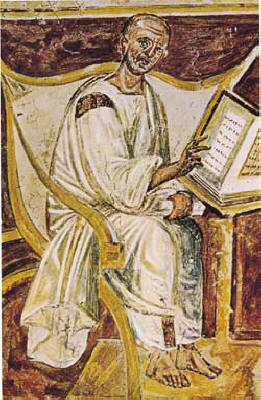
Augustine of Hippo ( , ; ; 13 November 354 – 28 August 430) was a theologian and philosopher of Berber origin and the bishop of Hippo Regius in Numidia, Roman North Africa. His writings deeply influenced the development of Western philosophy and Western Christianity, and he is viewed as one of the most important Church Fathers of the Latin Church in the Patristic Period. His many important works include '' The City of God'', '' On Christian Doctrine'', and '' Confessions''. According to his contemporary, Jerome of Stridon, Augustine "established anew the ancient Faith". In his youth he was drawn to the Manichaean faith, and later to the Hellenistic philosophy of Neoplatonism. After his conversion to Christianity and baptism in 386, Augustine developed his own approach to philosophy and theology, accommodating a variety of methods and perspectives. Believing the grace of Christ was indispensable to human freedom, he helped formulate the doctrine of original sin and m ... [...More Info...] [...Related Items...] OR: [Wikipedia] [Google] [Baidu] [Amazon] |
Cyril Of Jerusalem
Cyril of Jerusalem (, ''Kýrillos A Ierosolýmon''; ; 386) was a theologian of the Early Church. About the end of AD 350, he succeeded Maximus as Bishop of Jerusalem, but was exiled on more than one occasion due to the enmity of Acacius of Caesarea, and the policies of various emperors. Cyril left important writings documenting the instruction of catechumens and the order of the Liturgy in his day. Cyril is venerated as a saint within the Roman Catholic Church, the Eastern Orthodox Church, Oriental Orthodox Church, and the Anglican Communion. In 1883, Cyril was declared a Doctor of the Church by Pope Leo XIII. The Roman Catholic Church maintains an Optional Memorial for Cyril on 18 March. Cyril is remembered in the Church of England with a commemoration on 18 March. He should not be confused with Cyril of Alexandria. Life and character Little is known of his life before he became a bishop; the assignment of his birth to the year 315 rests on conjecture. According to ... [...More Info...] [...Related Items...] OR: [Wikipedia] [Google] [Baidu] [Amazon] |
Catholic Theology And Doctrine
The Catholic Church (), also known as the Roman Catholic Church, is the largest Christian church, with 1.27 to 1.41 billion baptized Catholics worldwide as of 2025. It is among the world's oldest and largest international institutions and has played a prominent role in the history and development of Western civilization. O'Collins, p. v (preface). The church consists of 24 ''sui iuris'' (autonomous) churches, including the Latin Church and 23 Eastern Catholic Churches, which comprise almost 3,500 dioceses and eparchies around the world, each overseen by one or more bishops. The pope, who is the bishop of Rome, is the chief pastor of the church. The core beliefs of Catholicism are found in the Nicene Creed. The Catholic Church teaches that it is the one, holy, catholic and apostolic church founded by Jesus Christ in his Great Commission, that its bishops are the successors of Christ's apostles, and that the pope is the successor of Saint Peter, upon whom ... [...More Info...] [...Related Items...] OR: [Wikipedia] [Google] [Baidu] [Amazon] |
Christian Theology Books
A Christian () is a person who follows or adheres to Christianity, a monotheistic Abrahamic religion based on the life and teachings of Jesus Christ. Christians form the largest religious community in the world. The words ''Christ'' and ''Christian'' derive from the Koine Greek title (), a translation of the Biblical Hebrew term '' mashiach'' () (usually rendered as ''messiah'' in English). While there are diverse interpretations of Christianity which sometimes conflict, they are united in believing that Jesus has a unique significance. The term ''Christian'' used as an adjective is descriptive of anything associated with Christianity or Christian churches, or in a proverbial sense "all that is noble, and good, and Christ-like." According to a 2011 Pew Research Center survey, there were 2.3 billion Christians around the world, up from about 600 million in 1910. Today, about 37% of all Christians live in the Americas, about 26% live in Europe, 24% live in sub-Saharan Africa, a ... [...More Info...] [...Related Items...] OR: [Wikipedia] [Google] [Baidu] [Amazon] |
Works By Augustine Of Hippo
Works may refer to: People * Caddy Works (1896–1982), American college sports coach * John D. Works (1847–1928), California senator and judge * Samuel Works (c. 1781–1868), New York politician Albums * ''Works'' (Pink Floyd album), a Pink Floyd album from 1983 * ''Works'', a Gary Burton album from 1972 * ''Works'', a Status Quo album from 1983 * ''Works'', a John Abercrombie album from 1991 * ''Works'', a Pat Metheny album from 1994 * ''Works'', an Alan Parson Project album from 2002 * ''Works Volume 1'', a 1977 Emerson, Lake & Palmer album * ''Works Volume 2'', a 1977 Emerson, Lake & Palmer album * '' The Works'', a 1984 Queen album Other uses *Good works, a topic in Christian theology * Microsoft Works, a collection of office productivity programs created by Microsoft * IBM Works, an office suite for the IBM OS/2 operating system * Mount Works, Victoria Land, Antarctica See also * The Works (other) * Work (other) Work may refer to: * Work ( ... [...More Info...] [...Related Items...] OR: [Wikipedia] [Google] [Baidu] [Amazon] |
5th-century Christian Texts
The 5th century is the time period from AD 401 (represented by the Roman numerals CDI) through AD 500 (D) in accordance with the Julian calendar. The 5th century is noted for being a period of migration and political instability throughout Eurasia. It saw the collapse of the Western Roman Empire, which came to a formal end in 476 AD. This empire had been ruled by a succession of weak emperors, with the real political might being increasingly concentrated among military leaders. Internal instability allowed a Visigoth army to reach and ransack Rome in 410. Some recovery took place during the following decades, but the Western Empire received another serious blow when a second foreign group, the Vandals, occupied Carthage, capital of an extremely important province in Africa. Attempts to retake the province were interrupted by the invasion of the Huns under Attila. After Attila's defeat, both Eastern and Western empires joined forces for a final assault on Vandal North Africa, but ... [...More Info...] [...Related Items...] OR: [Wikipedia] [Google] [Baidu] [Amazon] |
Iconology
Iconology is a method of interpretation in cultural history and the history of the visual arts used by Aby Warburg, Erwin Panofsky and their followers that uncovers the cultural, social, and historical background of themes and subjects in the visual arts. Though Panofsky differentiated between iconology and iconography, the distinction is not very widely followed, "and they have never been given definitions accepted by all iconographers and iconologists". Few 21st-century authors continue to use the term "iconology" consistently, and instead use iconography to cover both areas of scholarship. To those who use the term, iconology is derived from synthesis rather than scattered analysis and examines symbolic meaning on more than its face value by reconciling it with its historical context and with the artist's body of work – in contrast to the widely descriptive iconography, which, as described by Panofsky, is an approach to studying the content and meaning of works of art th ... [...More Info...] [...Related Items...] OR: [Wikipedia] [Google] [Baidu] [Amazon] |
Jacques-Paul Migne
Jacques Paul Migne (; 25 October 1800 – 24 October 1875) was a French priest who published inexpensive and widely distributed editions of theological works, encyclopedias, and the texts of the Church Fathers, with the goal of providing a universal library for the Catholic priesthood. The ''Patrologia Latina'' and the '' Patrologia Graeca'' (along with the ''Monumenta Germaniae Historica'') are among the great 19th century contributions to the scholarship of patristics and the Middle Ages. Within the Roman Catholic Church, Migne's editions put many original texts for the first time into the hands of the priesthood. Biography Migne was born in Saint-Flour, Cantal and studied theology at the University of Orléans. He was ordained in 1824 and placed in charge of the parish of Puiseaux, in the diocese of Orléans, where his uncompromisingly Catholic and royalist sympathies did not coincide with local patriotism and the new regime of the Citizen-King. In 1833, after fal ... [...More Info...] [...Related Items...] OR: [Wikipedia] [Google] [Baidu] [Amazon] |
Latin
Latin ( or ) is a classical language belonging to the Italic languages, Italic branch of the Indo-European languages. Latin was originally spoken by the Latins (Italic tribe), Latins in Latium (now known as Lazio), the lower Tiber area around Rome, Italy. Through the expansion of the Roman Republic, it became the dominant language in the Italian Peninsula and subsequently throughout the Roman Empire. It has greatly influenced many languages, Latin influence in English, including English, having contributed List of Latin words with English derivatives, many words to the English lexicon, particularly after the Christianity in Anglo-Saxon England, Christianization of the Anglo-Saxons and the Norman Conquest. Latin Root (linguistics), roots appear frequently in the technical vocabulary used by fields such as theology, List of Latin and Greek words commonly used in systematic names, the sciences, List of medical roots, suffixes and prefixes, medicine, and List of Latin legal terms ... [...More Info...] [...Related Items...] OR: [Wikipedia] [Google] [Baidu] [Amazon] |
Richard Of St
Richard is a male given name. It originates, via Old French, from Old Frankish and is a compound of the words descending from Proto-Germanic language">Proto-Germanic ''*rīk-'' 'ruler, leader, king' and ''*hardu-'' 'strong, brave, hardy', and it therefore means 'strong in rule'. Nicknames include "Richie", "Dick (nickname), Dick", "Dickon", "Dickie (name), Dickie", "Rich (given name), Rich", "Rick (given name), Rick", "Rico (name), Rico", "Ricky (given name), Ricky", and more. Richard is a common English (the name was introduced into England by the Normans), German and French male name. It's also used in many more languages, particularly Germanic, such as Norwegian, Danish, Swedish, Icelandic, and Dutch, as well as other languages including Irish, Scottish, Welsh and Finnish. Richard is cognate with variants of the name in other European languages, such as the Swedish "Rickard", the Portuguese and Spanish "Ricardo" and the Italian "Riccardo" (see comprehensive variant list belo ... [...More Info...] [...Related Items...] OR: [Wikipedia] [Google] [Baidu] [Amazon] |
Trinity
The Trinity (, from 'threefold') is the Christian doctrine concerning the nature of God, which defines one God existing in three, , consubstantial divine persons: God the Father, God the Son (Jesus Christ) and God the Holy Spirit, three distinct persons ('' hypostases'') sharing one essence/substance/nature ('' homoousion''). As the Fourth Lateran Council declared, it is the Father who s, the Son who is , and the Holy Spirit who proceeds. In this context, one essence/nature defines God is, while the three persons define God is. This expresses at once their distinction and their indissoluble unity. Thus, the entire process of creation and grace is viewed as a single shared action of the three divine persons, in which each person manifests the attributes unique to them in the Trinity, thereby proving that everything comes "from the Father", "through the Son", and "in the Holy Spirit". This doctrine is called Trinitarianism, and its adherents are called Trinitarians, ... [...More Info...] [...Related Items...] OR: [Wikipedia] [Google] [Baidu] [Amazon] |
Arianism
Arianism (, ) is a Christology, Christological doctrine which rejects the traditional notion of the Trinity and considers Jesus to be a creation of God, and therefore distinct from God. It is named after its major proponent, Arius (). It is considered Heresy in Christianity, heretical by most modern mainstream branches of Christianity. It is held by a minority of modern denominations, although some of these denominations hold related doctrines such as Socinianism, and some shy away from use of the term Arian due to the term's historically negative connotations. Modern denominations sometimes connected to the teaching include Jehovah's Witnesses, some individual churches within the Churches of Christ (including the movement's founder Barton W. Stone), as well as some Hebrew Roots Christians and Messianic Judaism, Messianic Jews (although many Messianic Jews also follow Nicene Christianity). It is first attributed to Arius (), a Christian presbyter who preached and studied in Ale ... [...More Info...] [...Related Items...] OR: [Wikipedia] [Google] [Baidu] [Amazon] |