|
Abd-Allah Ibn Abd-Allah Ibn Ubayy
Abd-Allah ibn Abd-Allah ibn Ubayy () () was the son of Abd-Allah ibn Ubayy and a companion of Muhammad. In contrast to his father, who is considered a munafiq by Muslims, he is well regarded by Muslims.A Restatement of the History of Islam and Muslims: Umar bin al-Khattab, the Second Khalifa of the Muslims' oal-islam.org/ref> Biography Nothing much is known about his personal life. He appears in 627, when both father and son participated in a preemptive raid against the Banu Mustaliq. When Abd-Allah's father voiced his discontent about the behaviour of the Muhajirun and this was reported to Muhammad, Umar advised Muhammad to have Ibn Ubayy killed. Reportedly, Abd-Allah volunteered for this deed, but Muhammad would not allow it.John Glubb, ''The Life and Times of Muhammad'', 1970 (reprint 2002), p. 221, 263. At the death of his father in 631, Abd-Allah requested Muhammad to offer his father's funeral prayer. Despite the conflicts with his father, Muhammad offered the funeral. Later, ... [...More Info...] [...Related Items...] OR: [Wikipedia] [Google] [Baidu] [Amazon] |
Abd-Allah Ibn Ubayy
Abd-Allah ibn Ubayy (, died 631), also called Ibn Salul in reference to his grandmother, was a chief of the Arab tribe Banu Khazraj and one of the leading men of Medina (then known as Yathrib). Upon the arrival of Muhammad, Ibn Ubayy became a Muslim, but the sincerity of his conversion is disputed. Because of repeated conflicts with Muhammad, Islamic tradition has labelled him a '' munafiq'' (hypocrite) and "leader of the munafiqun".William Montgomery Watt, "`Abd Allah b. Ubayy", ''Encyclopaedia of Islam'' Origins and early life Abd-Allah was the son of Ubayy ibn Salul and Uzza bint Ka'ab, also from Banu Khazraj. His father's mother was called Salul. Ibn Ubayy was one of the chiefs of the Khazraj, who then were in conflict with the other major Arab tribe of the city, the Banu Aws. During the ''fidjar'', the so-called "sacrilegious war", Ibn Ubayy had led parts of the Khazraj tribe on the first day of fighting but held aloof on the second day. Also, he did not participate in the ... [...More Info...] [...Related Items...] OR: [Wikipedia] [Google] [Baidu] [Amazon] |
Sahaba
The Companions of the Prophet () were the Muslim disciples and followers of the Islamic prophet Muhammad who saw or met him during his lifetime. The companions played a major role in Muslim battles, society, hadith narration, and governance during and after the life of Muhammad. The era of the companions began following the death of Muhammad in 632 CE, and ended in 110 AH (728 CE) when the last companion Abu al-Tufayl died. Later Islamic scholars accepted their testimony of the words and deeds of Muhammad, the occasions on which the Quran was revealed and other important matters in Islamic history and practice. The testimony of the companions, as it was passed down through trusted chains of narrators ('' asānīd''), was the basis of the developing Islamic tradition. From the traditions (''hadith'') of the life of Muhammad and his companions are drawn the Muslim way of life (''sunnah''), the code of conduct (''sharia'') it requires, and Islamic jurisprudence (''fiqh''). T ... [...More Info...] [...Related Items...] OR: [Wikipedia] [Google] [Baidu] [Amazon] |
Muhammad
Muhammad (8 June 632 CE) was an Arab religious and political leader and the founder of Islam. Muhammad in Islam, According to Islam, he was a prophet who was divinely inspired to preach and confirm the tawhid, monotheistic teachings of Adam in Islam, Adam, Noah in Islam, Noah, Abraham in Islam, Abraham, Moses in Islam, Moses, Jesus in Islam, Jesus, and other Prophets and messengers in Islam, prophets. He is believed to be the Seal of the Prophets in Islam, and along with the Quran, his teachings and Sunnah, normative examples form the basis for Islamic religious belief. Muhammad was born in Mecca to the aristocratic Banu Hashim clan of the Quraysh. He was the son of Abdullah ibn Abd al-Muttalib and Amina bint Wahb. His father, Abdullah, the son of tribal leader Abd al-Muttalib ibn Hashim, died around the time Muhammad was born. His mother Amina died when he was six, leaving Muhammad an orphan. He was raised under the care of his grandfather, Abd al-Muttalib, and paternal ... [...More Info...] [...Related Items...] OR: [Wikipedia] [Google] [Baidu] [Amazon] |
Munafiq
In Islam, the ''munafiqun'' (, , singular , ''munāfiq'') or false Muslims or false believers are a group decried in the Quran as outward Muslims who were inwardly concealing disbelief ("kufr") and actively sought to undermine the Muslim community. Munafiq is a person who in public and in community shows that he is a Muslim but rejects Islam or speaks against it either in his heart or among the enemies of Islam. The hypocrisy itself is called ''nifāq'' (). Types of hypocrisy * Hypocrisy towards God regarding actual faith. ( Q2:8) and ( Q2:14) * Hypocrisy towards the tenets of faith: for example, somebody may believe in God, Judgment Day, accounting, scales of deeds and Hellfire but not fear them at all or not refrain from committing sins because of them. Yet he claims, "I fear God". * Hypocrisy towards the deeds: Not performing obligatory works properly. * Hypocrisy towards others: somebody is double-faced and double-tongued. He praises someone in their presence, then, beh ... [...More Info...] [...Related Items...] OR: [Wikipedia] [Google] [Baidu] [Amazon] |
Muslim
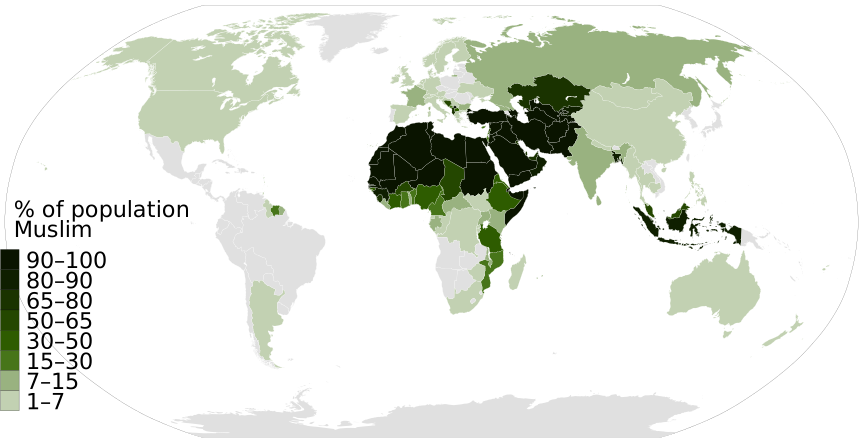
Muslims () are people who adhere to Islam, a Monotheism, monotheistic religion belonging to the Abrahamic religions, Abrahamic tradition. They consider the Quran, the foundational religious text of Islam, to be the verbatim word of the God in Abrahamic religions, God of Abraham (or ''Allah'') as it was revealed to Muhammad, the last Islamic prophet. Alongside the Quran, Muslims also believe in previous Islamic holy books, revelations, such as the Tawrat (Torah), the Zabur (Psalms), and the Injeel (Gospel). These earlier revelations are associated with Judaism and Christianity, which are regarded by Muslims as earlier versions of Islam. The majority of Muslims also follow the teachings and practices attributed to Muhammad (''sunnah'') as recorded in traditional accounts (hadith). With an estimated population of almost 2 billion followers, Muslims comprise around 26% of the world's total population. In descending order, the percentage of people who identify as Muslims on each ... [...More Info...] [...Related Items...] OR: [Wikipedia] [Google] [Baidu] [Amazon] |
Banu Mustaliq
The Banu Mustaliq () is an Arab tribe. The tribe is a sub-clan of the Banu Khuza'a, descended from Azdi Qahtani. They occupied the territory of Qadid on the Red Sea shore between Jeddah and Rabigh. History The Banu al Mustaliq, allied to the Quraish of Mecca, were the subject to an attack by Muslims in the month of Sha'ban of the year 626 CE (5 AH) after several months of inciting assassination attempts against Muhammad, according to Leone Caetani. The Muslim force met the Banu Mustaliq in battle at a watering place called al-Muraysi‘ and defeated them soundly, taking the Mustaliq chief, al-Harith and others captive. Among the captives taken by the Muslims was al-Harith's daughter Juwayriya. She initially fell among the booty of Muhammad's companion Thabit ibn Qays ibn Al-Shammas. Troubled by this, Juwayriya sought a deed of redemption from Muhammad. Muhammad proposed to marry her and as a result freed her from the bondage of Thabit and consequently ameliorated the condit ... [...More Info...] [...Related Items...] OR: [Wikipedia] [Google] [Baidu] [Amazon] |
Muhajirun
The ''Muhajirun'' (, singular , ) were the converts to Islam and the Islamic prophet Muhammad's advisors and relatives, who emigrated from Mecca to Medina; the event is known in Islam as the '' Hijra''. The early Muslims from Medina are called the '' Ansar'' ("helpers"). During Muhammad's era About a month after Hamzah's unsuccessful attack in the first caravan raid, Muhammad entrusted a party of sixty ''Muhajirun'' led by Ubaydah to conduct another operation at a Quraysh caravan that was returning from Syria and protected by one hundred men. The leader of this caravan was Abu Sufyan ibn Harb. The Muslim party went as far as Thanyatul-Murra, a watering place in Hejaz. No fighting took place, as the Quraysh were quite far from the place where Muslims were in the offing to attack the caravan. Nevertheless, Sa`d ibn Abi Waqqas shot an arrow at the Quraysh. This is known as the first arrow of Islam. Despite this surprise attack, no fighting took place and the Muslims returned empty- ... [...More Info...] [...Related Items...] OR: [Wikipedia] [Google] [Baidu] [Amazon] |
Umar
Umar ibn al-Khattab (; ), also spelled Omar, was the second Rashidun caliph, ruling from August 634 until his assassination in 644. He succeeded Abu Bakr () and is regarded as a senior companion and father-in-law of the Islamic prophet Muhammad. Initially, Umar opposed Muhammad, who was his distant Qurayshite kinsman. However, after converting to Islam in 616, he became the first Muslim to openly pray at the Kaaba. He participated in nearly all of Muhammad’s battles and expeditions, and Muhammad conferred upon him the title ''al-Fārūq'' ("the Distinguisher") for his sound judgement. After Muhammad’s death in June 632, Umar pledged allegiance to Abu Bakr as the first caliph and served as his chief adviser. In 634, shortly before his death, Abu Bakr nominated Umar as his successor. During Umar’s reign, the caliphate expanded at an unprecedented rate, conquering the Sasanian Empire and more than two-thirds of the Byzantine Empire. His campaigns against the Sasanian ... [...More Info...] [...Related Items...] OR: [Wikipedia] [Google] [Baidu] [Amazon] |
Abd Allah Ibn Ubayy
Abd-Allah ibn Ubayy (, died 631), also called Ibn Salul in reference to his grandmother, was a chief of the Arab tribe Banu Khazraj and one of the leading men of Medina (then known as Yathrib). Upon the arrival of Muhammad, Ibn Ubayy became a Muslim, but the sincerity of his conversion is disputed. Because of repeated conflicts with Muhammad, Islamic tradition has labelled him a ''munafiq'' (hypocrite) and "leader of the munafiqun".William Montgomery Watt, "`Abd Allah b. Ubayy", ''Encyclopaedia of Islam'' Origins and early life Abd-Allah was the son of Ubayy ibn Salul and Uzza bint Ka'ab, also from Banu Khazraj. His father's mother was called Salul. Ibn Ubayy was one of the chiefs of the Khazraj, who then were in conflict with the other major Arab tribe of the city, the Banu Aws. During the ''fidjar'', the so-called "sacrilegious war", Ibn Ubayy had led parts of the Khazraj tribe on the first day of fighting but held aloof on the second day. Also, he did not participate in the B ... [...More Info...] [...Related Items...] OR: [Wikipedia] [Google] [Baidu] [Amazon] |
Battle Of Yamama
The Battle of Yamama was fought in December 632 as part of the Ridda Wars against a rebellion within the Rashidun Caliphate in the region of al-Yamama (in present-day Saudi Arabia, South of Riyadh City) between the forces of Abu Bakr and Musaylimah, Musaylima, a self-proclaimed prophet.This battle was a part of a multi prolonged engagement in the plains of Aqrama and the City of Al-Hadiqat.Tabari, Imam (1993). ''History of al-Tabari Vol.10''. New York: State University of New York Press. Special:BookSources/0791408515, ISBN 0-7914-0851-5 Background After the death of the Prophet Muhammad, many Arab tribes rebelled against the State of Medina. Caliph Abu Bakr organized 11 corps to deal with the rebels. Abu Bakr appointed Ikrima ibn Amr, Ikrima as the commander of one of the corps. Ikrima's orders were to advance and make contact with the forces of Musaylimah, Musaylima at al-Yamama, but not to get involved in battle with him. Ikrima had insufficient forces to attack the overwhe ... [...More Info...] [...Related Items...] OR: [Wikipedia] [Google] [Baidu] [Amazon] |
Rashidun Caliph
The Rashidun Caliphate () is a title given for the reigns of first caliphs (lit. "successors") — Abu Bakr, Umar, Uthman, and Ali collectively — believed to represent the perfect Islam and governance who led the Muslim community and polity from the death of the Islamic prophet Muhammad (in 632 AD), to the establishment of the Umayyad Caliphate (in 661 AD). The reign of these four caliphs is considered in Sunni Islam to have been "rightly-guided", meaning that it constitutes a model to be followed and emulated from a religious point of view. This term is not used by Shia Muslims, who reject the rule of the first three caliphs as illegitimate. Following Muhammad's death in June 632, Muslim leaders debated who should succeed him. Unlike later caliphs, Rashidun were often chosen by some form of a small group of high-ranking companions of the Prophet in () or appointed by their predecessor. Muhammad's close companion Abu Bakr (), of the Banu Taym clan, was elected the f ... [...More Info...] [...Related Items...] OR: [Wikipedia] [Google] [Baidu] [Amazon] |
Abu Bakr
Abd Allah ibn Abi Quhafa (23 August 634), better known by his ''Kunya (Arabic), kunya'' Abu Bakr, was a senior Sahaba, companion, the closest friend, and father-in-law of Muhammad. He served as the first caliph of the Rashidun Caliphate, ruling from 632 until his death in 634. Abu Bakr was granted the honorific title ''al-Ṣiddīq'' (lit. the Veracious) by Muhammad, a designation that continues to be used by Sunni Muslims to this day. Born to Abu Quhafa and Umm al-Khayr of the Banu Taym, Abu Bakr was amongst the Early Muslims, earliest converts to Islam and propagated dawah to the Mushrikites. He was considered the first Da'i, Muslim missionary as several companions of the Prophet, companions of Muhammad converted through Abu Bakr. He accompanied Muhammad on his Hegira, migration to Medina and became one of his Haras (unit), bodyguards. Abu Bakr participated in all of List of expeditions of Muhammad, Muhammad's campaigns and served as the first in 631. In the absence of Muha ... [...More Info...] [...Related Items...] OR: [Wikipedia] [Google] [Baidu] [Amazon] |