Topic summary
Spontaneous emission
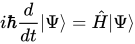
Spontaneous emission is the process in which a quantum mechanical system (such as a molecule, an atom or a subatomic particle) transitions from an excited energy state to a lower energy state (e.g., its ground state) and emits a quantized amount of energy in the form of a photon into a field that was previously devoid of radiation. Lasers start via spontaneous emission, then during continuous operation work by stimulated emission.
Albert Einstein discussed spontaneous emission in a series of papers starting in 1916, which first predicted the phenomenon of stimulated emission and introduced the Einstein Coefficients. Einstein's quantum theory of radiation anticipated ideas later expressed in quantum electrodynamics and quantum optics by several decades. Later, after the formal discovery of quantum mechanics in 1926, the rate of spontaneous emission was accurately described from first principles by Paul Dirac in his quantum theory of radiation, the precursor to the theory which he later called quantum electrodynamics. Contemporary physicists, when asked to give a physical explanation for spontaneous emission, generally invoke the zero-point energy of the electromagnetic field. In 1963, the Jaynes–Cummings model was developed describing the system of a two-level atom interacting with a quantized field mode (i.e. the vacuum) within an optical cavity. This model predicted that the rate of spontaneous emission could be controlled depending on the boundary conditions of the surrounding vacuum field. These experiments gave rise to cavity quantum electrodynamics (CQED), the study of effects of mirrors and cavities on radiative corrections.