Topic summary
Pseudo-polynomial time
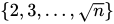
In computational complexity theory, a numeric algorithm runs in pseudo-polynomial time if its running time is bounded from above by a polynomial function of the two variables: the numeric value of the input (the largest integer present in the input) and the length of the input (the number of bits required to represent it).
In general, using a positional number system, the numeric value of the input is exponential in the input length, which is why a pseudo-polynomial time algorithm does not necessarily run in polynomial time with respect to the input length. The distinction between the value of a number and its length is due to positional encoding; if numeric inputs are instead encoded in unary then the length and value are the same.
An NP-complete problem with known pseudo-polynomial time algorithms is called weakly NP-complete. An NP-complete problem is called strongly NP-complete if it is proven that it cannot be solved by a pseudo-polynomial time algorithm unless P = NP. The strong/weak kinds of NP-hardness are defined analogously.