Topic summary
Infinite sum
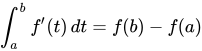
Extracted from the Wikipedia article Series (mathematics).
Among the Ancient Greeks, the idea that a potentially infinitesummation could produce a finite result was considered paradoxical, most famously in Zeno's paradoxes. Nonetheless, infinite series were applied practically by Ancient Greek mathematicians including Archimedes, for instance in the quadrature of the parabola. The mathematical side of Zeno's paradoxes was resolved using the concept of a limit during the 17th century, especially through the early calculus of Isaac Newton. The resolution was made more rigorous and further improved in the 19th century through the work of Carl Friedrich Gauss and Augustin-Louis Cauchy, among others, answering questions about which of these sums exist via the completeness of the real numbers and whether series terms can be rearranged or not without changing their sums using absolute convergence and conditional convergence of series.