Topic summary
Generalizations of the derivative
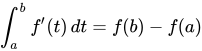
Fundamental construction of differential calculus In mathematics, the derivative is a fundamental construction of differential calculus and admits many possible generalizations within the fields of mathematical analysis, combinatorics, algebra, geometry, etc. Fréchet derivative The Fréchet derivative defines the derivative for general normed vector spaces V , W {\displaystyle V,W} . Briefly, a function f : U → W {\displaystyle f:U\to W} , where U {\displaystyle U} is an open subset of V {\displaystyle V} , is called Fréchet differentiable at x ∈ U {\displaystyle x\in U} if there exists a bounded linear operator A : V → W {\displaystyle A:V\to W} such that lim ‖ h ‖ → 0 ‖ f ( x + h ) − f ( x ) − A h ‖ W ‖ h ‖ V = 0. {\displaystyle \lim _{\|h\|\to 0}{\frac {\|f(x+h)-f(x)-Ah\|_{W}}{\|h\|_{V}}}=0.} Functions are defined as being differentiable in some open neighbourhood of x {\displaystyle x} , rather than at individual points, as not doing so tends to lead to many pathological counterexamples. The Fréchet derivative is quite similar to the formula for the derivative found in elementary one-variable calculus, lim h → 0 f ( x + h ) − f ( x ) h = A , {\dis