Topic summary
Field equations

Extracted from the Wikipedia article Classical field theory.
Gravitation
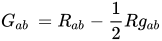
After Newtonian gravitation was found to be inconsistent with special relativity, Albert Einstein formulated a new theory of gravitation called general relativity. This treats gravitation as a geometric phenomenon ('curved spacetime') caused by masses and represents the gravitational field mathematically by a tensor field called the metric tensor. The Einstein field equations describe how this curvature is produced. Newtonian gravitation is now superseded by Einstein's theory of general relativity, in which gravitation is thought of as being due to a curved spacetime, caused by masses. The Einstein field equations, describe how this curvature is produced by matter and radiation, where Gab is the Einstein tensor, written in terms of the Ricci tensorRab and Ricci scalarR = Rabg, Tab is the stress–energy tensor and κ = 8πG/c is a constant. In the absence of matter and radiation (including sources) the vacuum field equations, can be derived by varying the Einstein–Hilbert action, with respect to the metric, where g is the determinant of the metric tensorg. Solutions of the vacuum field equations are called vacuum solutions. An alternative interpretation, due to Arthur Eddington, is that is fundamental, is merely one aspect of , and is forced by the choice of units.