Topic summary
Electron-multiplying CCD

Extracted from the Wikipedia article Charge-coupled device.
Electron-multiplying CCD
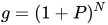
An electron-multiplying CCD (EMCCD, also known as an L3Vision CCD, a product commercialized by e2v Ltd., GB, L3CCD or Impactron CCD, a now-discontinued product offered in the past by Texas Instruments) is a charge-coupled device in which a gain register is placed between the shift register and the output amplifier. The gain register is split up into a large number of stages. In each stage, the electrons are multiplied by impact ionization in a similar way to an avalanche diode. The gain probability at every stage of the register is small (P < 2%), but as the number of elements is large (N > 500), the overall gain can be very high (), with single input electrons giving many thousands of output electrons. Reading a signal from a CCD gives a noise background, typically a few electrons. In an EMCCD, this noise is superimposed on many thousands of electrons rather than a single electron; the devices' primary advantage is thus their negligible readout noise. The use of avalanche breakdown for amplification of photo charges had already been described in the U.S. patent 3,761,744 in 1973 by George E. Smith/Bell Telephone Laboratories.