Topic summary
Differential of a function
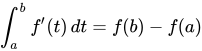
Notion in calculus In calculus, the differential represents the principal part of the change in a function y = f ( x ) {\displaystyle y=f(x)} with respect to changes in the independent variable. The differential d y {\displaystyle dy} is defined by d y = f ′ ( x ) d x , {\displaystyle dy=f'(x)\,dx,} where f ′ ( x ) {\displaystyle f'(x)} is the derivative of f with respect to x {\displaystyle x} , and d x {\displaystyle dx} is an additional real variable (so that d y {\displaystyle dy} is a function of x {\displaystyle x} and d x {\displaystyle dx} ). The notation is such that the equation d y = d y d x d x {\displaystyle dy={\frac {dy}{dx}}\,dx} holds, where the derivative is represented in the Leibniz notation d y / d x {\displaystyle dy/dx} , and this is consistent with regarding the derivative as the quotient of the differentials. One also writes d f ( x ) = f ′ ( x ) d x . {\displaystyle df(x)=f'(x)\,dx.} The precise meaning of the variables d y {\displaystyle dy} and d x {\displaystyle dx} depends on the context of the application and the required level of mathematical rigor. The domain of these variables may take on a particular geometrical significance if the different