Topic summary
Differential equation
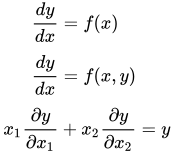
HistoryDifferential equations came into existence with the invention of calculus by Isaac Newton and Gottfried Leibniz. In Chapter 2 of his 1671 work Methodus fluxionum et Serierum Infinitarum, Newton listed three kinds of differential equations: dydx=f(x)dydx=f(x,y)x1∂y∂x1+x2∂y∂x2=y{\displaystyle {\begin{aligned}{\frac {dy}{dx}}&=f(x)\\[4pt]{\frac {dy}{dx}}&=f(x,y)\\[4pt]x_{1}{\frac {\partial y}{\partial x_{1}}}&+x_{2}{\frac {\partial y}{\partial x_{2}}}=y\end{aligned}}}In all these cases, y is an unknown function of x (or of x1 and x2), and f is a given function. He solved these examples and others using infinite series and discussed the non-uniqueness of solutions. Jacob Bernoulli proposed the Bernoulli differential equation in 1695. This is an ordinary differential equation of the form y′+P(x)y=Q(x)yn{\displaystyle y'+P(x)y=Q(x)y^{n}\,}for which the following year Leibniz obtained solutions by simplifying it. Historically, the problem of a vibrating string such as that of a musical instrument was studied by Jean le Rond d'Alembert, Leonhard Euler, Daniel Bernoulli, and Joseph-Louis Lagrange. In 1746, d’Alembert discovered the one-dimensional wave equation, and withi