Topic summary
Conversion factor

Extracted from the Wikipedia article Conversion of units.
Factor–label method
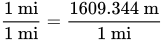
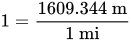
Each conversion factor is chosen based on the relationship between one of the original units and one of the desired units (or some intermediary unit), before being rearranged to create a factor that cancels out the original unit. For example, as "mile" is the numerator in the original fraction and , "mile" will need to be the denominator in the conversion factor. Dividing both sides of the equation by 1 mile yields , which when simplified results in the dimensionless . Because of the identity property of multiplication, multiplying any quantity (physical or not) by the dimensionless 1 does not change that quantity. Once this and the conversion factor for seconds per hour have been multiplied by the original fraction to cancel out the units mile and hour, 10 miles per hour converts to 4.4704 metres per second.