Topic summary
Convergent series

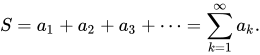
In mathematics, a series is the sum of the terms of an infinite sequence of numbers. More precisely, an infinite sequence defines a seriesS that is denoted

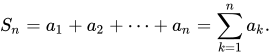
The nth partial sumSn is the sum of the first n terms of the sequence; that is,
A series is convergent (or converges) if the sequence of its partial sums tends to a limit and that limit is finite; that means that, when adding one after the other in the order given by the indices, the partial sums approximate a number . More precisely, for any given error tolerance, all but finitely many of the partial sums lie within that tolerance of the value . If the series is convergent, the (necessarily unique) number is called the sum of the series.



The same notation

is used for the series, and, if it is convergent, to its sum. This convention is similar to that which is used for addition: a + b denotes the operation of adding a and b as well as the result of this addition, which is called the sum of a and b.
Any series that is not convergent is said to be divergent or to diverge.