Topic summary
Commodore GCR
Extracted from the Wikipedia article Group coded recording.
References
- ^ 2.
IBM added three new models to the 3420 magnetic tape system than can record data at the "densest recording capability yet offered", according to the company. Using a new method called Group Coded Recording (GCR), the IBM drives can handle tapes containing a data density of 6,250 byte/in. compared with 1,600 byte/in. on earlier models of the 3420. [...] An upgraded control unit was also announced – the 3803 Model 2 – which operates with both the earlier and latest 3420 tape units. The Model 2 includes the capability of correcting errors in one or two tracks "simultaneously while the tape is in motion", IBM said. [...] The GCR method segments data written on tape into groups of characters to which a special coding character is added. And the higher density is based on a combination of a modified coding scheme, a smaller interrecord gap (called an interblock gap) and modified electronics and electromechanical components, IBM said. Installed 3803/3420 tape systems can be converted to the higher densities in the field. [...]
- ^ (American National Standard). ANSI. 1976.
- ^
- ^ (NB. An anonymous comment by one of the developers on the origin of the name "Group Coded Recording".)
- ^ 700. doi:10.1147/rd.255.0691.
- ^ . (672 pages)
- ^ , School of Computer Engineering, Nanyang Technological University, Singapore, Chapter 7. Magnetic Recording Fundamentals, archived(PDF) from the original on 2017-03-23
- ^ 61. ISBN .
- ^.
- ^ 588. doi:10.1147/rd.186.0579. Archived from the original on 2017-11-04.
- ^ 1204. doi:10.1109/TMAG.1977.1059670. (NB. This article about the 3PM code was also presented at the Intermag 1977 in June 1977.)
- ^.)
- ^ (NB. Application Number: US 06/098381)
- ^ .
[...] Micropolis has extended the capacity of 5.25-in. floppy disk subsystems via double-sided models with formatted file storage of up to nearly 2 million bytes [...] The Megafloppy series also features an intelligent controller that facilitates interconnection of four subsystems to a common host interface for a total on-line storage capacity of more than 15M bytes [...] Double-sided versions of the product line will be implemented first in two OEM series – Model 1015 and Model 1055 [...] The Model 1015 is an unpackaged drive designed for the manufacturer who integrates floppy disk storage into his own system enclosure. A range of storage capacities from 143,000 to 630,000 bytes per drive is available [...] Model 1015 customers have the option of using the Micropolis intelligent controller and Group Code Recording (GCR) method to further expand file space up to 946,000 bytes [...] Offering GCR and a microprocessor-based controller as standard features, the Model 1055 5.25-in. floppy has four soft-sectored formats for each of its 77 tracks, yielding a maximum capacity of 1,892,000 bytes of file space on its double-sided version [...] An add-on module available for the 1055 is comprised of two read/write heads and two drives, sharing a common controller. The subsystem capacity (formatted) with the module is 3,784,000 bytes [...] Up to four 1055s, each with an add-on module, can be daisy-chained to a common host for a maximum on-line storage capacity of more than 15M bytes [...]
- ^ (revision 1, 1st ed.). Micropolis Corporation. February 1979. 1082-04. Archived(PDF) from the original on 2017-06-12. (NB. Micropolis 100163-51-8 and 100163-52-6 are GCR-based.)
- ^.
[...] Four new 96 tracks-per-inch products have been added to Micropolis' current line of 100 tpi single-sided and double-sided floppy disks. The 96 tpi drives offer 70 tracks-per-side, as opposed to the 77 offered by the MegaFloppy line. The four models are: 1) The 1015-V: 436 KB, unformatted, FM/MFM recording [...] 2) The 1016-V: 532 KB unformatted, Group Coded Recording (GCR) [...] 3) The 1015-VI: a two-head version of the MFM drive, 872 KB [...] 4) The 1016-VI: also a two-head drive, 1.064 MB GCR encoding [...]
- ^ .
[...] At the same time Micropolis was working a 5.25" drive that could hold about as much as an 8", using some tricks. The Micropolis drive was 100 tpi, 77 track and, by using GCR, could hold 12 512-byte sectors per track. That's 462 KiB. This was about 1977–78. [...] The [...] drive and controller implementation (ours was done by a guy we'd recruited from Sperry ISS) was [...] complex and expensive [...] Brother WP disks [...] are 38 track, single-sided, Brother-encoded GCR that hold [...] 120K on 2D floppies. [...]
- ^ . BYTE. 3 (2). Kansas City, USA: 114, 116–118, 120, 122, 134–125. Archived from the original(PDF) on 2017-06-14.
[...] Of the alternative codes used to achieve double density, GCR (Group Coded Recording) looks quite attractive. Micro Peripherals Inc has implemented double density using GCR in a full size floppy disk and controller system currently being marketed. [...] GCR is nothing more than the old standby NRZ with its attendant advantages, but, since ordinary NRZ has no clocking information and a potentially high DC content during long strings of ones or zeros, the data is reformatted to eliminate the long strings. The reformatting converts each four bit group of original data into five bits of group coded data; the five bits in the encoded version will always have a mix of ones and zeros, even if the real data is all in one state. Reformatting in GCR can be accomplished in software, as opposed to MFM, etc, which almost unavoidably must be encoded and decoded in hardware. Thus, GCR has good possibilities as a low cost, high reliability scheme for achieving double density. [...]
[1] - ^.
- ^.
- ^ . Interviewed by Hendrie, Gardner. Mountain View, California, USA: Computer History Museum. CHM X2727.2004. Archived(PDF) from the original on 2017-03-23.
- ^ .
- ^ . San Jose, CA, USA: Durango Systems, Inc.Archived(PDF) from the original on 2017-03-23.
- ^.
- ^ . 9.0. Central Point Software, Inc. 1989-10-31 [1982].
{{}}: CS1 maint: deprecated archival service () - ^ .[2] (NB. Interview with Steve Wozniak, where he describes creating the Apple version of GCR.)
- ^ .[3][4][5]Archived 9 March 2016 at the Wayback Machine
- ^ .
- ^ (2nd printing ed.). Chatsworth, CA, USA: Quality Software. ISBN . LCCN 84-61383. Archived(PDF) from the original on 2017-03-21.[6]
- ^ 224. ISBN .
- ^ (19 ed.). DigiBarn Computer Museum. Archived(PDF) from the original on 2016-08-06.
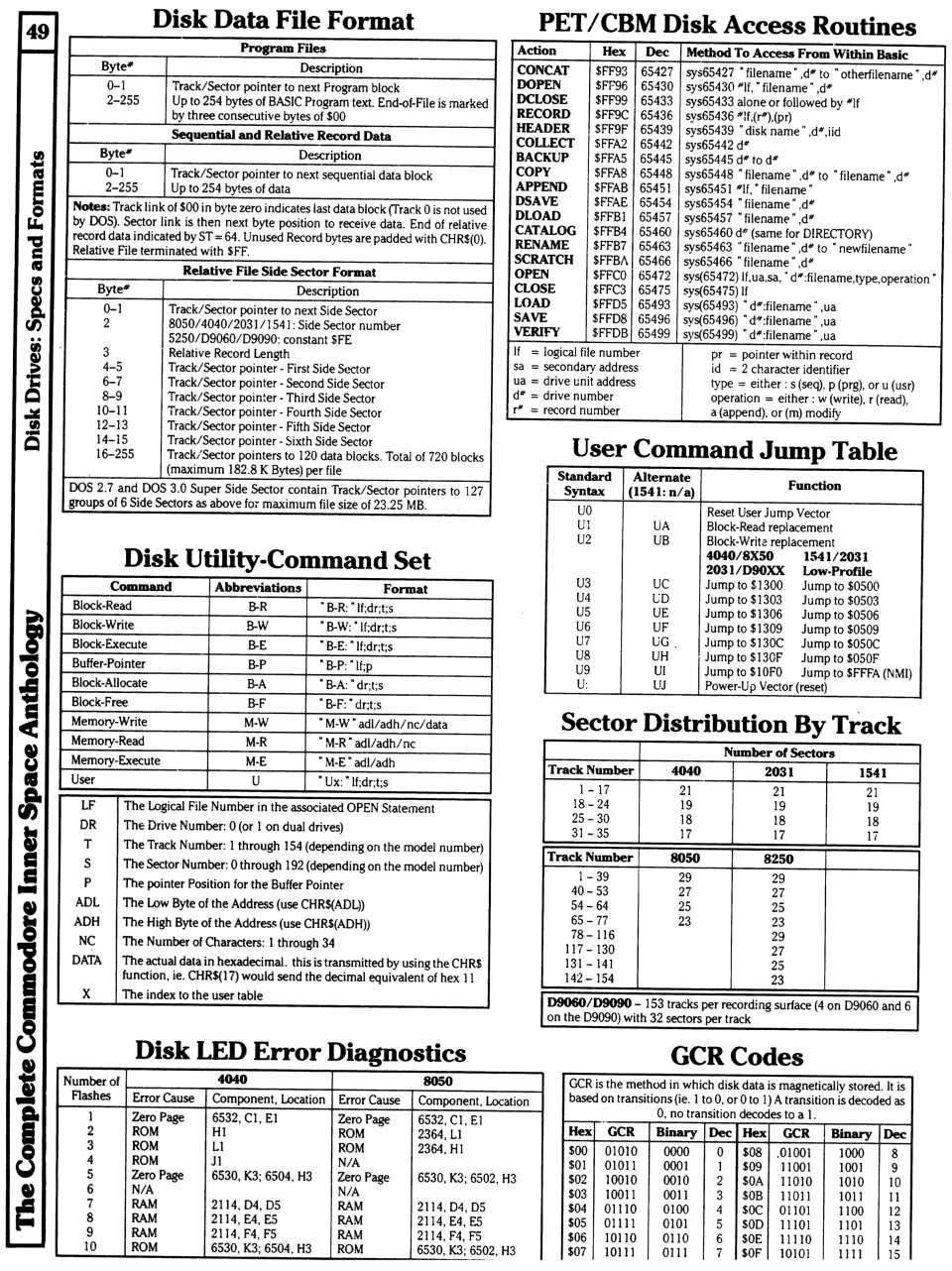
- ^ . Milton, Ontario, Canada: Transactor Publishing Incorporated. p. 49. ISBN . Archived(PDF) from the original on 2017-03-23.[7] (NB. Commodore GCR codes—but this reference erroneously claims that a 1-bit indicates a lack of a transition.)
- ^.
- ^ . commodore.ca. Archived(PDF) from the original on 2017-03-23.
- ^
- ^ . Victor Business Products, Inc. June 1982. pp. 7–1..7–9. 710620. Archived(PDF) from the original on 2017-03-23.
[...] Track density is 96 tracks per inch, and recording density is maintained at approximately 8000 bits per inch on all tracks. [...] The VICTOR 9000 uses an encoding technique called group code recording (GCR) to convert the data from internal representation to an acceptable form. GCR converts each (4-bit) nibble into a 5-bit code that guarantees a recording pattern that never has more than two zeros together. Then data is recorded on the disk by causing a flux reversal for each "one" bit and no flux reversal for each "zero" bit. [...]
- ^
- ^.
- ^. (NB. Reportedly, the Brother WP-1 technical data was derived from page 109 of the user manual.)
- ^.
[...] The 3.5" 240Kb disk drive is a single head Brother part no.13194989 and is connected with a 15 pin ribbon. [...] it initializes (formats) the disk to a capacity of 236.5Kb. [...]
- ^.
[...] There were several 3.5" Brother disks that are completely nonstandard. [...] One had 1296 byte sectors and another had 12 x 256 byte GCR sectors [...]
- ^ . Yamatokoriyama, Japan: Sharp Corporation, Information Systems Group, Quality & Reliability Control Center. July 1986. pp. 98–104. Archived(PDF) from the original on 2017-05-07.
GCR is an abbreviation of Group Coded Recording. A single byte, 8 bits, data are divided into two 4-bit data which is also converted onto a 5-bit data. Thus, a single byte (8 bits) is recorded on the media as a 10-bit data.
- ^ . Sharp Corporation. 00ZCE140F/SME. Archived(PDF) from the original on 2017-03-11.
- ^ . BYTE. 4 (4). Andover, MA, USA: 50, 52.