Topic summary
Capital-sigma notation

Extracted from the Wikipedia article Summation.
Capital-sigma notation
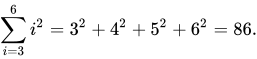
Mathematical notation uses a symbol that compactly represents summation of many similar terms: the summation symbol, , an enlarged form of the upright capital Greek letter sigma. This is defined as where i is the "index of summation" or "dummy variable", ai is an indexed variable representing each term of the sum; m is the "lower bound of summation", and n is the "upper bound of summation". The "i = m" under the summation symbol means that the index i starts out equal to m. The index, i, is incremented by one for each successive term, stopping when i = n. This is read as "sum of ai, from i = m to n". However, some notations may include the index at the upper bound of summation, or omit the index at the lower bound as in or , respectively. There are sigma notation variants where the range of bounds is omitted, which denotes the dummy variable only, like . Here is an example showing the summation of squares: In general, while any variable can be used as the index of summation (provided that no ambiguity is incurred), some of the most common ones include letters such as , , , and ; the latter is also often used for the upper bound of a summation. Alternatively, the index and bounds of summation are sometimes omitted from the definition of summation if the context is sufficiently clear. This applies particularly when the index runs from 1 to n. For example, one might write that .