Topic summary
Autoregressive moving-average model
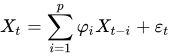
In the statistical analysis of time series, an autoregressive–moving-average (ARMA) model is used to represent a (weakly) stationary stochastic process by combining two components: autoregression (AR) and moving average (MA). These models are widely used for analyzing the structure of a series and for forecasting future values.
The AR component specifies that the current value of the series depends linearly on its own past values (lags), while the MA component specifies that the current value depends on a linear combination of past error terms. An ARMA model is typically denoted as ARMA(p, q), where p is the order of the autoregressive part and q is the order of the moving-average part.
The general ARMA model was described in the 1951 thesis of Peter Whittle, Hypothesis testing in time series analysis, and it was popularized in the 1970 book by George E. P. Box and Gwilym Jenkins.
ARMA models can be estimated by using the Box–Jenkins method.