 Affine transformationIn Euclidean geometry, an affine transformation or affinity (from the Latin, , "connected with") is a geometric transformation that preserves lines and parallelism, but not necessarily Euclidean distances and angles.
 Geometric transformationIn mathematics, a geometric transformation is any bijection of a set to itself (or to another such set) with some salient geometrical underpinning, such as preserving distances, angles, or ratios (scale). More specifically, it is a function whose domain and range are sets of points – most often a real coordinate space, R2{\displaystyle \mathbb {R} ^{2}} or R3{\displaystyle \mathbb {R} ^{3}} – such that the function is bijective so that its inverse exists.
 Reflection (mathematics)In mathematics, a reflection (also spelled reflexion) is a mapping from a Euclidean space to itself that is an isometry with a hyperplane as the set of fixed points; this set is called the axis (in dimension 2) or plane (in dimension 3) of reflection. The image of a figure by a reflection is its mirror image in the axis or plane of reflection.
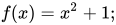 Function (mathematics)Association of one output to each inputIn mathematics, a function from a setX to a set Y assigns to each element of X exactly one element of Y. The set X is called the domain of the function and the set Y is called the codomain of the function. Functions were originally the idealization of how a varying quantity depends on another quantity. For example, the position of a planet is a function of time.
 Set (mathematics)In mathematics, a set is a collection of different things; the things are called elements or members of the set and are typically mathematical objects: numbers, symbols, points in space, lines, other geometric shapes, variables, functions, or even other sets. Mathematics typically does not define precisely what constitutes a "set" or "collection", because such a definition would have to be in terms of something else previously defined.
 Translation (geometry)In Euclidean geometry, a translation is a geometric transformation that moves every point of a figure, shape or space by the same distance in a given direction. A translation can also be interpreted as the addition of a constant vector to every point, or as shifting the origin of the coordinate system. In a Euclidean space, any translation is an isometry. A translation is an isometry that displaces the original figure according to a direction, a sense, and a length (vector).
 RotationRotation, also known as rotational motion or rotary motion, is the movement of an object that leaves at least one point unchanged. In 2 dimensions, a plane figure can rotate in either a clockwise or counterclockwise sense around a point called the center of rotation. In 3 dimensions, a solid figure rotates around an imaginary line called an axis of rotation.
 MathematicsField of knowledgeIlluminated letter P at the beginning of Adelard of Bath's translation of Euclid's Elements, which starts "Punctum est illud cui pars non est" ('A point is that which has no part'). Geometry is shown personified as a woman, following Martianus Capella's De nuptiis Philologiae et Mercurii.Mathematics is a field of knowledge concerned with abstract concepts such as numbers, geometric shapes, sets, functions, and probabilities.
 GeometryBranch of mathematics GeometryProjecting a sphere to a plane Branches Euclidean Non-Euclidean Elliptic Spherical Hyperbolic Non-Archimedean geometry Projective Affine Synthetic Analytic Algebraic Arithmetic Diophantine Differential Riemannian Symplectic Discrete differential Complex Finite Discrete/Combinatorial Digital Convex Computational Fractal Incidence Noncommutative geometry Noncommutative algebraic geometry ConceptsFeaturesDimension Straightedge and compass constructions Angle Polytope Centroid Diagonal Orthogonality (Perpendicular) Parallel Vertex Congruence Similarity Symmetry Zero-dimensional Point One-dimensional Line Line segment Ray Curve Geodesic Length Two-dimensional Surface Plane Area Polygon Simple Convex Concave Star Regular Reuleaux Triangle Centers Altitude Hypotenuse Pythagorean theorem Circular Reuleaux Hyperbolic Ideal Spherical Quadrilateral Parallelogram Rectangle Square Rhombus Rhomboid Trapezoid Kite Circle Radius Diameter Circumference Disk Area Three-dimensional Surface area Volume Polyhedron Platonic Solid Tetrahedron Reuleaux cuboid Cube Octahedron Dodecahedron Icosahedron Pyramid Star Toroidal Ideal Solid of revolution Sphere Great circle Cylinder Cone Four - other-dimensional 4-polytope Simplex 5-cell Hypercube Tesseract n-sphere Geometers by name Aida Aryabhata Ahmes Alhazen Apollonius Archimedes Atiyah Baudhayana Bolyai Brahmagupta Cartan Chern Coxeter Descartes Euclid Euler Gauss Gromov Hilbert Huygens Jyeṣṭhadeva Kātyāyana Khayyám Klein Lobachevsky Manava Minkowski Minggatu Pascal Pythagoras Parameshvara Poincaré Riemann Sakabe Sijzi al-Tusi Veblen Virasena Yang Hui al-Yasamin Zhang List of geometers by period BCE Ahmes Baudhayana Manava Pythagoras Euclid Archimedes Apollonius 1–1400s Zhang Kātyāyana Aryabhata Brahmagupta Virasena Alhazen Sijzi Khayyám al-Yasamin al-Tusi Yang Hui Parameshvara 1400s–1700s Jyeṣṭhadeva Descartes Pascal Huygens Minggatu Euler Sakabe Aida 1700s–1900s Gauss Lobachevsky Bolyai Riemann Klein Poincaré Hilbert Minkowski Cartan Veblen Coxeter Chern Present day Atiyah Gromov vte Geometry is a branch of mathematics concerned with properties of space such as the distance, shape, size, and relative position of figures.
 Linear mapMathematical function, in linear algebraIn mathematics, and more specifically in linear algebra, a linear map, linear mapping, or linear operator is a particular kind of function between vector spaces, which respects the basic operations of vector addition and scalar multiplication.
 Vector spaceAlgebraic structure in linear algebraVector addition and scalar multiplication: a vector v (blue) is added to another vector w (red, upper illustration). Below, w is stretched by a factor of 2, yielding the sum v + 2w.In mathematics, a vector space (also called a linear space) is a set whose elements, often called vectors, can be added together and multiplied ("scaled") by numbers called scalars.
 HomographyIn projective geometry, a homography is an isomorphism of projective spaces, induced by an isomorphism of the vector spaces from which the projective spaces derive. It is a bijection that maps lines to lines, and thus a collineation. In general, some collineations are not homographies, but the fundamental theorem of projective geometry asserts that is not so in the case of real projective spaces of dimension at least two.
*As an Amazon Associate I earn from qualifying purchases.