Skew-symmetric matrixIn mathematics, particularly in linear algebra, a skew-symmetric (or antisymmetric or antimetric) matrix is a square matrix whose transpose equals its negative. Identity matrixIn linear algebra, the identity matrix of size n{\displaystyle n} is the n×n{\displaystyle n\times n}square matrix with ones on the main diagonal and zeros elsewhere. It has unique properties; for example when the identity matrix represents a geometric transformation, the object remains unchanged by the transformation. In other contexts, it is analogous to multiplying by the number 1.
 Matrix (mathematics)Array of numbersAn m × n matrix: the m rows are horizontal and the n columns are vertical. Each element of a matrix is often denoted by a variable with two subscripts.
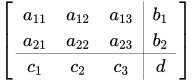 Block matrixMatrix defined using smaller matrices called blocksIn mathematics, a block matrix or a partitioned matrix is a matrix that is interpreted as having been broken into sections called blocks or submatrices. Intuitively, a matrix interpreted as a block matrix can be visualized as the original matrix with a collection of horizontal and vertical lines, which break it up, or partition it, into a collection of smaller matrices.
 Field (mathematics)Algebraic structure with addition, multiplication, and divisionA field is an algebraic structure that is closed under the four usual arithmetic operations (except when it comes to division by zero).In mathematics, a field is a set on which addition, subtraction, multiplication, and division are defined and behave as the corresponding operations on rational numbers do.
 Complex numberNumber with a real and an imaginary partA complex number z = a + bi can be visually represented as a pair of numbers (a, b) forming a position vector (blue) or a point (red) on an Argand diagram, representing the complex plane.Finite fieldIn mathematics, a finite field or Galois field (so-named in honor of Évariste Galois) is a field that has a finite number of elements. As with any field, a finite field is a set on which the operations of multiplication, addition, subtraction and division are defined and satisfy certain basic rules. The most common examples of finite fields are the integers mod p {\displaystyle p} when p {\displaystyle p} is a prime number.
 P-adic numberNumber system extending the rational numbersThe 3-adic integers, depicted as a slice of a solenoidIn number theory, given a prime numberp, the p-adic numbers form an extension of the rational numbers that is distinct from the real numbers, though with some similar properties; p-adic numbers can be written in a form similar to (possibly infinite) decimals, but with digits based on a prime number p rather than ten, and extending to the left rather than to the right.
 Real numberIn mathematics, a real number is a number that can be used to measure a continuous one-dimensionalquantity such as a length, duration or temperature. Here, continuous means that pairs of values can have arbitrarily small differences. Every real number can be almost uniquely represented by an infinite decimal expansion.Function field of an algebraic varietyIn algebraic geometry, the function field of an algebraic variety V consists of objects that are interpreted as rational functions on V. In classical algebraic geometry they are ratios of polynomials; in complex geometry these are meromorphic functions and their higher-dimensional analogues; in modern algebraic geometry they are elements of some quotient ring's field of fractions.
 TransposeIn linear algebra, transposition is an operation that flips a matrix over its diagonal; that is, transposition switches the row and column indices of the matrix A to produce another matrix, called the transpose of A and often denoted A (among other notations). The transpose of a matrix was introduced in 1858 by the British mathematician Arthur Cayley.
 Invertible matrixIn linear algebra, an invertible matrix (non-singular, non-degenerate or regular) is a square matrix that has an inverse. In other words, if a matrix is invertible, it can be multiplied by its inverse matrix to yield the identity matrix. Invertible matrices are the same size as their inverse.
Identity matrixIn linear algebra, the identity matrix of size n{\displaystyle n} is the n×n{\displaystyle n\times n}square matrix with ones on the main diagonal and zeros elsewhere. It has unique properties; for example when the identity matrix represents a geometric transformation, the object remains unchanged by the transformation. In other contexts, it is analogous to multiplying by the number 1.Matrix (mathematics)Array of numbersAn m × n matrix: the m rows are horizontal and the n columns are vertical. Each element of a matrix is often denoted by a variable with two subscripts.Block matrixMatrix defined using smaller matrices called blocksIn mathematics, a block matrix or a partitioned matrix is a matrix that is interpreted as having been broken into sections called blocks or submatrices. Intuitively, a matrix interpreted as a block matrix can be visualized as the original matrix with a collection of horizontal and vertical lines, which break it up, or partition it, into a collection of smaller matrices.Field (mathematics)Algebraic structure with addition, multiplication, and divisionA field is an algebraic structure that is closed under the four usual arithmetic operations (except when it comes to division by zero).In mathematics, a field is a set on which addition, subtraction, multiplication, and division are defined and behave as the corresponding operations on rational numbers do.Complex numberNumber with a real and an imaginary partA complex number z = a + bi can be visually represented as a pair of numbers (a, b) forming a position vector (blue) or a point (red) on an Argand diagram, representing the complex plane.Finite fieldIn mathematics, a finite field or Galois field (so-named in honor of Évariste Galois) is a field that has a finite number of elements. As with any field, a finite field is a set on which the operations of multiplication, addition, subtraction and division are defined and satisfy certain basic rules. The most common examples of finite fields are the integers mod p {\displaystyle p} when p {\displaystyle p} is a prime number.P-adic numberNumber system extending the rational numbersThe 3-adic integers, depicted as a slice of a solenoidIn number theory, given a prime numberp, the p-adic numbers form an extension of the rational numbers that is distinct from the real numbers, though with some similar properties; p-adic numbers can be written in a form similar to (possibly infinite) decimals, but with digits based on a prime number p rather than ten, and extending to the left rather than to the right.Real numberIn mathematics, a real number is a number that can be used to measure a continuous one-dimensionalquantity such as a length, duration or temperature. Here, continuous means that pairs of values can have arbitrarily small differences. Every real number can be almost uniquely represented by an infinite decimal expansion.Function field of an algebraic varietyIn algebraic geometry, the function field of an algebraic variety V consists of objects that are interpreted as rational functions on V. In classical algebraic geometry they are ratios of polynomials; in complex geometry these are meromorphic functions and their higher-dimensional analogues; in modern algebraic geometry they are elements of some quotient ring's field of fractions.TransposeIn linear algebra, transposition is an operation that flips a matrix over its diagonal; that is, transposition switches the row and column indices of the matrix A to produce another matrix, called the transpose of A and often denoted A (among other notations). The transpose of a matrix was introduced in 1858 by the British mathematician Arthur Cayley.Invertible matrixIn linear algebra, an invertible matrix (non-singular, non-degenerate or regular) is a square matrix that has an inverse. In other words, if a matrix is invertible, it can be multiplied by its inverse matrix to yield the identity matrix. Invertible matrices are the same size as their inverse.*As an Amazon Associate I earn from qualifying purchases.