 Modal logicModal logic is a kind of logic used to represent statements about necessity and possibility. In philosophy and related fields it is used as a tool for understanding concepts such as knowledge, obligation, and causation. For instance, in epistemic modal logic, the formula◻P{\displaystyle \Box P} can be used to represent the statement that P{\displaystyle P} is known. In deontic modal logic, that same formula can represent that P{\displaystyle P} is a moral obligation.
 Material conditionalThe material conditional (also known as material implication) is a binary operation commonly used in logic. When the conditional symbol → {\displaystyle \to } is interpreted as material implication, a formula P → Q {\displaystyle P\to Q} is true unless P {\displaystyle P} is true and Q {\displaystyle Q} is false. Material implication is used in all the basic systems of classical logic as well as some nonclassical logics.
 Logical connectiveIn logic, a logical connective (also called a logical operator, sentential connective, or sentential operator) is an operator that combines or modifies one or more logical variables or formulas, similarly to how arithmetic connectives like + {\displaystyle +} and − {\displaystyle -} combine or negate arithmetic expressions.
 Logical consequenceLogical consequence (also entailment or logical implication) is a fundamental concept in logic which describes the relationship between statements that hold true when one statement logically follows from one or more statements. A valid logical argument is one in which the conclusion is entailed by the premises, because the conclusion is the consequence of the premises.
 Modal operatorA modal connective (or modal operator) is a logical connective for modal logic. It is an operator which forms propositions from propositions. In general, a modal operator has the "formal" property of being non-truth-functional in the following sense: The truth-value of composite formulae sometimes depend on factors other than the actual truth-value of their components.
 C. I. LewisClarence Irving Lewis (April 12, 1883 – February 3, 1964) was an American academic philosopher. He is considered the progenitor of modern modal logic and the founder of conceptual pragmatism. First a noted logician, he later branched into epistemology, and during the last 20 years of his life, he wrote much on ethics. The New York Times memorialized him as "a leading authority on symbolic logic and on the philosophic concepts of knowledge and value."
 Logical truthLogical truth is one of the most fundamental concepts in logic. Broadly speaking, a logical truth is a statement which is true regardless of the truth or falsity of its constituent propositions. In other words, a logical truth is a statement which is not only true, but one which is true under all interpretations of its logical components (other than its logical constants). Thus, logical truths such as "if p, then p" can be considered tautologies.
 LogicStudy of correct reasoningLogic studies valid forms of inference like modus ponens.Logic is the study of correct reasoning. It includes both formal and informal logic. Formal logic is the study of deductively valid inferences or logical truths. It examines how conclusions follow from premises based on the structure of arguments alone, independent of their topic and content. Informal logic is associated with informal fallacies, critical thinking, and argumentation theory.
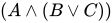 Well-formed formulaIn mathematical logic, propositional logic, and predicate logic, a well-formed formula, abbreviated WFF or wff, often simply formula, is a finite sequence of symbols from a given alphabet, constructed following the defined grammar of a formal language. The abbreviation wff is pronounced "woof", or sometimes "wiff", "weff", or "whiff". A formal language can be identified with the set of formulas in the language.
 Logical equivalenceIn logic and mathematics, statements p{\displaystyle p} and q{\displaystyle q} are said to be logically equivalent if they have the same truth value in every model. The logical equivalence of p{\displaystyle p} and q{\displaystyle q} is sometimes expressed as p≡q{\displaystyle p\equiv q}, p::q{\displaystyle p::q}, Epq{\displaystyle {\textsf {E}}pq}, or p⟺q{\displaystyle p\iff q}, depending on the notation being used.Classical logicClassical logic (or standard logic) or Frege–Russell logic is the intensively studied and most widely used class of deductive logic. Classical logic has had much influence on analytic philosophy.PropositionPropositions are the meanings of declarative sentences, objects of beliefs, and bearers of truth values. They explain how different sentences, such as the English "Snow is white" and the German "Schnee ist weiß", can have identical meaning by expressing the same proposition. Similarly, they ground the fact that different people can share a belief by being directed at the same content. True propositions describe the world as it is, while false ones fail to do so.
*As an Amazon Associate I earn from qualifying purchases.