 Floor and ceiling functionsNearest integers from a numberFloor and ceiling functionsFloor functionCeiling functionIn mathematics, the floor function is the function that takes a real numberx as input and returns the greatest integer less than or equal to x, written ⌊x⌋ or floor(x). Similarly, the ceiling function returns the least integer greater than or equal to x, written ⌈x⌉ or ceil(x).
 Heaviside step functionThe Heaviside step function, or the unit step function, usually denoted by H or θ (but sometimes u, 1 or 𝟙), is a step function named after Oliver Heaviside, the value of which is zero for negative arguments and one for positive arguments. Different conventions concerning the value H(0) are in use. It is an example of the general class of step functions, all of which can be represented as linear combinations of translations of this one.
 Absolute valueIn mathematics, the absolute value or modulus of a real numberx{\displaystyle x}, denoted |x|{\displaystyle |x|}, is the (non-negative) magnitudeof x{\displaystyle x}measured without regard to its sign. Namely, |x|=x{\displaystyle |x|=x} if x{\displaystyle x} is a positive number, and |x|=−x{\displaystyle |x|=-x} if x{\displaystyle x} is negative (in which case −x{\displaystyle -x} is positive), and |0|=0{\displaystyle |0|=0}.
 Dirac delta functionGeneralized function whose value is zero everywhere except at zero Schematic representation of the Dirac delta function by a line surmounted by an arrow. The height of the arrow is usually meant to specify the value of any multiplicative constant, which will give the area under the function. The other convention is to write the area next to the arrowhead.Iverson bracketIn mathematics, the Iverson bracket, named after Kenneth E. Iverson, is a notation that generalises the Kronecker delta, which is the Iverson bracket of the statement x = y. It maps any statement to a function of the free variables in that statement. This function is defined to take the value 1 for the values of the variables for which the statement is true, and takes the value 0 otherwise.
 Zero to the power of zeroZero to the power of zero, denoted as 0, is a mathematical expression with different interpretations depending on the context. In certain areas of mathematics, such as combinatorics and algebra, 0 is defined as 1 because this simplifies many formulas and ensures consistency in operations involving exponents. For instance, defining 0 = 1 aligns with the interpretation of choosing 0 elements from a set and simplifies polynomial and binomial expansions.
 Law of trichotomyIn mathematics, the law of trichotomy states that every real number is either positive, negative, or zero. More generally, a binary relationR on a setX is trichotomous if for all x and y in X, exactly one of xRy, yRx and x = y holds.
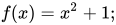 Function (mathematics)Association of one output to each inputIn mathematics, a function from a setX to a set Y assigns to each element of X exactly one element of Y. The set X is called the domain of the function and the set Y is called the codomain of the function. Functions were originally the idealization of how a varying quantity depends on another quantity. For example, the position of a planet is a function of time.
 Real numberIn mathematics, a real number is a number that can be used to measure a continuous one-dimensionalquantity such as a length, duration or temperature. Here, continuous means that pairs of values can have arbitrarily small differences. Every real number can be almost uniquely represented by an infinite decimal expansion.
 Mathematical notationMathematical notation consists of using symbols for representing operations, unspecified numbers, relations, and any other mathematical objects and assembling them into expressions and formulas. Mathematical notation is widely used in mathematics, science, and engineering for representing complex concepts and properties in a concise, unambiguous, and accurate way.
 MathematicsMathematics is a field of knowledge concerned with abstract concepts such as numbers, geometric shapes, sets, functions, and probabilities. It uses logical reasoning and proof to study and establish their properties, often expressed as theorems, formulas, and equations. Mathematics is used to model and solve problems in science, engineering, technology, economics, and everyday life.
 Sign (mathematics)In mathematics, the sign of a real number is its property of being either positive, negative, or 0. Depending on local conventions, zero may be considered as having its own unique sign, having no sign, or having both positive and negative sign. In some contexts, it makes sense to distinguish between a positive and a negative zero.
 Piecewise functionIn mathematics, a piecewise function (also called a piecewise-defined function, a hybrid function, or a function defined by cases) is a function whose domain is partitioned into several intervals ("subdomains") on which the function may be defined differently.
*As an Amazon Associate I earn from qualifying purchases.