 Scalar (physics)Scalar quantities or simply scalars are physical quantities that can be described by a single pure number (a scalar, typically a real number), accompanied by a unit of measurement, as in "10cm" (ten centimeters). Examples of scalar quantities are length, mass, charge, volume, and time. Scalars may represent the magnitude of physical quantities, such as speed is to velocity. Scalars do not represent a direction.
 Scalar (mathematics)In mathematics, more specifically in linear algebra, a scalar is an element of a field which is used to define a vector space through the operation of scalar multiplication: a vector (denoted v) multiplied by a scalar (denoted a) produces another vector (av). Real numbers and complex numbers may be used as scalars in real and complex vector spaces, respectively.
 Space (mathematics)In mathematics, a space is a set (sometimes known as a universe) endowed with a structure defining the relationships among the elements of the set. A subspace is a subset of the parent space which retains the same mathematical structure. While modern mathematics uses many types of spaces, such as Euclidean spaces, linear spaces, topological spaces, Hilbert spaces, or probability spaces, it does not define the notion of "space" itself.
 Point (geometry)In geometry, a point is an abstract idealization of an exact position, without size, in physical space, or its generalization to other kinds of mathematical spaces. As zero-dimensional objects, points are usually taken to be the fundamental indivisible elements comprising the space, of which one-dimensional curves, two-dimensional surfaces, and higher-dimensional objects consist.
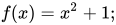 Function (mathematics)Association of one output to each inputIn mathematics, a function from a setX to a set Y assigns to each element of X exactly one element of Y. The set X is called the domain of the function and the set Y is called the codomain of the function. Functions were originally the idealization of how a varying quantity depends on another quantity. For example, the position of a planet is a function of time.PhysicsPhysics is the scientific study of matter, its fundamental constituents, its motion and behavior through space and time, and the related entities of energy and force. It is one of the most fundamental scientific disciplines. A scientist who specializes in the field of physics is called a physicist. Physics is one of the oldest academic disciplines.
 MathematicsField of knowledgeIlluminated letter P at the beginning of Adelard of Bath's translation of Euclid's Elements, which starts "Punctum est illud cui pars non est" ('A point is that which has no part'). Geometry is shown personified as a woman, following Martianus Capella's De nuptiis Philologiae et Mercurii.Mathematics is a field of knowledge concerned with abstract concepts such as numbers, geometric shapes, sets, functions, and probabilities.
 Unit of measurementA unit of measurement, or unit of measure, is a definite magnitude of a quantity, defined and adopted by convention or by law, that is used as a standard for measurement of the same kind of quantity. Any other quantity of that kind can be expressed as a multiple of the unit of measurement, For example, a length is a physical quantity. The metre (symbol: m) is a unit of length that represents a definite predetermined length.
 SpaceSpace is a three-dimensional continuum containing positions and directions. In classical physics, physical space is often conceived in three lineardimensions. Modern physicists usually consider it, with time, to be part of a boundless four-dimensionalcontinuum known as spacetime. The concept of space is considered to be of fundamental importance to an understanding of the physical universe.
 NumberUsed to count, measure, and labelSet inclusions between the natural numbers (ℕ), the integers (ℤ), the decimal fractions (𝔻), the rational numbers (ℚ), the real numbers (ℝ), and the complex numbers (ℂ)A number is a mathematical object used to count, measure, and label. The most basic examples are the natural numbers: 1, 2, 3, 4, 5, and so forth.Domain (mathematical analysis)In mathematical analysis, a domain or region is a non-empty, connected, and open set in a topological space. In particular, it is any non-empty connected open subset of the real coordinate spaceR or the complex coordinate spaceC. A connected open subset of coordinate space is frequently used for the domain of a function.Dimensionless quantityDimensionless quantities, or quantities of dimension one, are quantities with no associated units of measurement. These may be ratios of quantities with the same physical units or ratios of dimensionally equal products with identical units. For instance, alcohol by volume (ABV) represents a volumetric ratio; its value remains independent of the specific units of volume used, such as in milliliters per milliliter (mL/mL).
*As an Amazon Associate I earn from qualifying purchases.