 Fictitious forceA fictitious force, also known as an inertial force or pseudo-force, is a force that appears to act on an object when its motion is described or experienced from a non-inertial frame of reference. Unlike real forces, which result from physical interactions between objects, fictitious forces occur due to the acceleration of the observer's frame of reference rather than any actual force acting on a body.
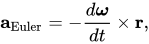 Euler forceIn classical mechanics, the Euler force is the fictitioustangential force that appears when a non-uniformly rotating reference frame is used for analysis of motion and there is variation in the angular velocity of the reference frame's axes. The Euler acceleration (named for Leonhard Euler), also known as azimuthal acceleration or transverse acceleration, is that part of the absolute acceleration that is caused by the variation in the angular velocity of the reference frame.
 Coriolis forceIn physics, the Coriolis force is a pseudo-force that acts on objects in motion within a frame of reference that rotates with respect to an inertial frame. In a reference frame with clockwise rotation, the force acts to the left of the motion of the object. In one with anticlockwise (or counterclockwise) rotation, the force acts to the right. Deflection of an object due to the Coriolis force is called the Coriolis effect.
 Angular velocityIn kinematics, angular velocity (symbol ω or ω→{\displaystyle {\vec {\omega }}}, the lowercase Greek letter omega), also known as the angular frequency vector, is a three-dimensional Euclidean vector that uniquely identifies the plane, direction and angular speed of rotation of a particle rotating in a circle at constant speed in three dimensions.
 Newton's laws of motionLaws in physics about force and motionNewton's laws of motion are three physical laws that describe the relationship between the motion of an object and the forces acting on it.
 Non-inertial reference frameA non-inertial reference frame (also known as an accelerated reference frame) is a frame of reference that undergoes acceleration with respect to an inertial frame. An accelerometer at rest in a non-inertial frame will, in general, detect a non-zero acceleration. While the laws of motion are the same in all inertial frames, they vary in non-inertial frames, with apparent motion depending on the acceleration.
 Classical mechanicsDiagram of orbital motion of a satellite around the Earth, showing perpendicular velocity and acceleration (force) vectors, represented through a classical interpretationIn physics, classical mechanics is a theory that describes the effect of forces on the motion of macroscopic objects and bulk matter, without considering quantum effects, and often without incorporating relativistic effects either.
 Centrifugal forceIn Newtonian mechanics, a centrifugal force is a kind of fictitious force (or inertial force) that appears to act on all objects when viewed in a rotating frame of reference. It appears to be directed perpendicularly from the axis of rotation of the frame. The magnitude of the centrifugal force F on an object of massm at the perpendicular distanceρ from the axis of a rotating frame of reference with angular velocityω is F=mω2ρ{\textstyle F=m\omega ^{2} ho }.Inertial frame of referenceIn classical physics and special relativity, an inertial frame of reference (also called an inertial space or a Galilean reference frame) is a frame of reference in which objects exhibit inertia: they remain at rest or in uniform motion relative to the frame until acted upon by external forces. In such a frame, the laws of nature can be observed without the need to correct for acceleration.RotationRotation, also known as rotational motion or rotary motion, is the movement of an object that leaves at least one point unchanged. In 2 dimensions, a plane figure can rotate in either a clockwise or counterclockwise sense around a point called the center of rotation. In 3 dimensions, a solid figure rotates around an imaginary line called an axis of rotation.
 Rotational frequencyRotational frequency, also known as rotational speed or rate of rotation (symbols ν, lowercase Greek nu, and also n), is the frequency of rotation of an object around an axis. Its SI unit is the reciprocal seconds (s); other common units of measurement include the hertz (Hz), cycles per second (cps), and revolutions per minute (rpm). Rotational frequency can be obtained dividing angular frequency, ω, by a full turn (2πradians): ν=ω/(2πrad).
 EarthSurface equivalent doserate0.274 μSv/hAbsolute magnitude (H)−3.99AtmosphereSurface pressure101.325 kPa (at sea level)Composition by volume78.08% nitrogen (dry air)20.95% oxygen (dry air)≤1% water vapor (variable)0.9340% argon0.0430% carbon dioxide0.00182% neon0.00052% helium0.00017% methane0.00011% krypton0.00006% hydrogen Source:Earth is the third planet from the Sun and the only astronomical object known to harbor life.
*As an Amazon Associate I earn from qualifying purchases.