 Graph of a functionIn mathematics, the graph of a functionf{\displaystyle f} is the set of ordered pairs(x,y){\displaystyle (x,y)}, where f(x)=y.{\displaystyle f(x)=y.} In the common case where x{\displaystyle x} and f(x){\displaystyle f(x)} are real numbers, these pairs are Cartesian coordinates of points in a plane and often form a curve. The graphical representation of the graph of a function is also known as a plot.
 Domain of a functionIn mathematics, the domain of a function is the set of inputs accepted by the function. It is sometimes denoted by dom(f){\displaystyle \operatorname {dom} (f)} or domf{\displaystyle \operatorname {dom} f}, where f is the function. In layman's terms, the domain of a function can generally be thought of as "what x can be".
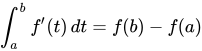 Continuous functionMathematical function with no sudden changes
 SubsetIn mathematics, a setA is a subset of a set Bif and only if all elements of A are also elements of B; B is then a superset of A. It is possible for A and B to be equal; if they are unequal, then A is a proper subset of B. The relationship of one set being a subset of another is called inclusion (or sometimes containment). A is a subset of B may also be expressed as B includes (or contains) A or A is included (or contained) in B. A k-subset is a subset with k elements.
 Set (mathematics)In mathematics, a set is a collection of different things; the things are called elements or members of the set and are typically mathematical objects: numbers, symbols, points in space, lines, other geometric shapes, variables, functions, or even other sets. Mathematics typically does not define precisely what constitutes a "set" or "collection", because such a definition would have to be in terms of something else previously defined.
 Injective functionIn mathematics, an injective function (also known as injection, or one-to-one function) is a functionf that maps distinct elements of its domain to distinct elements of its codomain; that is, x1 ≠ x2 implies f(x1) ≠ f(x2) (equivalently by contraposition, f(x1) = f(x2) implies x1 = x2). In other words, every element of the function's codomain is the image of at most one element of its domain.
 Linear mapMathematical function, in linear algebraIn mathematics, and more specifically in linear algebra, a linear map, linear mapping, or linear operator is a particular kind of function between vector spaces, which respects the basic operations of vector addition and scalar multiplication.
 Ordered pairIn mathematics, an ordered pair, denoted (a, b), is a pair of objects in which their order is significant. If a and b are different, then (a,b) is different from (b,a). In contrast, the unordered pair {a,b} always equals the unordered pair {b,a}. Ordered pairs are also called 2-tuples, or sequences (sometimes, lists in a computer science context) of length 2.
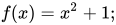 Function (mathematics)Association of one output to each inputIn mathematics, a function from a setX to a set Y assigns to each element of X exactly one element of Y. The set X is called the domain of the function and the set Y is called the codomain of the function. Functions were originally the idealization of how a varying quantity depends on another quantity. For example, the position of a planet is a function of time.
 Relation (mathematics)In mathematics, a relation denotes some kind of relationship between two objects in a set, which may or may not hold. As an example, "is less than" is a relation on the set of natural numbers; it holds, for instance, between the values 1 and 3 (denoted as 1 < 3), and likewise between 3 and 4 (denoted as 3 < 4), but not between the values 3 and 1 nor between 4 and 4, that is, 3 < 1 and 4 < 4 both evaluate to false.
 Cartesian productCartesian product of the sets {x,y,z} and {1,2,3}In mathematics, specifically set theory, the Cartesian product of two setsA and B, denoted A × B, is the set of all ordered pairs(a, b) where a is an element of A and b is an element of B. In terms of set-builder notation, that is A×B={(a,b)∣a∈A and b∈B}.{\displaystyle A\times B=\{(a,b)\mid a\in A\ {\mbox{ and }}\ b\in B\}.}A table can be created by taking the Cartesian product of a set of rows and a set of columns.
 MathematicsMathematics is a field of knowledge concerned with abstract concepts such as numbers, geometric shapes, sets, functions, and probabilities. It uses logical reasoning and proof to study and establish their properties, often expressed as theorems, formulas, and equations. Mathematics is used to model and solve problems in science, engineering, technology, economics, and everyday life.
*As an Amazon Associate I earn from qualifying purchases.