 Dirac delta functionGeneralized function whose value is zero everywhere except at zero Schematic representation of the Dirac delta function by a line surmounted by an arrow. The height of the arrow is usually meant to specify the value of any multiplicative constant, which will give the area under the function. The other convention is to write the area next to the arrowhead.
 Probability amplitudeIn quantum mechanics, a probability amplitude is a complex number used for describing the behaviour of systems. The square modulus of this quantity at a point in space represents a probability density at that point. Probability amplitudes provide a relationship between the quantum state of a system and the results of observations of that system, a link that was first proposed by Max Born, in 1926.
 Self-adjoint operatorIn mathematics, a self-adjoint operator on a complex vector spaceV{\displaystyle V} with inner product⟨⋅,⋅⟩{\displaystyle \langle \cdot ,\cdot angle } is a linear mapA{\displaystyle A} (from V{\displaystyle V} to itself) that is its own adjoint. That is, ⟨Ax,y⟩=⟨x,Ay⟩{\displaystyle \langle Ax,y angle =\langle x,Ay angle } for all x,y∈V{\displaystyle x,y\in V}.
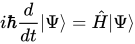 Quantum stateIn quantum physics, a quantum state is a mathematical entity that represents a physical system. Quantum mechanics specifies the construction, evolution, and measurement of a quantum state. Knowledge of the quantum state, and the rules for the system's evolution in time, exhausts all that can be known about a quantum system. Quantum states are either pure or mixed, and have several possible representations.Operator (physics)An operator is a function over a space of physical states onto another space of states. The simplest example of the utility of operators is the study of symmetry (which makes the concept of a group useful in this context). Because of this, they are useful tools in classical mechanics. Operators are even more important in quantum mechanics, where they form an intrinsic part of the formulation of the theory.
 ObservableIn physics, an observable is a physical property or physical quantity that can be measured. In classical mechanics, an observable is a real-valued "function" on the set of all possible system states, e.g., position and momentum. In quantum mechanics, an observable is described by a linear operator. For example, these operators might represent submitting the system to various electromagnetic fields and eventually reading a value.
 Unitary operatorIn functional analysis, a unitary operator is a surjectivebounded operator on a Hilbert space that preserves the inner product. Non-trivial examples include rotations, reflections, and the Fourier operator. Unitary operators generalize unitary matrices. Unitary operators are usually taken as operating on a Hilbert space, but the same notion serves to define the concept of isomorphismbetween Hilbert spaces. DefinitionDefinition 1.
 Eigenvalues and eigenvectorsConcepts from linear algebraIn linear algebra, an eigenvector ( ) or characteristic vector is a (nonzero) vector that has its direction unchanged (or reversed) by a given linear transformation. More precisely, an eigenvector v{\displaystyle \mathbf {v} } of a linear transformation T{\displaystyle T} is scaled by a constant factorλ{\displaystyle \lambda } when the linear transformation is applied to it: Tv=λv{\displaystyle T\mathbf {v} =\lambda \mathbf {v} }.
 Subatomic particleIn physics, a subatomic particle is a particle smaller than an atom. According to the Standard Model of particle physics, a subatomic particle can be a composite particle or an elementary particle. A composite particle, such as a proton or a neutron, is composed of other particles, while an elementary particle, such as an electron, is not composed of any substructure. Particle physics and nuclear physics study these particles and how they interact.Distribution (mathematical analysis)In mathematical analysis, distributions are a type of generalized function that makes it possible to differentiate functions whose derivatives do not exist in the classical sense. In particular, any locally integrable function has a distributional derivative.
 Quantum mechanicsQuantum mechanics, also known as quantum physics, is the fundamental physical theory that describes the behavior of matter and of light; the behaviors it models typically occur at and below the scale of atoms, and have often been described as counterintuitive. Its concepts and methods have been applied across many disciplines, including quantum chemistry, quantum biology, quantum field theory, quantum technology, and quantum information science.
 Position (geometry)In geometry, a position or position vector, also known as location vector or radius vector, is a Euclidean vector that represents a pointP in space. Its length represents the distance in relation to an arbitrary reference originO, and its direction represents the angular orientation with respect to given reference axes.
*As an Amazon Associate I earn from qualifying purchases.