 SequenceIn mathematics, a sequence is a collection of objects possibly with repetition, that come in a specified order. Like a set, it contains members (also called elements, or terms). Unlike a set, the same elements can appear multiple times at different positions in a sequence, and unlike a set, the order does matter. The notion of a sequence can be generalized to an indexed family, defined as a function from an arbitrary index set.
 Rational numberIn mathematics, a rational number is a number that can be expressed as the quotient or fraction p q {\displaystyle {\tfrac {p}{q}}} of two integers, a numerator p and a nonzero denominator q. For example, 3 7 {\displaystyle {\tfrac {3}{7}}} is a rational number, as is every integer (for example, − 5 = − 5 1 {\displaystyle -5={\tfrac {-5}{1}}} ).
 Root of unityIn mathematics, a root of unity is any complex number that yields 1 when raised to some positive integer power n. Roots of unity are used in many branches of mathematics, and are especially important in number theory, the theory of group characters, and the discrete Fourier transform. It is occasionally called a de Moivre number after French mathematician Abraham de Moivre. Roots of unity can be defined in any field.
 Periodic functionAn illustration of a periodic function with period P.{\displaystyle P.}A periodic function is a function that repeats its values at regular intervals. For example, the trigonometric functions, which are used to describe waves and other repeating phenomena, are periodic. Many aspects of the natural world have periodic behavior, such as the phases of the Moon, the swinging of a pendulum, and the beating of a heart.
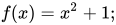 Function (mathematics)Association of one output to each inputIn mathematics, a function from a setX to a set Y assigns to each element of X exactly one element of Y. The set X is called the domain of the function and the set Y is called the codomain of the function. Functions were originally the idealization of how a varying quantity depends on another quantity. For example, the position of a planet is a function of time.
 DecimalNumber in base-10 numeral system Place value of number in decimal system A decimal system (also called base-ten, denary or decenary) is a numeral system that uses ten as its radix (base). Decimal systems are the global standard for denoting integer and non-integer numbers. The way of denoting numbers in a decimal system is often referred to as decimal notation.
 Natural numberIn mathematics, the natural numbers are the numbers used for counting up, starting from 0 or 1. The first few natural numbers are 0 (if included), 1, 2, 3, and so on. The terms positive integers, non-negative integers, whole numbers, and counting numbers are also used. The set of the natural numbers is commonly denoted by a bold N or a blackboard boldN{\displaystyle \mathbb {N} }.
 Order (group theory)Cardinality of a mathematical group, or of the subgroup generated by an element Examples of transformations with different orders: 90° rotation with order 4, shearing with infinite order, and their compositions with order 3. In mathematics, the order of a finite group is the number of its elements. If a group is not finite, one says that its order is infinite.
 Group (mathematics)Set with associative invertible operationThe manipulations of the Rubik's Cube form the Rubik's Cube group.In mathematics, a group is a set with an operation that combines any two elements of the set to produce a third element within the same set. The following conditions must hold: the operation is associative, it has an identity element, and every element of the set has an inverse element. For example, the integers with the addition operation form a group.Term (logic)In mathematical logic, a term is an arrangement of dependent/bound symbols that denotes a mathematical object within an expression/formula. In particular, terms appear as components of a formula. This is analogous to natural language, where a noun phrase refers to an object and a whole sentence refers to a fact. A first-order term is recursively constructed from constant symbols, variable symbols, and function symbols.
 MathematicsField of knowledgeIlluminated letter P at the beginning of Adelard of Bath's translation of Euclid's Elements, which starts "Punctum est illud cui pars non est" ('A point is that which has no part'). Geometry is shown personified as a woman, following Martianus Capella's De nuptiis Philologiae et Mercurii.Mathematics is a field of knowledge concerned with abstract concepts such as numbers, geometric shapes, sets, functions, and probabilities.
 FrequencyFrequency is the number of occurrences of a repeating event per unit of time. Frequency is an important parameter used in science and engineering to specify the rate of oscillatory and vibratory phenomena, such as mechanical vibrations, audio signals (sound), radio waves, and light. The interval of time between events is called the period. It is the reciprocal of the frequency.
*As an Amazon Associate I earn from qualifying purchases.