 Nuclear fissionNuclear fission is a reaction in which the nucleus of an atom splits into two or more smaller nuclei. The fission process often produces neutrons and gamma rays, and releases a very large amount of energy even by the energetic standards of radioactive decay. The free energy released by the fission of one uranium-235 atom is about 100 million times the energy released by burning one carbon atom in air to produce CO2.
 Neutron moderatorIn nuclear engineering, a neutron moderator is a medium that reduces the speed of fast neutrons, ideally without capturing any, leaving them as thermal neutrons with only minimal (thermal) kinetic energy. These thermal neutrons are immensely more susceptible than fast neutrons to propagate a nuclear chain reaction of uranium-235 or other fissileisotope by colliding with their atomic nucleus.
 NeutronA neutron is a subatomic particle, symbol n or n, that has no electric charge, and a mass slightly greater than that of a proton. The neutron was discovered by James Chadwick in 1932, leading to the discovery of nuclear fission in 1938, the first self-sustaining nuclear reactor (Chicago Pile-1, 1942), and the first nuclear weapon (Trinity, 1945). Neutrons are found, together with a similar number of protons, in the nuclei of atoms.
 DeuteriumDeuterium (hydrogen-2, symbol H or D, also known as heavy hydrogen) is one of two stable isotopes of hydrogen; the other is protium, or hydrogen-1, H. The deuterium nucleus (deuteron) contains one proton and one neutron, whereas the far more common H has no neutrons. The name deuterium comes from Greek , meaning "second". American chemist Harold Urey discovered deuterium in 1931. Urey and others produced samples of heavy water in which the H had been highly concentrated.
 Fissile materialIn nuclear engineering, fissile material is material that can undergo nuclear fission when struck by a neutron of low energy. A self-sustaining thermal chain reaction can only be achieved with fissile material. The predominant neutron energy in a system may be typified by either slow neutrons (i.e., a thermal system) or fast neutrons. Fissile material can be used to fuel thermal-neutron reactors, fast-neutron reactors and nuclear explosives.
 JouleThe joule ( , or ; symbol: J) is the unit of energy in the International System of Units (SI). In terms of SI base units, one joule corresponds to one kilogram-metre squared per second squared(1 J = 1 kg⋅m⋅s). One joule is equal to the amount of work done when a force of one newton displaces a body through a distance of one metre in the direction of that force.
 ElectronvoltIn physics, an electronvolt (symbol eV), also written as electron-volt and electron volt, is a unit of measurement equivalent to the amount of kinetic energy gained by a single electron accelerating through an electric potential difference of one volt in a vacuum. When used as a unit of energy, the numerical value of 1 eV expressed in unit of joules (symbol J) is equal to the numerical value of the charge of an electron in coulombs (symbol C).
 Kinetic energyIn physics, the kinetic energy of an object is the form of energy that it possesses due to its motion. In classical mechanics, the kinetic energy of a non-rotating object of massm traveling at a speedv is 12mv2{\textstyle {\frac {1}{2}}mv^{2}}. The kinetic energy of an object is equal to the work, or force (F) in the direction of motion times its displacement (s), needed to accelerate the object from rest to its given speed.
 Maxwell–Boltzmann distributionIn physics (in particular in statistical mechanics), the Maxwell–Boltzmann distribution, or Maxwell(ian) distribution, is a particular probability distribution named after James Clerk Maxwell and Ludwig Boltzmann.
 WavelengthIn physics and mathematics, wavelength or spatial period of a wave or periodic function is the distance over which the wave's shape repeats. In other words, it is the distance between consecutive corresponding points of the same phase on the wave, such as two adjacent crests, troughs, or zero crossings. Wavelength is a characteristic of both traveling waves and standing waves, as well as other spatial wave patterns.
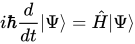 Matter waveMatter waves are a central part of the theory of quantum mechanics, being half of wave–particle duality. At all scales where measurements have been practical, matter exhibits wave-like behavior. For example, a beam of electrons can be diffracted just like a beam of light or a water wave. The concept that matter behaves like a wave was proposed by French physicist Louis de Broglie () in 1924, and so matter waves are also known as de Broglie waves.
 MomentumIn Newtonian mechanics, momentum (pl.: momenta or momentums; more specifically linear momentum or translational momentum) is the product of the mass and velocity of an object. It is a vector quantity, possessing a magnitude and a direction.
*As an Amazon Associate I earn from qualifying purchases.