 Wave functionMathematical description of quantum stateQuantum harmonic oscillators for a single spinless particle. The oscillations have no trajectory, but are instead represented each as waves; the vertical axis shows the real part (blue) and imaginary part (red) of the wave function. Panels A–D show four different standing-wave solutions of the Schrödinger equation.
 Condensed matter physicsCondensed matter physics is the field of physics that deals with the macroscopic and microscopic physical properties of matter, especially the solid and liquidphases, that arise from electromagnetic forces between atoms and electrons. More generally, the subject deals with condensed phases of matter: systems of many constituents with strong interactions among them.Faddeev equationsThe Faddeev equations, named after their discoverer Ludvig Faddeev, describe, at once, all the possible exchanges/interactions in a system of three particles in a fully quantum mechanical formulation. They can be solved iteratively. In general, Faddeev equations need as input a potential that describes the interaction between two individual particles. It is also possible to introduce a term in the equation in order to take also three-body forces into account.
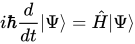 Schrödinger equationThe Schrödinger equation is a partial differential equation that governs the wave function of a non-relativistic quantum-mechanical system. Its discovery was a significant landmark in the development of quantum mechanics. It is named after Erwin Schrödinger, an Austrian physicist, who postulated the equation in 1925 and published it in 1926, forming the basis for the work that resulted in his Nobel Prize in Physics in 1933.
 Perturbation theory (quantum mechanics)In quantum mechanics, perturbation theory is a set of approximation schemes directly related to mathematical perturbation for describing a complicated quantum system in terms of a simpler, known system.
 Variational method (quantum mechanics)In quantum mechanics, the variational method is one way of finding approximations to the lowest energy eigenstate or ground state, and some excited states. This allows calculating approximate wavefunctions such as molecular orbitals. The basis for this method is the variational principle.Few-body systemsIn physics, a few-body system consists of a small number of well-defined structures or point particles.
 Molecular physicsMolecular physics is the study of the physical properties of molecules and molecular dynamics. The field overlaps significantly with physical chemistry, chemical physics, and quantum chemistry. It is often considered as a sub-field of atomic, molecular, and optical physics. Research groups studying molecular physics are typically designated as one of these other fields.
 Solid-state physicsSolid-state physics is the study of rigid matter, or solids, through methods such as solid-state chemistry, quantum mechanics, crystallography, electromagnetism, and metallurgy. It is the largest branch of condensed matter physics. Solid-state physics studies how the large-scale properties of solid materials result from their atomic-scale properties. Thus, solid-state physics forms a theoretical basis of materials science.
 SuperconductivitySuperconductivity is a set of physical properties observed in superconductors: materials where electrical resistance is exactly zero and magnetic fields are expelled from the material. Unlike an ordinary metallic conductor, whose resistance decreases gradually as its temperature is lowered, even down to near absolute zero, a superconductor has a characteristic critical temperature below which the resistance drops abruptly to zero.
 High-performance computingHigh-performance computing (HPC) is the use of supercomputers and computer clusters to solve advanced problems.
 NanotechnologyTechnology with features near one nanometerFullerene nanogearsNanotechnology is the manipulation of matter with at least one dimension size measuring between 1 to 100 nanometers (nm). At this scale, commonly known as the nanoscale, surface area and quantum mechanical effects become important in describing the properties of matter. This definition of nanotechnology includes all types of research and technologies that deal with these distinctive properties.
*As an Amazon Associate I earn from qualifying purchases.