 Speech codingSpeech coding is an application of data compression to digital audio signals containing speech. Speech coding uses speech-specific parameter estimation using audio signal processing techniques to model the speech signal, combined with generic data compression algorithms to represent the resulting modeled parameters in a compact bitstream. Common applications of speech coding are mobile telephony and voice over IP (VoIP).
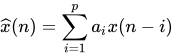 Linear predictionLinear prediction is a mathematical operation where future values of a discrete-timesignal are estimated as a linear function of previous samples. In digital signal processing, linear prediction is often called linear predictive coding (LPC) and can thus be viewed as a subset of filter theory. In system analysis, a subfield of mathematics, linear prediction can be viewed as a part of mathematical modelling or optimization.
 Speech processingSpeech processing is the study of speechsignals and the processing methods of signals. The signals are usually processed in a digital representation, so speech processing can be regarded as a special case of digital signal processing, applied to speech signals. Aspects of speech processing includes the acquisition, manipulation, storage, transfer and output of speech signals.
 Speech synthesisArtificial production of human speechA synthetic voice announcing an arriving train in Sweden.Problems playing this file? See .Speech synthesis is the artificial production of human speech. A computer system used for this purpose is called a speech synthesizer, and can be implemented in software or hardware products.
 Bit rateIn telecommunications and computing, bit rate (bitrate or as a variable R) is the number of bits that are conveyed or processed per unit of time. The bit rate is expressed as bits per second (symbol: bit/s), often with an SI prefix such as kilo (1 kbit/s = 1,000 bit/s), mega (1 Mbit/s = 1,000 kbit/s), giga (1 Gbit/s = 1,000 Mbit/s) or tera (1 Tbit/s = 1,000 Gbit/s). The non-standard abbreviation bps is often used: 1 Mbps is 1 Mbit/s, that is, one million bits per second.
 Data compressionCompact encoding of digital dataIn information theory, data compression, source coding, or bit-rate reduction is the process of encoding information using fewer bits than the original representation. Any particular compression is either lossy or lossless. Lossless compression reduces bits by identifying and eliminating statistical redundancy. No information is lost in lossless compression. Lossy compression reduces bits by removing unnecessary or less important information.
 Predictive modellingIn finance and mathematics, predictive modelling is the use of statistics to predict outcomes. Most often the event one wants to predict is in the future, but predictive modelling can be applied to any type of unknown event, regardless of when it occurred. For example, predictive models are often used to detect crimes and identify suspects, after the crime has taken place.Audio signal processingAudio signal processing is a subfield of signal processing that is concerned with the electronic manipulation of audio signals. Audio signals are electronic representations of sound waves—longitudinal waves which travel through air, consisting of compressions and rarefactions. As audio signals may be represented in either digital or analog format, processing may occur in either domain.
 Digital dataDigital data or digital information, in information theory and information systems, is data or information represented as a string of discrete symbols, each of which can take on one of only a finite number of values from some alphabet, such as letters or digits. An example is a text document, which consists of a string of alphanumeric characters.
 Spectral densityIn signal processing, the power spectrumSxx(f){\displaystyle S_{xx}(f)} of a continuous timesignalx(t){\displaystyle x(t)} describes the distribution of power into frequency components f{\displaystyle f} composing that signal. Fourier analysis shows that any physical signal can be decomposed into a distribution of frequencies over a continuous range, where some of the power may be concentrated at discrete frequencies.
 SignalA signal is both the process and the result of transmission of data over some media accomplished by embedding some variation. Signals are important in multiple subject fields, including signal processing, information theory and biology. In signal processing, a signal is a function that conveys information about a phenomenon. Any quantity that can vary over space or time can be used as a signal to share messages between observers.
 SpeechSpeech is the use of the human voice as a medium for language. Spoken language combines vowel and consonant sounds to form units of meaning like words, which belong to a language's lexicon. There are many different intentional speech acts, such as informing, declaring, asking, persuading, directing; acts may vary in various aspects like enunciation, intonation, loudness, and tempo to convey meaning.
*As an Amazon Associate I earn from qualifying purchases.