 Dimension (vector space)A diagram of dimensions 1, 2, 3, and 4In mathematics, the dimension of a vector spaceV is the cardinality (i.e., the number of vectors) of a basis of V over its base field. It is sometimes called Hamel dimension (after Georg Hamel) or algebraic dimension to distinguish it from other types of dimension. For every vector space there exists a basis, and all bases of a vector space have equal cardinality; as a result, the dimension of a vector space is uniquely defined.
 Vector spaceAlgebraic structure in linear algebraVector addition and scalar multiplication: a vector v (blue) is added to another vector w (red, upper illustration). Below, w is stretched by a factor of 2, yielding the sum v + 2w.In mathematics, a vector space (also called a linear space) is a set whose elements, often called vectors, can be added together and multiplied ("scaled") by numbers called scalars.
 Matrix (mathematics)Array of numbersAn m × n matrix: the m rows are horizontal and the n columns are vertical. Each element of a matrix is often denoted by a variable with two subscripts.
 Scalar (mathematics)In mathematics, more specifically in linear algebra, a scalar is an element of a field which is used to define a vector space through the operation of scalar multiplication: a vector (denoted v) multiplied by a scalar (denoted a) produces another vector (av). Real numbers and complex numbers may be used as scalars in real and complex vector spaces, respectively.
 Linear algebraLinear algebra is the branch of mathematics concerning linear equations such as a 1 x 1 + ⋯ + a n x n = b , {\displaystyle a_{1}x_{1}+\cdots +a_{n}x_{n}=b,} linear maps such as the following: ( x 1 , … , x n ) ↦ a 1 x 1 + ⋯ + a n x n , {\displaystyle (x_{1},\ldots ,x_{n})\mapsto a_{1}x_{1}+\cdots +a_{n}x_{n},} and their representations in vector spaces and through matrices. Linear algebra is central to almost all areas of mathematics.
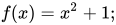 Function (mathematics)Association of one output to each inputIn mathematics, a function from a setX to a set Y assigns to each element of X exactly one element of Y. The set X is called the domain of the function and the set Y is called the codomain of the function. Functions were originally the idealization of how a varying quantity depends on another quantity. For example, the position of a planet is a function of time.Linear subspaceIn mathematics, and more specifically in linear algebra, a linear subspace or vector subspace is a vector space that is a subset of some larger vector space. A linear subspace is usually simply called a subspace when the context serves to distinguish it from other types of subspaces.
 Scalar multiplicationIn mathematics, scalar multiplication is one of the basic operations defining a vector space in linear algebra (or more generally, a module in abstract algebra). In common geometrical contexts, scalar multiplication of a real Euclidean vector by a positive real number multiplies the magnitude of the vector without changing its direction.HomomorphismIn algebra, a homomorphism is a structure-preserving map between two algebraic structures of the same type (such as two groups, two rings, or two vector spaces). The word homomorphism comes from the Ancient Greek language: ὁμός (homos) meaning "same" and μορφή (morphe) meaning "form" or "shape". However, the word was apparently introduced to mathematics due to a (mis)translation of German ähnlich meaning "similar" to ὁμός meaning "same".
 MathematicsField of knowledgeIlluminated letter P at the beginning of Adelard of Bath's translation of Euclid's Elements, which starts "Punctum est illud cui pars non est" ('A point is that which has no part'). Geometry is shown personified as a woman, following Martianus Capella's De nuptiis Philologiae et Mercurii.Mathematics is a field of knowledge concerned with abstract concepts such as numbers, geometric shapes, sets, functions, and probabilities.
 Euclidean vectorIn mathematics, physics, and engineering, a Euclidean vector or simply a vector (sometimes called a geometric vector or spatial vector) is a geometric object that has magnitude (or length) and direction. Euclidean vectors can be added and scaled to form a vector space. A vector quantity is a vector-valued physical quantity, including units of measurement and possibly a support, formulated as a directed line segment.
 Line (geometry)In geometry, a straight line, usually abbreviated line, is an infinitely long object with no width, depth, or curvature. It is a special case of a curve and an idealisation of such physical objects as a straightedge, a taut string, or a ray of light. Lines are spaces of dimension one, which may be embedded in spaces of dimension two, three, or higher.
 Euclidean planeIn mathematics, a Euclidean plane is a Euclidean space of dimension two, denoted E 2 {\displaystyle {\textbf {E}}^{2}} or E 2 {\displaystyle \mathbb {E} ^{2}} . It is a geometric space in which two real numbers are required to determine the position of each point. It is an affine space, which includes in particular the concept of parallel lines. It has also metrical properties induced by a distance, which allows to define circles, and angle measurement.
 constraintRelated word or term.
*As an Amazon Associate I earn from qualifying purchases.