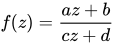
 Möbius transformationRational function of the form (az + b)/(cz + d)In geometry and complex analysis, a Möbius transformation of the complex plane is a rational function of the form f(z)=az+bcz+d{\displaystyle f(z)={\frac {az+b}{cz+d}}} of one complex variable z; here the coefficients a, b, c, d are complex numbers satisfying ad − bc ≠ 0.
 Kleinian groupDiscrete group of Möbius transformations In mathematics, a Kleinian group is a discrete subgroup of the group of orientation-preserving isometries of hyperbolic 3-space H3. The latter, identifiable with PSL(2, C), is the quotient group of the 2 by 2 complex matrices of determinant 1 by their center, which consists of the identity matrix and its product by −1.
 Upper half-planeIn mathematics, the upper half-plane, H,{\displaystyle {\mathcal {H}},} is the set of points (x,y){\displaystyle (x,y)} in the Cartesian plane with y>0.{\displaystyle y>0.} The lower half-plane is the set of points (x,y){\displaystyle (x,y)} with y<0{\displaystyle y<0} instead. Arbitrarily oriented half-planes can be obtained via a planar rotation. Half-planes are an example of two-dimensional half-space.
 Discrete groupIn mathematics, a topological group G is called a discrete group if there is no limit point in it (i.e., for each element in G, there is a neighborhood which only contains that element). Equivalently, the group G is discrete if and only if its identity is isolated.
 Finitely generated groupIn algebra, a finitely generated group is a groupG that has some finitegenerating setS so that every element of G can be written as the combination (under the group operation) of finitely many elements of S and of inverses of such elements. By definition, every finite group is finitely generated, since S can be taken to be G itself. Every infinite finitely generated group must be countable but countable groups need not be finitely generated.
 Unit diskIn mathematics, the open unit disk (or disc) around P (where P is a given point in the plane), is the set of points whose distance from P is less than 1: D1(P)={Q:|P−Q|<1}.{\displaystyle D_{1}(P)=\{Q:\vert P-Q\vert <1\}.\,}The closed unit disk around P is the set of points whose distance from P is less than or equal to one: D¯1(P)={Q:|P−Q|≤1}.{\displaystyle {\bar {D}}_{1}(P)=\{Q:|P-Q|\leq 1\}.\,}Unit disks are special cases of disks and unit balls; as such, they contain the interior of the unit circle and, in the case of the closed unit disk, the unit circle itself.
 Group (mathematics)Set with associative invertible operationThe manipulations of the Rubik's Cube form the Rubik's Cube group.In mathematics, a group is a set with an operation that combines any two elements of the set to produce a third element within the same set. The following conditions must hold: the operation is associative, it has an identity element, and every element of the set has an inverse element. For example, the integers with the addition operation form a group.
 IsometryIn mathematics, an isometry (or congruence, or congruent transformation) is a distance-preserving transformation between metric spaces, usually assumed to be bijective. The word isometry is derived from the Ancient Greek: ἴσος isos meaning "equal", and μέτρον metron meaning "measure". If the transformation is from a metric space to itself, it is a kind of geometric transformation known as a motion.SL2(R)Group of real 2×2 matrices with unit determinant In mathematics, the special linear group SL(2, R) or SL2(R) is the group of 2 × 2 real matrices with determinant one: SL ( 2 , R ) = { ( a b c d ) : a , b , c , d ∈ R and a d − b c = 1 } .Hyperbolic geometryType of non-Euclidean geometry Lines through a given point P and asymptotic to line R A triangle immersed in a saddle-shape plane (a hyperbolic paraboloid), along with two diverging ultra-parallel lines In mathematics, hyperbolic geometry (also called Lobachevskian geometry or Bolyai–Lobachevskian geometry) is a non-Euclidean geometry.
 Conformal mapIn mathematics, a conformal map is a function that locally preserves angles, but not necessarily lengths. More formally, let U{\displaystyle U} and V{\displaystyle V} be open subsets of Rn{\displaystyle \mathbb {R} ^{n}}. A function f:U→V{\displaystyle f:U\to V} is called conformal (or angle-preserving) at a point u0∈U{\displaystyle u_{0}\in U} if it preserves angles between directed curves through u0{\displaystyle u_{0}}, as well as preserving orientation.
 MathematicsMathematics is a field of knowledge concerned with abstract concepts such as numbers, geometric shapes, sets, functions, and probabilities. It uses logical reasoning and proof to study and establish their properties, often expressed as theorems, formulas, and equations. Mathematics is used to model and solve problems in science, engineering, technology, economics, and everyday life.
*As an Amazon Associate I earn from qualifying purchases.