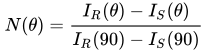
 Static light scatteringStatic light scattering is a technique in physical chemistry that measures the intensity of the scattered light to obtain the average molecular weight Mw of a macromolecule like a polymer or a protein in solution. Measurement of the scattering intensity at many angles allows calculation of the root mean square radius, also called the radius of gyrationRg.
 Rayleigh scatteringRayleigh scattering ( ) is the scattering or deflection of light, or other electromagnetic radiation, by particles with a size much smaller than the wavelength of the radiation. For light frequencies well below the resonance frequency of the scattering medium (normal dispersion regime), the amount of scattering is inversely proportional to the fourth power of the wavelength (e.g., a blue color is scattered much more than a red color as light propagates through air).
 PolarizerA polarizer or polariser is an optical filter that lets light waves of a specific polarization pass through while blocking light waves of other polarizations. It can filter a beam of light of undefined or mixed polarization into a beam of well-defined polarization, known as polarized light. Polarizers are used in many optical techniques and instruments. Polarizers find applications in photography and LCD technology.
 LaserA laser is a device that emits light through a process of optical amplification based on the stimulated emission of electromagnetic radiation. The word laser originated as an acronym for light amplification by stimulated emission of radiation. The first laser was built in 1960 by Theodore Maiman at Hughes Research Laboratories, based on theoretical work by Charles H. Townes and Arthur Leonard Schawlow and the optical amplifier patented by Gordon Gould.
 AutocorrelationCorrelation of a signal with a time-shifted copy of itself, as a function of shiftAbove: A plot of a series of 100 random numbers concealing a sine function. Below: Its correlogram plots the autocorrelation function (ACF) of the series on the y-axis for every lag on the x-axis. Peaks occur at lags where the series is highly correlated with itself.
 MonochromeA monochrome or monochromatic image, object or palette is composed of one color (or values of one color). Images using only shades of grey are called grayscale (typically digital) or black-and-white (typically analog). In physics, monochromatic light refers to electromagnetic radiation that contains a narrow band of wavelengths, which is a distinct concept.
 Suspension (chemistry)In chemistry, a suspension is a heterogeneous mixture of a fluid that contains solidparticles sufficiently large for sedimentation. The particles may be visible to the naked eye, usually must be larger than one micrometer, and will eventually settle, although the mixture is only classified as a suspension when and while the particles have not settled out.
 NanometreThe nanometre (international spelling as used by the International Bureau of Weights and Measures; SI symbol: nm), or nanometer (American spelling), is a unit of length in the International System of Units (SI), equal to one billionth (short scale) or one thousand millionth (long scale) of a metre (0.000000001 m) and to 1000 picometres.
 Solution (chemistry)In chemistry, a solution is defined by IUPAC as "A liquid or solid phase containing more than one substance, when for convenience one (or more) substance, which is called the solvent, is treated differently from the other substances, which are called solutes. When, as is often but not necessarily the case, the sum of the mole fractions of solutes is small compared with unity, the solution is called a dilute solution."
 Fourier transformMathematical transform that expresses a function of time as a function of frequencyThe Fourier transform applied to the waveform of a C majorpianochord (with logarithmic horizontal (frequency) axis). The first three peaks on the left correspond to the fundamental frequencies of the chord (C, E, G).
 Spectral densityRelative importance of certain frequencies in a composite signalThe spectral density of a fluorescent light as a function of optical wavelength shows peaks at atomic transitions, indicated by the numbered arrows.The voice waveform over time (left) has a broad audio power spectrum (right).Graph of power spectral density versus frequency (Hz).In signal processing, the power spectrumSxx(f){\displaystyle S_{xx}(f)} of a continuous timesignalx(t){\displaystyle x(t)} describes the distribution of power into frequency components f{\displaystyle f} composing that signal.
 Time domainIn mathematics and signal processing, the time domain is a representation of how a signal, function, or data set varies with time. It is used for the analysis of mathematical functions, physical signals or time series of economic or environmental data. In the time domain, the independent variable is time, and the dependent variable is the value of the signal. This contrasts with the frequency domain, where the signal is represented by its constituent frequencies.PhysicsPhysics is the scientific study of matter, its fundamental constituents, its motion and behavior through space and time, and the related entities of energy and force. It is one of the most fundamental scientific disciplines. A scientist who specializes in the field of physics is called a physicist. Physics is one of the oldest academic disciplines.
 particleRelated word or term.
*As an Amazon Associate I earn from qualifying purchases.