 Linear regressionStatistical modeling methodIn linear regression, the observations (red) are assumed to be the result of random deviations (green) from an underlying relationship (blue) between a dependent variable (y) and an independent variable (x).In statistics, linear regression is a model that estimates the relationship between a scalar response (dependent variable) and one or more explanatory variables (regressor or independent variable) related via a linear combination.
 Design of experimentsThe design of experiments (DOE), also known as experimental design, refers to the construction of procedures that attempt to explain how changes in one aspect of a system will lead to changes in other aspects of a system. In general, the design of experiments involves decisions about which aspects of the system to change and which to control based on hypotheses about the sources of variance in the aspects of the system considered by the experimenter.
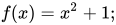 Function (mathematics)Association of one output to each inputIn mathematics, a function from a setX to a set Y assigns to each element of X exactly one element of Y. The set X is called the domain of the function and the set Y is called the codomain of the function. Functions were originally the idealization of how a varying quantity depends on another quantity. For example, the position of a planet is a function of time.Linear modelIn statistics, the term linear model refers to any model which assumes linearity in the system. The most common occurrence is in connection with regression models and the term is often taken as synonymous with linear regression model. However, the term is also used in time series analysis with a different meaning.Bivariate dataIn statistics, bivariate data is data on each of two variables, where each value of one of the variables is paired with a value of the other variable. It is a specific but very common case of multivariate data. The association can be studied via a tabular or graphical display, or via sample statistics which might be used for inference. Typically it would be of interest to investigate the possible association between the two variables.
 Multivariable calculusCalculus of functions of several variables Part of a series of articles aboutCalculus ∫ a b f ′ ( t ) d t = f ( b ) − f ( a ) {\displaystyle \int _{a}^{b}f'(t)\,dt=f(b)-f(a)} Fundamental theorem Limits Continuity Rolle's theorem Mean value theorem Inverse function theorem Differential Definitions Derivative (generalizations) Differential infinitesimal of a function total Concepts Differentiation notation Second derivative Implicit differentiation Logarithmic differentiation Related rates Taylor's theorem Rules and identities Sum Product Chain Power Quotient L'Hôpital's rule Inverse General Leibniz Faà di Bruno's formula Reynolds Integral Lists of integrals Integral transform Leibniz integral rule Definitions Antiderivative Integral (improper) Riemann integral Lebesgue integration Contour integration Integral of inverse functions Nonelementary integral Integration by Parts Discs Cylindrical shells Substitution (trigonometric, tangent half-angle, Euler) Euler's formula Partial fractions (Heaviside's method) Changing order Reduction formulae Differentiating under the integral sign Risch algorithm Series Geometric (arithmetico-geometric) Harmonic Alternating Power Binomial Taylor Convergence tests Summand limit (term test) Ratio Root Integral Direct comparison Limit comparison Alternating series Cauchy condensation Dirichlet Abel Vector Gradient Divergence Curl Laplacian Directional derivative Identities Theorems Gradient Green's Stokes' Divergence Generalized Stokes Helmholtz decomposition Multivariable Formalisms Matrix Tensor Exterior Geometric Definitions Partial derivative Multiple integral Line integral Surface integral Volume integral Jacobian Hessian Theorems Clairaut's Fubini's Advanced Calculus on Euclidean space Generalized functions Limit of distributions Specialized Fractional Malliavin Stochastic Variations Miscellanea Precalculus History Glossary List of topics Integration Bee Mathematical analysis Nonstandard analysis vte Multivariable calculus (also known as multivariate calculus) is the extension of calculus in one variable to functions of several variables: the differentiation and integration of functions involving multiple variables (multivariate), rather than just one.
 StochasticStochasticity is the property of being well-described by a randomprobability distribution. Stochasticity and randomness are technically distinct concepts: stochasticity refers to a modeling approach, while randomness describes phenomena. These terms are often used interchangeably. In probability theory, the formal concept of a stochastic process is also referred to as a random process.
 Scatter plotA scatter plot, also called a scatterplot, scatter graph, scatter chart, scattergram, or scatter diagram, is a type of plot or mathematical diagram using Cartesian coordinates to display values for typically two variables for a set of data. If the points are coded (color/shape/size), one additional variable can be displayed.
 Machine learningSubset of artificial intelligenceMachine learning (ML) is a field of study in artificial intelligence concerned with the development and study of statistical algorithms that can learn from data and generalize to unseen data, and thus perform tasks without being explicitly programmed. Statistics and mathematical optimisation methods compose the foundations of machine learning.
 Mathematical modelA mathematical model is an abstract description of a concrete system using mathematical concepts and language. The process of developing a mathematical model is termed mathematical modeling. Mathematical models are used in many fields, including applied mathematics, natural sciences, social sciences and engineering. In particular, the field of operations research studies the use of mathematical modelling and related tools to solve problems in business or military operations.
 Vector-valued functionA vector-valued function, also referred to as a vector function, is a mathematical function of one or more variables whose range is a set of multidimensional vectors or infinite-dimensional vectors. The input of a vector-valued function could be a scalar or a vector (that is, the dimension of the domain could be 1 or greater than 1); the dimension of the function's domain has no relation to the dimension of its range.
*As an Amazon Associate I earn from qualifying purchases.