 Cumulonimbus cloudCumulonimbus (from Latin'swell' and 'cloud') is a dense, towering, vertical cloud, typically forming from water vapor condensing in the lower troposphere that builds upward carried by powerful buoyant air currents. Above the lower portions of the cumulonimbus the water vapor becomes ice crystals, such as snow and graupel, the interaction of which can lead to hail and to lightning formation, respectively. When causing thunderstorms, these clouds may be called thunderheads.
 Cumulus congestus cloudCumulus congestus or towering cumulus clouds are a species of cumulus that can be based in the low- to middle-height ranges. They achieve considerable vertical development in areas of deep, moist convection. They are an intermediate stage between cumulus mediocris and cumulonimbus, sometimes producing rainshowers, snow, or ice pellets. Precipitation that evaporates before reaching the surface is virga.
 CloudVisible mass of particles suspended in the atmosphereCloudscape over Borneo, taken by the International Space StationIn meteorology, a cloud is an aerosol consisting of a visible mass of miniature liquid droplets, ice crystals, or other particles, suspended in the atmosphere of a planetary body or similar space. Water, primarily, comprises the droplets and crystals.
 Cloud baseA cloud base (or the base of the cloud) is the lowest altitude of the visible portion of a cloud. It is traditionally expressed either in metres or feet above mean sea level or above a planetary surface, or as the pressure level corresponding to this altitude in hectopascals (hPa, equivalent to the millibar). MeasurementThe height of the cloud base can be measured using a ceilometer.
 SupercoolingSupercooling, also known as undercooling, is the process of lowering the temperature of a liquid below its freezing point without it becoming a solid. Per the established international definition, supercooling means "cooling a substance below the normal freezing point without solidification". While it can be achieved by different physical means, the postponed solidification is most often due to the absence of seed crystals or nuclei around which a crystal structure can form.
 Ice crystalIce crystals are solid water (known as ice) in symmetrical shapes including hexagonal columns, hexagonal plates, and dendritic crystals. Ice crystals are responsible for various atmospheric optical displays and cloud formations. FormationAt ambient temperature and pressure, water molecules have a V shape. The two hydrogen atoms bond to the oxygen atom at a 105° angle.
 AltitudeAltitude is a distance measurement, usually in the vertical or "up" direction, between a reference datum and a point or object. The exact definition and reference datum varies according to the context (e.g., aviation, geometry, geographical survey, sport, or atmospheric pressure). Although the term altitude is commonly used to mean the height above sea level of a location, in geography the term elevation is often preferred for this usage.
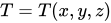 Temperature gradientA temperature gradient is a physical quantity that describes in which direction and at what rate the temperature changes the most rapidly around a particular location. The temperature spatial gradient is a vector quantity with dimension of temperature difference per unit length. The SIunit is kelvin per meter (K/m). Temperature gradients in the atmosphere are important in the atmospheric sciences (meteorology, climatology and related fields).
 Water vaporWater vapor, water vapour, or aqueous vapor is the gaseous phase of water. It is one state of water within the hydrosphere. Water vapor can be produced from the evaporation or boiling of liquid water or from the sublimation of ice. Water vapor is transparent, like most constituents of the atmosphere. Under typical atmospheric conditions, water vapor is continuously generated by evaporation and removed by condensation.
 HumidityConcentration of water vapour in the airGlobal distribution of relative humidity at the surface averaged over the years 1981–2010 from the CHELSA-BIOCLIM+ data setHumidity is the concentration of water vapor present in the air. Water vapor, the gaseous state of water, is generally invisible to the naked eye. Humidity indicates the likelihood for precipitation, dew, or fog to be present. Humidity depends on the temperature and pressure of the system of interest.
 Atmospheric instabilityAtmospheric instability is a condition where the Earth's atmosphere is considered to be unstable and as a result local weather is highly variable through distance and time. Atmospheric instability encourages vertical motion, which is directly correlated to different types of weather systems and their severity.
 LatinLatin (lingua Latina or Latinum) is a classical language belonging to the Italic branch of the Indo-European languages. Latin was originally spoken by the Latins in Latium (now known as Lazio), the lower Tiber area around Rome, Italy. Through the expansion of the Roman Republic, it became the dominant language in the Italian Peninsula and subsequently throughout the Roman Empire.
*As an Amazon Associate I earn from qualifying purchases.