 Disjunctive normal formIn boolean logic, a disjunctive normal form (DNF) is a normal form of a logical formula consisting of a disjunction of conjunctions; it can also be described as an OR of ANDs, a sum of products, or — in philosophical logic — a cluster concept. The disjunctive normal form and its counterpart, the conjunctive normal form, are the most common standardized ways of representing boolean expressions.
 Boolean satisfiability problemIn logic and computer science, the Boolean satisfiability problem (sometimes called propositional satisfiability problem and abbreviated SATISFIABILITY, SAT or B-SAT) asks whether there exists an interpretation that satisfies a given Booleanformula. In other words, it asks whether the formula's variables can be consistently replaced by the values TRUE or FALSE to make the formula evaluate to TRUE. If this is the case, the formula is called satisfiable, else unsatisfiable.
 De Morgan's lawsIn propositional logic and Boolean algebra, De Morgan's laws, also known as De Morgan's theorem, are a pair of transformation rules that are both validrules of inference. They are named after Augustus De Morgan, a 19th-century British mathematician. The rules allow the expression of conjunctions and disjunctions purely in terms of each other via negation.
 Clause (logic)In logic, a clause is a propositional formula formed from a finite collection of literals (atoms or their negations) and logical connectives. A clause is true either whenever at least one of the literals that form it is true (a disjunctive clause, the most common use of the term), or when all of the literals that form it are true (a conjunctive clause, a less common use of the term). That is, it is a finite disjunction or conjunction of literals, depending on the context.
 Literal (mathematical logic)In mathematical logic, a literal is an atomic formula (also known as an atom or prime formula) or its negation. The definition mostly appears in proof theory (of classical logic), e.g. in conjunctive normal form and the method of resolution.
 Logical equivalenceIn logic and mathematics, statements p{\displaystyle p} and q{\displaystyle q} are said to be logically equivalent if they have the same truth value in every model. The logical equivalence of p{\displaystyle p} and q{\displaystyle q} is sometimes expressed as p≡q{\displaystyle p\equiv q}, p::q{\displaystyle p::q}, Epq{\displaystyle {\textsf {E}}pq}, or p⟺q{\displaystyle p\iff q}, depending on the notation being used.
 Logical disjunctionRelated conceptsPropositional calculusPredicate logicBoolean algebraTruth tableTruth functionBoolean functionFunctional completenessScope (logic) ApplicationsDigital logicProgramming languagesMathematical logicPhilosophy of logicIn logic, disjunction (also known as logical disjunction, logical or, logical addition, or inclusive disjunction) is a logical connective typically notated as ∨ and read aloud as "or".
 Truth tableRelated conceptsPropositional calculusPredicate logicBoolean algebraTruth tableTruth functionBoolean functionFunctional completenessScope (logic) ApplicationsDigital logicProgramming languagesMathematical logicPhilosophy of logicA truth table is a mathematical table used in logic—specifically in connection with Boolean algebra, Boolean functions, and propositional calculus—which sets out the functional values of logical expressions on each of their functional arguments, that is, for each combination of values taken by their logical variables.
 Logical conjunctionRelated conceptsPropositional calculusPredicate logicBoolean algebraTruth tableTruth functionBoolean functionFunctional completenessScope (logic) ApplicationsDigital logicProgramming languagesMathematical logicPhilosophy of logicIn logic, mathematics and linguistics, and (∧{\displaystyle \wedge }) is the truth-functional operator of conjunction or logical conjunction.Boolean algebraIn mathematics and mathematical logic, Boolean algebra is a branch of algebra. It differs from elementary algebra in two ways. First, the values of the variables are the truth values true and false, usually denoted by 1 and 0, whereas in elementary algebra the values of the variables are numbers. Second, Boolean algebra uses logical operators such as conjunction (and) denoted as ∧, disjunction (or) denoted as ∨, and negation (not) denoted as ¬.
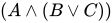 Well-formed formulaIn mathematical logic, propositional logic, and predicate logic, a well-formed formula, abbreviated WFF or wff, often simply formula, is a finite sequence of symbols from a given alphabet, constructed following the defined grammar of a formal language. The abbreviation wff is pronounced "woof", or sometimes "wiff", "weff", or "whiff". A formal language can be identified with the set of formulas in the language.
 Automated theorem provingAutomated theorem proving (also known as ATP or automated deduction) is a subfield of automated reasoning and mathematical logic dealing with proving mathematical theorems by computer programs. Automated reasoning over mathematical proof was a major motivating factor for the development of computer science.
*As an Amazon Associate I earn from qualifying purchases.