 Sequentially compact spaceIn mathematics, a topological spaceX{\displaystyle X} is sequentially compact if every sequence of points in X{\displaystyle X} has a convergentsubsequence converging to a point in X{\displaystyle X}. Every metric space is naturally a topological space, and for metric spaces, the notions of compactness and sequential compactness are equivalent (using the axiom of countable choice).
 General topologyIn mathematics, general topology (or point set topology) is the branch of topology that deals with the basic set-theoretic definitions and constructions used in topology. It is the foundation of most other branches of topology, including differential topology, geometric topology, and algebraic topology.
 Topological spaceIn mathematics, a topological space is, roughly speaking, a space in which closeness is defined but cannot necessarily be measured by a numeric distance. More specifically, a topological space is a set whose elements are called points, along with an additional structure called a topology, which can be defined as a set of neighbourhoods for each point that satisfy some axioms formalizing the concept of closeness.
 Extreme value theoremIn real analysis, the extreme value theorem states that if a real-valued function f {\displaystyle f} is continuous on the closed and bounded interval [ a , b ] {\displaystyle [a,b]} , then f {\displaystyle f} must attain a maximum and a minimum, each at least once. That is, there exist numbers c {\displaystyle c} and d {\displaystyle d} in [ a , b ] {\displaystyle [a,b]} such that: f ( d ) ≤ f ( x ) ≤ f ( c ) ∀ x ∈ [ a , b ] .
 Euclidean spaceEuclidean space is the fundamental space of geometry, intended to represent physical space. Originally, in Euclid's Elements, it was the three-dimensional space of Euclidean geometry, but in modern mathematics there are Euclidean spaces of any positive integer dimensionn, which are called Euclidean n-spaces when one wants to specify their dimension. For n equal to one or two, they are commonly called respectively Euclidean lines and Euclidean planes.
 SubsequenceMathematical binary relation In mathematics, a subsequence of a given sequence is a sequence that can be derived from the given sequence by deleting some or no elements without changing the order of the remaining elements.
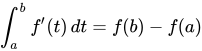 Continuous functionMathematical function with no sudden changes
 Finite setIn mathematics, a finite set is a collection of finitely many different things; the things are called elements or members of the set and are typically mathematical objects, such as numbers, symbols, points in space, lines, other geometric shapes, variables, or other sets. Informally, a finite set is a set which one could in principle count and finish counting. For example, { 2 , 4 , 6 , 8 , 10 } {\displaystyle \{2,4,6,8,10\}} is a finite set with five elements.
 SequenceIn mathematics, a sequence is a collection of objects possibly with repetition, that come in a specified order. Like a set, it contains members (also called elements, or terms). Unlike a set, the same elements can appear multiple times at different positions in a sequence, and unlike a set, the order does matter. The notion of a sequence can be generalized to an indexed family, defined as a function from an arbitrary index set.
 MathematicsMathematics is a field of knowledge concerned with abstract concepts such as numbers, geometric shapes, sets, functions, and probabilities. It uses logical reasoning and proof to study and establish their properties, often expressed as theorems, formulas, and equations. Mathematics is used to model and solve problems in science, engineering, technology, economics, and everyday life.
 Mathematical analysisMathematical analysis is the branch of mathematics that studies functions, spaces, and operators through methods of approximation and convergence. It grew out of calculus, especially the use of derivatives and integrals to study variable quantities, and in the 19th century its foundations were reformulated with greater rigor. Basic objects of study in mathematical analysis include the real numbers, functions, sequences, series, and limits.
 Pigeonhole principleIn mathematics, the pigeonhole principle states that if n items are put into m containers, with n > m, then at least one container must contain more than one item. For example, of three gloves, at least two must be right-handed or at least two must be left-handed, because there are three objects but only two categories of handedness to put them into. This seemingly obvious statement, a type of counting argument, can be used to demonstrate possibly unexpected results.
*As an Amazon Associate I earn from qualifying purchases.