 Concrete categoryIn mathematics, a concrete category is a category that is equipped with a faithful functor to the category of sets (or sometimes to another category). This functor makes it possible to think of the objects of the category as sets with additional structure, and of its morphisms as structure-preserving functions.
 Category of setsIn the mathematical field of category theory, the category of sets, denoted by Set, is the category whose objects are sets. The arrows or morphisms between sets A and B are the functions from A to B, and the composition of morphisms is the composition of functions. Many other categories (such as the category of groups, with group homomorphisms as arrows) add structure to the objects of the category of sets or restrict the arrows to functions of a particular kind (or both).
 Category theoryCategory theory is a general theory of mathematical structures and their relations. It was introduced by Samuel Eilenberg and Saunders Mac Lane in the mid-20th century in their foundational work on algebraic topology. Category theory can be used in most areas of mathematics. In particular, many constructions of new mathematical objects from previous ones that appear similarly in several contexts are conveniently expressed and unified in terms of categories.
 Equivalence of categoriesIn category theory, a branch of abstract mathematics, an equivalence of categories is a relation between two categories that establishes that these categories are "essentially the same". There are numerous examples of categorical equivalences from many areas of mathematics. Establishing an equivalence involves demonstrating strong similarities between the mathematical structures concerned.
 Set (mathematics)In mathematics, a set is a collection of different things; the things are called elements or members of the set and are typically mathematical objects: numbers, symbols, points in space, lines, other geometric shapes, variables, functions, or even other sets. Mathematics typically does not define precisely what constitutes a "set" or "collection", because such a definition would have to be in terms of something else previously defined.
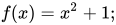 Function (mathematics)Association of one output to each inputIn mathematics, a function from a setX to a set Y assigns to each element of X exactly one element of Y. The set X is called the domain of the function and the set Y is called the codomain of the function. Functions were originally the idealization of how a varying quantity depends on another quantity. For example, the position of a planet is a function of time.FunctorIn mathematics, specifically category theory, a functor is a mapping between categories. Functors were first considered in algebraic topology, where algebraic objects (such as the fundamental group) are associated to topological spaces, and maps between these algebraic objects are associated to continuous maps between spaces. Nowadays, functors are used throughout modern mathematics to relate various categories.
 Set theorySet theory is the branch of mathematical logic that studies sets, which can be informally described as collections of objects. Although objects of any kind can be collected into a set, set theory, as a branch of mathematics, is mostly concerned with objects that are relevant to mathematics as a whole.
 MathematicsField of knowledgeIlluminated letter P at the beginning of Adelard of Bath's translation of Euclid's Elements, which starts "Punctum est illud cui pars non est" ('A point is that which has no part'). Geometry is shown personified as a woman, following Martianus Capella's De nuptiis Philologiae et Mercurii.Mathematics is a field of knowledge concerned with abstract concepts such as numbers, geometric shapes, sets, functions, and probabilities.
 Associative propertyIn mathematics, the associative property is a property of some binary operations that rearranging the parentheses in an expression will not change the result. In propositional logic, associativity is a validrule of replacement for expressions in logical proofs. Within an expression containing two or more occurrences in a row of the same associative operator, the order in which the operations are performed does not matter as long as the sequence of the operands is not changed.
 Computer scienceComputer science is the study of computation, information, and automation. Included broadly in the sciences, computer science spans theoretical disciplines (such as algorithms, theory of computation, and information theory) to applied disciplines (including the design and implementation of hardware and software). An expert in the field is known as a computer scientist. Algorithms and data structures are central to computer science.Semantics (programming languages)Semantics ofprogramming languagesLanguageLinguisticsIn programming language theory, semantics is the rigorous mathematical logic study of the meaning of programming languages. Semantics assigns computational meaning to valid strings in a programming language syntax. It is closely related to, and often crosses over with, the semantics of mathematical proofs. Semantics describes the processes a computer follows when executing a program in that specific language.
*As an Amazon Associate I earn from qualifying purchases.