 PorosityPorosity or void fraction is a measure of the void (i.e. "empty") spaces in a material, and is a fraction of the volume of voids over the total volume, between 0 and 1, or as a percentage between 0% and 100%. Strictly speaking, some tests measure the "accessible void", the total amount of void space accessible from the surface (cf.closed-cell foam). There are many ways to test porosity in a substance or part, such as industrial CT scanning.
 Granular materialExamples of granular materialsA granular material is a conglomeration of discrete solid, macroscopicparticles characterized by a loss of energy whenever the particles interact (the most common example would be friction when grains collide). The constituents that compose granular material are large enough such that they are not subject to thermal motion fluctuations.
 SolidSolid is a state of matter in which atoms are closely packed and are difficult to move past each other. Solids resist compression, expansion, or external forces that would alter its shape, with the degree of resistance being dependent upon the specific material under consideration.
 MassMass is an intrinsic physical quantity of a body which in modern physics is generally defined as the strength of an object's gravitational attraction to other bodies. The unit of mass in the International System of Units (SI) is the kilogram (kg). Mass can also be understood as a measure of the energy content of a body (see E=mc²).
 PowderA powder is a dry solid composed of many very fine particles that may flow freely when shaken or tilted. Powders are a special sub-class of granular materials, although the terms powder and granular are sometimes used to distinguish separate classes of material. In particular, powders refer to those granular materials that have the finer grain sizes, and that therefore have a greater tendency to form clumps when flowing.
 GravelGravel () is a loose aggregation of rock fragments. Gravel occurs naturally on Earth as a result of sedimentary and erosive geological processes; it is also produced in large quantities commercially as crushed stone. Gravel is classified by particle size range and includes size classes from granule- to boulder-sized fragments. In the Udden-Wentworth scale gravel is categorized into granular gravel (2–4 mm or 0.079–0.157 in) and pebble gravel (4–64 mm or 0.2–2.5 in).
 MineralCrystalline chemical element or compound formed by geologic processesCrystals of serandite, natrolite, analcime, and aegirine from Mont Saint-Hilaire, Quebec, CanadaIn geology and mineralogy, a mineral or mineral species is, broadly speaking, a solid substance with a fairly well-defined chemical composition and a specific crystal structure that occurs naturally in pure form. The geological definition of mineral normally excludes compounds that occur only in living organisms.
 SoilEarth, a natural materialSurface-water-gley developed in glacial till in Northern IrelandSoil, also commonly referred to as earth, is a mixture of organic matter, minerals, gases, water, and organisms that together support the life of plants and soil organisms. Some scientific definitions distinguish dirt from soil by restricting the former term specifically to displaced soil.
 Materials scienceMaterials science is an interdisciplinary field concerned with understanding the relationships between the structure of materials and their properties and using this knowledge to design materials for specific applications. The internal structure of a material—from atomic arrangements to microscopic features—strongly influences its mechanical, electrical, thermal, and optical behavior.
 VolumeVolume is a measure of regions in three-dimensional space. It is often quantified numerically using SI derived units (such as the cubic metre and litre) or by various imperial or US customary units (such as the gallon, quart, cubic inch). The definition of length and height (cubed) is interrelated with volume.List of materials propertiesA material property is an intensive property of a material, i.e., a physical property or chemical property that does not depend on the amount of the material. These quantitative properties may be used as a metric by which the benefits of one material versus another can be compared, thereby aiding in materials selection. A property having a fixed value for a given material or substance is called material constant or constant of matter.
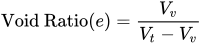 Void (composites)A void or a pore is three-dimensional region that remains unfilled with polymer and fibers in a composite material. Voids are typically the result of poor manufacturing of the material and are generally deemed undesirable. Voids can affect the mechanical properties and lifespan of the composite. They degrade mainly the matrix-dominated properties such as interlaminar shear strength, longitudinal compressive strength, and transverse tensile strength.
*As an Amazon Associate I earn from qualifying purchases.