 Homogeneous relationIn mathematics, a homogeneous relation (also called endorelation) on a set X is a binary relation between X and itself, i.e. it is a subset of the Cartesian productX × X. This is commonly phrased as "a relation on X" or "a (binary) relation over X". An example of a homogeneous relation is the relation of kinship, where the relation is between people. Common types of endorelations include orders, graphs, and equivalences.
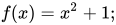 Function (mathematics)Association of one output to each inputIn mathematics, a function from a setX to a set Y assigns to each element of X exactly one element of Y. The set X is called the domain of the function and the set Y is called the codomain of the function. Functions were originally the idealization of how a varying quantity depends on another quantity. For example, the position of a planet is a function of time.
 Ordered pairIn mathematics, an ordered pair, denoted (a, b), is a pair of objects in which their order is significant. If a and b are different, then (a,b) is different from (b,a). In contrast, the unordered pair {a,b} always equals the unordered pair {b,a}. Ordered pairs are also called 2-tuples, or sequences (sometimes, lists in a computer science context) of length 2.
 CodomainIn mathematics, a codomain or set of destination of a function is a set into which all of the outputs of the function are constrained to fall. It is the set Y in the notation f : X → Y. The term range is sometimes ambiguously used to refer to either the codomain or the image of a function. A codomain is part of a function f if f is defined as a triple (X, Y, G) where X is called the domain of f, Y its codomain, and G its graph.
 Prime numberNumber divisible only by 1 and itselfComposite numbers can be arranged into rectangles but prime numbers cannot.A prime number (or a prime) is a natural number greater than 1 that is not a product of two smaller natural numbers. A natural number greater than 1 that is not prime is called a composite number. For example, 5 is prime because the only ways of writing it as a product, 1 × 5 or 5 × 1, involve 5 itself.IntegerAn integer is the number zero (0), a positive natural number (1, 2, 3, ...), or the negation of a positive natural number (−1, −2, −3, ...). The negations or additive inverses of the positive natural numbers are referred to as negative integers. The set of all integers is often denoted by the boldface Z or blackboard bold Z {\displaystyle \mathbb {Z} } .
 Set (mathematics)In mathematics, a set is a collection of different things; the things are called elements or members of the set and are typically mathematical objects: numbers, symbols, points in space, lines, other geometric shapes, variables, functions, or even other sets. Mathematics typically does not define precisely what constitutes a "set" or "collection", because such a definition would have to be in terms of something else previously defined.
 Multiple (mathematics)In mathematics, a multiple is the product of any quantity and an integer. In other words, for the quantities a{\displaystyle a} and b{\displaystyle b}, it can be said that b{\displaystyle b} is a multiple of a{\displaystyle a} if b=n⋅a{\displaystyle b=n\cdot a} for some integer n, which is called the multiplier. If a{\displaystyle a} is not zero, this is equivalent to saying that b/a{\displaystyle b/a} is an integer.
 If and only ifIn logic and related fields such as mathematics and philosophy, "if and only if" (often shortened as "iff") states that the truth values of two statements are equal. It is paraphrased by the biconditional, a logical connective between statements. The biconditional is true in two cases, where either both statements are true or both are false.
 MathematicsMathematics is a field of knowledge concerned with abstract concepts such as numbers, geometric shapes, sets, functions, and probabilities. It uses logical reasoning and proof to study and establish their properties, often expressed as theorems, formulas, and equations. Mathematics is used to model and solve problems in science, engineering, technology, economics, and everyday life.
 DivisorIn mathematics, a divisor of an integern,{\displaystyle n,} also called a factor of n,{\displaystyle n,} is an integer m{\displaystyle m} that may be multiplied by some integer to produce n.{\displaystyle n.} In this case, one also says that n{\displaystyle n} is a multiple of m.{\displaystyle m.} An integer n{\displaystyle n} is divisible or evenly divisible by another integer m{\displaystyle m} if m{\displaystyle m} is a divisor of n{\displaystyle n}; this implies dividing n{\displaystyle n} by m{\displaystyle m} leaves no remainder.
*As an Amazon Associate I earn from qualifying purchases.