 Order of approximationIn science, engineering, and other quantitative disciplines, order of approximation refers to formal or informal expressions for how accurate an approximation is in terms of the number of parameters used to construct the approximation. This article focuses on the approximation of smooth real-valued functions of one variable – the notion extends to functions between other spaces, such as between Euclidean spaces of varying dimension.
 Domain of a functionIn mathematics, the domain of a function is the set of inputs accepted by the function. It is sometimes denoted by dom(f){\displaystyle \operatorname {dom} (f)} or domf{\displaystyle \operatorname {dom} f}, where f is the function. In layman's terms, the domain of a function can generally be thought of as "what x can be".
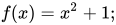 Function (mathematics)Association of one output to each inputIn mathematics, a function from a setX to a set Y assigns to each element of X exactly one element of Y. The set X is called the domain of the function and the set Y is called the codomain of the function. Functions were originally the idealization of how a varying quantity depends on another quantity. For example, the position of a planet is a function of time.
 Prime number theoremCharacterization of how many integers are prime without a subscript base should be interpreted as a natural logarithm, also commonly written as ln(x){\displaystyle \ln(x)} or loge(x){\displaystyle \log _{e}(x)}.In mathematics, the prime number theorem (PNT) describes the asymptotic distribution of prime numbers among the positive integers.
 Analytic number theoryIn mathematics, analytic number theory is a branch of number theory that uses methods from mathematical analysis to solve problems about the integers. It is often said to have begun with Peter Gustav Lejeune Dirichlet's 1837 introduction of Dirichlet L-functions to give the first proof of Dirichlet's theorem on arithmetic progressions.
 Computer scienceStudy of computationFundamental areas of computer scienceProgramming language theoryComputer architectureArtificial intelligenceComputational complexity theoryComputer science is the study of computation, information, and automation, together with their associated phenomena.Arithmetic functionIn number theory, an arithmetic, arithmetical, or number-theoretic function is generally any function whose domain is the set of positive integers and whose range is a subset of the complex numbers. Hardy & Wright include in their definition the requirement that an arithmetical function "expresses some arithmetical property of n". There is a larger class of number-theoretic functions that do not fit this definition, for example, the prime-counting functions.
 Mathematical notationMathematical notation consists of using symbols for representing operations, unspecified numbers, relations, and any other mathematical objects and assembling them into expressions and formulas. Mathematical notation is widely used in mathematics, science, and engineering for representing complex concepts and properties in a concise, unambiguous, and accurate way.
 Computational complexity theoryIn theoretical computer science and mathematics, computational complexity theory focuses on classifying computational problems according to their resource usage, and explores the relationships between these classifications. A computational problem is a task solved by a computer and is solvable by mechanical application of mathematical steps, such as an algorithm.Edmund LandauEdmund Georg Hermann Landau (14 February 1877 – 19 February 1938) was a German mathematician who worked in the fields of number theory and complex analysis. BiographyEdmund Landau was born to a Jewish family in Berlin. His father was Leopold Landau, a gynecologist, and his mother was Johanna Jacoby.
 Mathematical analysisMathematical analysis is the branch of mathematics that studies functions, spaces, and operators through methods of approximation and convergence. It grew out of calculus, especially the use of derivatives and integrals to study variable quantities, and in the 19th century its foundations were reformulated with greater rigor. Basic objects of study in mathematical analysis include the real numbers, functions, sequences, series, and limits.
 Paul Gustav Heinrich BachmannPaul Gustav Heinrich Bachmann (22 June 1837 – 31 March 1920) was a German mathematician.
*As an Amazon Associate I earn from qualifying purchases.