 Hash tableIn computer science, a hash table is a data structure that implements an associative array, also called a dictionary or simply map; an associative array is an abstract data type that maps keys to values. A hash table uses a hash function to compute an index, also called a hash code, into an array of buckets or slots, from which the desired value can be found. During lookup, the key is hashed and the resulting hash indicates where the corresponding value is stored.
 Binary search treeIn computer science, a binary search tree (BST), also called an ordered or sorted binary tree, is a rootedbinary treedata structure with the key of each internal node being greater than all the keys in the respective node's left subtree and less than the ones in its right subtree. The time complexity of operations on the binary search tree is linear with respect to the height of the tree.
 Search treeIn computer science, a search tree is a tree data structure used for locating specific keys from within a set. In order for a tree to function as a search tree, the key for each node must be greater than any keys in subtrees on the left, and less than any keys in subtrees on the right. The advantage of search trees is their efficient search time given the tree is reasonably balanced, which is to say the leaves at either end are of comparable depths.
 Array (data structure)In computer science, an array is a data structure consisting of a collection of elements (values or variables), of the same memory size, each identified by at least one array index or key, the collection of which may be a tuple, known as an index tuple. In general, an array is a mutable and linear collection of elements with the same data type.Data structureIn computer science, a data structure is a way to organize and store data that is usually chosen for efficient access to data. More precisely, a data structure is the physical implementation of a data type, including specifications of the data organization and storage format, as well as functions or operations for working with this data. Data structures are closely related to abstract data types (ADTs).Abstract data typeIn computer science, an abstract data type (ADT) is a mathematical model for data types, defined by its behavior (semantics) from the point of view of a user of the data, specifically in terms of possible values, possible operations on data of this type, and the behavior of these operations. This mathematical model contrasts with data structures, which are concrete representations of data, and represent the point of view of an implementer, not a user.
 Collection (abstract data type)In computer programming, a collection is an abstract data type that is a grouping of items that can be used in a polymorphic way. Often, the items are of the same data type such as int or string. Sometimes the items derive from a common type; even deriving from the most general type of a programming language such as object or variant.Primitive data typeIn computer science, primitive data types are sets of basic data types from which all other data types are constructed. Specifically it often refers to the limited set of data representations in use by a particular processor, which all compiled programs must use. Most processors support a similar set of primitive data types, although the specific representations vary.
 Name–value pairA name–value pair, also known as an attribute–value pair, key–value pair, or field–value pair, is a fundamental data representation in computer systems and applications. Designers often desire an open-ended data structure that allows for future extension without modifying existing code or data.
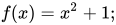 Function (mathematics)Association of one output to each inputIn mathematics, a function from a setX to a set Y assigns to each element of X exactly one element of Y. The set X is called the domain of the function and the set Y is called the codomain of the function. Functions were originally the idealization of how a varying quantity depends on another quantity. For example, the position of a planet is a function of time.
 Computer scienceComputer science is the study of computation, information, and automation. Included broadly in the sciences, computer science spans theoretical disciplines (such as algorithms, theory of computation, and information theory) to applied disciplines (including the design and implementation of hardware and software). An expert in the field is known as a computer scientist. Algorithms and data structures are central to computer science.
 Domain of a functionIn mathematics, the domain of a function is the set of inputs accepted by the function. It is sometimes denoted by dom(f){\displaystyle \operatorname {dom} (f)} or domf{\displaystyle \operatorname {dom} f}, where f is the function. In layman's terms, the domain of a function can generally be thought of as "what x can be".
 associative arrayRelated word or term.
*As an Amazon Associate I earn from qualifying purchases.