Mikoyan-Gurevich MiG-17 on:
[Wikipedia]
[Google]
[Amazon]
The Mikoyan-Gurevich MiG-17 (;

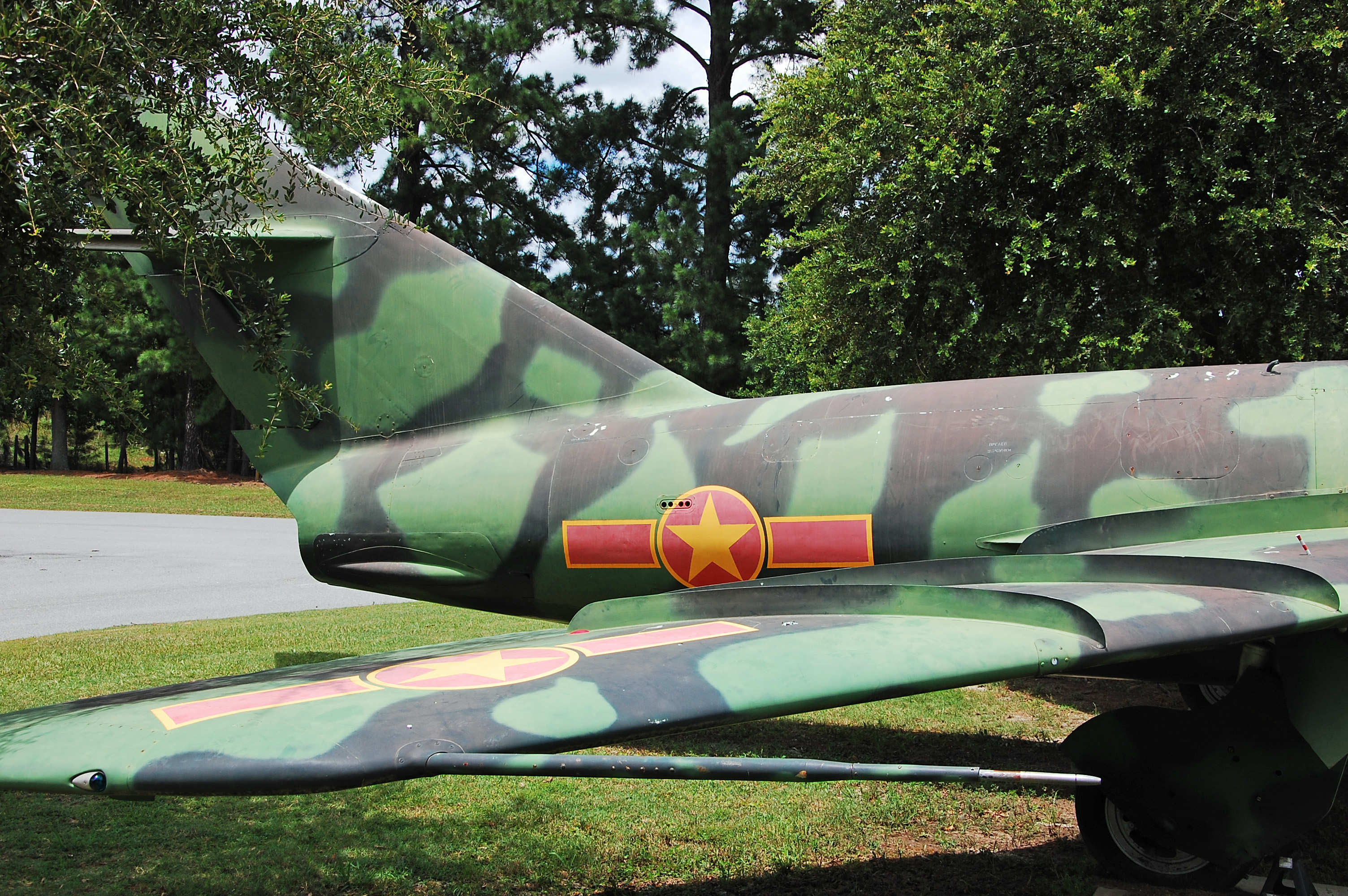 In the midst of testing, pilot Ivan Ivashchenko was killed when his aircraft developed flutter, which tore off his horizontal tail, causing a spin and crash on 17 March 1950. Lack of wing stiffness also resulted in aileron reversal which was discovered and fixed. Construction and tests of additional prototypes "SI-2" and experimental series aircraft "SI-02" and "SI-01" in 1951, were generally successful. On 1 September 1951, the aircraft was accepted for production, and formally given its own MiG-17 designation after so many changes from the original MiG-15. It was estimated that with the same engine as the MiG-15's, the MiG-17's maximum speed is higher by 40–50 km/h, and the fighter has greater maneuverability at high altitude.
Serial production started in August 1951, but large quantity production was delayed in favor of producing more MiG-15s so it was never introduced in the Korean War. It did not enter service until October 1952, when the MiG-19 was almost ready to be flight tested. During production, the aircraft was improved and modified several times. The basic MiG-17 was a general-purpose day fighter, armed with three
In the midst of testing, pilot Ivan Ivashchenko was killed when his aircraft developed flutter, which tore off his horizontal tail, causing a spin and crash on 17 March 1950. Lack of wing stiffness also resulted in aileron reversal which was discovered and fixed. Construction and tests of additional prototypes "SI-2" and experimental series aircraft "SI-02" and "SI-01" in 1951, were generally successful. On 1 September 1951, the aircraft was accepted for production, and formally given its own MiG-17 designation after so many changes from the original MiG-15. It was estimated that with the same engine as the MiG-15's, the MiG-17's maximum speed is higher by 40–50 km/h, and the fighter has greater maneuverability at high altitude.
Serial production started in August 1951, but large quantity production was delayed in favor of producing more MiG-15s so it was never introduced in the Korean War. It did not enter service until October 1952, when the MiG-19 was almost ready to be flight tested. During production, the aircraft was improved and modified several times. The basic MiG-17 was a general-purpose day fighter, armed with three
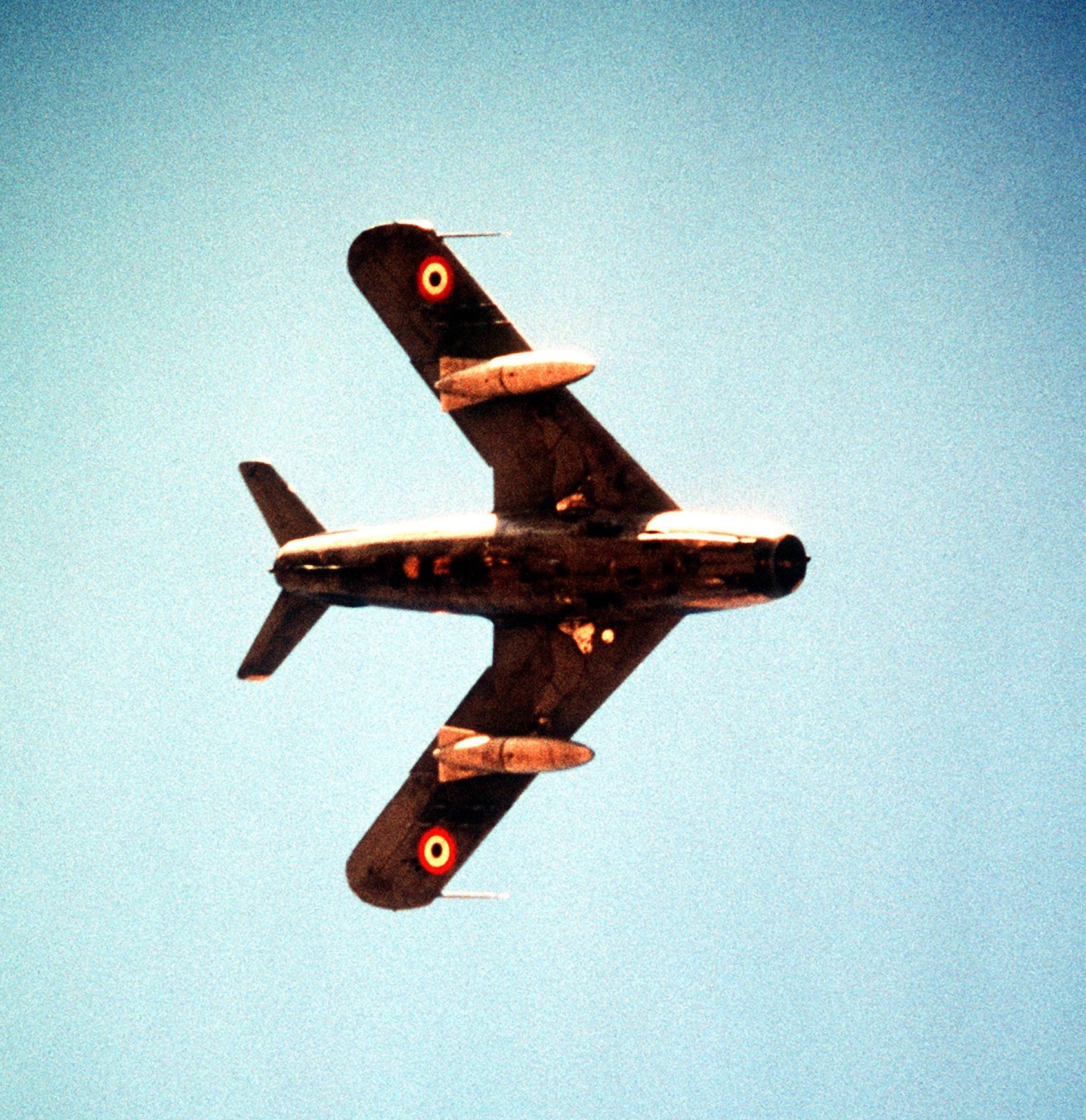 MiG-17s were designed to intercept straight-and-level-flying enemy bombers, not for dogfighting with other fighters. This subsonic (Mach .93) fighter was effective against slower (Mach .6-.8), heavily loaded U.S. fighter-bombers, as well as the mainstay American strategic bombers during the MiG-17's development cycle (such as the Boeing B-50 Superfortress or
''National Vigilance Park- NSA/CSS'' via ''nsa.gov,'' 15 January 2009. Retrieved: 15 September 2012.
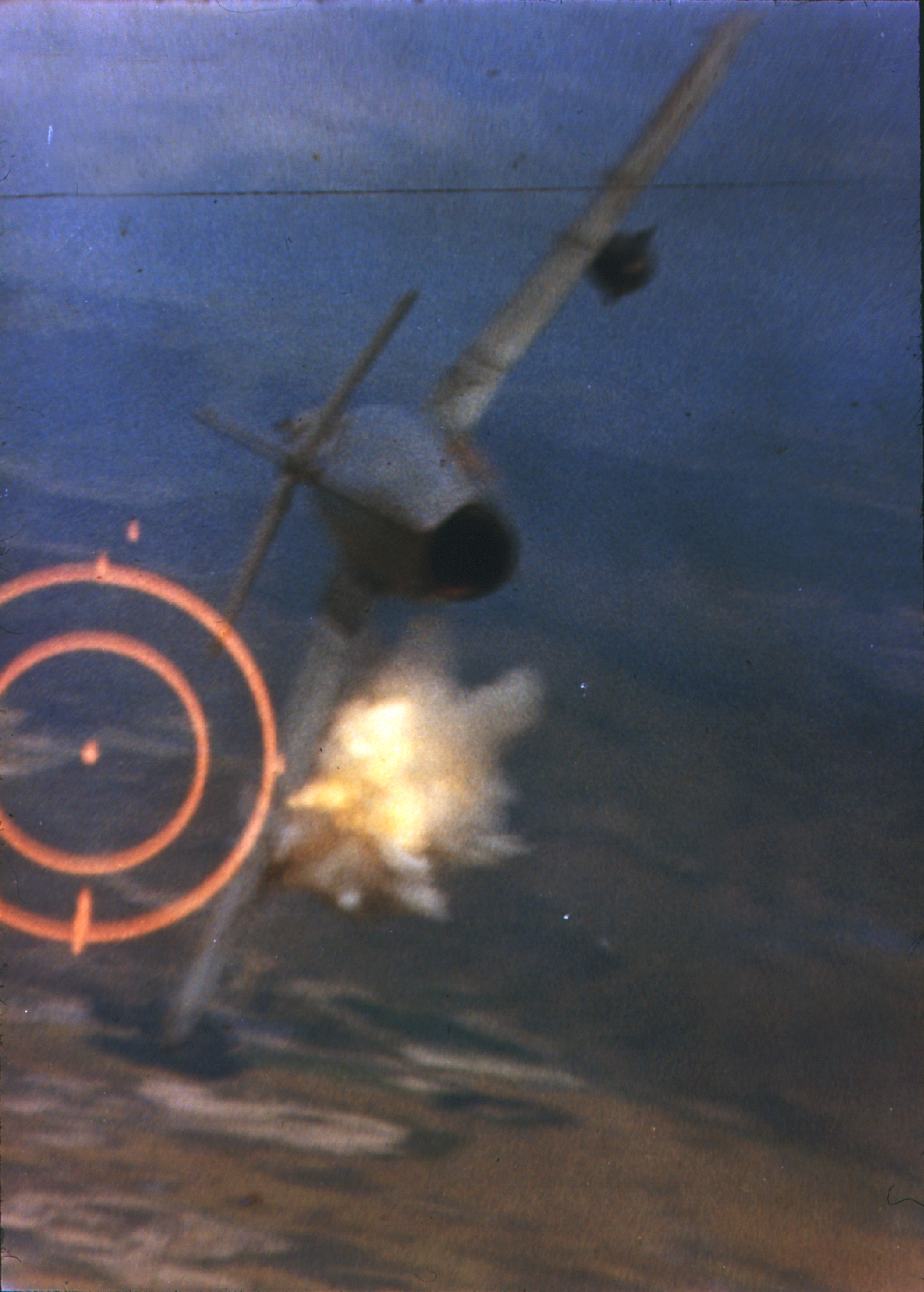 American fighter-bombers had been in theatre flying combat sorties since 1961, and the U.S. had many experienced pilots from the Korean War and
 Twenty countries flew MiG-17s. The MiG-17 became a standard fighter in all
 The
The
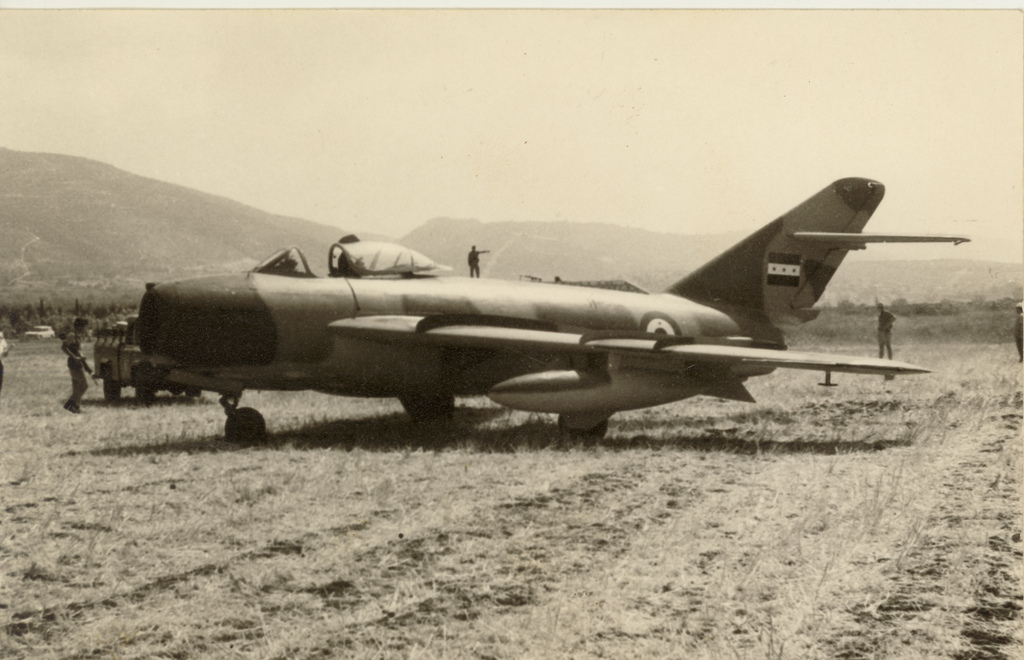
 A number of U.S. federal agencies undertook a program at Groom Lake to evaluate the MiG-17 to help fight the Vietnam War, as the kill ratio against North Vietnamese MiG-17s and MiG-21s was only 2:1. The program was code-named HAVE DRILL (see also Have Doughnut), involving trials of two ex-
 According to the
 ;I-330 (''Samolet'' SI)
:Prototype.
;MiG-17 (''Samolet'' SI, "Fresco A")
:Basic fighter version powered by VK-1 engine.
;''Samolet'' SI-10
:Single MiG-17 modified with new Fowler flaps, leading-edge slats, and other improvements to enhance handling.
;''Samolet'' SI-16
:Testbed for the 57 mm N-57 autocannon.
;''Samolet'' SI-19
:Testbed for the TRS-190 rocket on modified APU-4 pylons.
;MiG-17A
:Fighter version powered by VK-1A engine with longer lifespan.
;MiG-17AS
:Multirole conversion, fitted to carry unguided rockets and the K-13 air-to-air missile.
;''Samolet'' SP-2
:Experimental variant with an afterburning VK-1F engine and a ''Korshun'' interception radar.
;MiG-17P (''Samolet'' SP-7, "Fresco B")
:All-weather fighter version equipped with Izumrud radar. 225 built.
;MiG-17F (''Samolet'' SF, "Fresco C")
:Basic fighter version powered by VK-1F engine with afterburner. 1,685 built.
;I-340 (''Samolet'' SM-1)
:Experimental twin-engined variant powered by two Mikulin AM-5 engines. Developed into the Mikoyan-Gurevich MiG-19.
;MiG-17F (''Samolet'' SR-2)
:Reconnaissance variant of the similarly-designated MiG-17F fighter. Sometimes mistakenly referred to as ''MiG-17R''.
;MiG-17PF (''Samolet'' SP-7F, "Fresco D")
:All-weather fighter version equipped with Izumrud radar, 3 x 23 mm NR-23 cannons and VK-1F engine. 668 built.
;MiG-17PM/PFU (''Samolet'' SP-6, "Fresco E")
:Fighter version equipped with radar and K-5 (NATO: AA-1 "Alkali") air-to-air missiles.
;''Samolet'' SP-8
:Testbed for the SRD-3 ''Grad'' radar.
;''Samolet'' SP-9
:Testbed for the RP-2U ''Izumrud'' radar and the K-5M missile.
;''Samolet'' SP-10
:MiG-17PF converted to a testbed for a pair of unidentified 23 mm guns and the ARS-57 rocket.
;''Samolet'' SN
:Experimental variant with twin side intakes, no central intake, and nose redesigned to allow 23 mm cannons to pivot to engage ground targets.
;M-17
:Target UAV, converting program for MiG-17 with service life at its end (1968).
;Lim-5
:Polish variant of MiG-17
; Lim-6
:Polish attack variant of MiG-17
;S-104
:Czechoslovak variant of MiG-17
; Shenyang J-5
:Chinese variant of MiG-17
Some withdrawn aircraft were converted to remotely controlled targets.
;I-330 (''Samolet'' SI)
:Prototype.
;MiG-17 (''Samolet'' SI, "Fresco A")
:Basic fighter version powered by VK-1 engine.
;''Samolet'' SI-10
:Single MiG-17 modified with new Fowler flaps, leading-edge slats, and other improvements to enhance handling.
;''Samolet'' SI-16
:Testbed for the 57 mm N-57 autocannon.
;''Samolet'' SI-19
:Testbed for the TRS-190 rocket on modified APU-4 pylons.
;MiG-17A
:Fighter version powered by VK-1A engine with longer lifespan.
;MiG-17AS
:Multirole conversion, fitted to carry unguided rockets and the K-13 air-to-air missile.
;''Samolet'' SP-2
:Experimental variant with an afterburning VK-1F engine and a ''Korshun'' interception radar.
;MiG-17P (''Samolet'' SP-7, "Fresco B")
:All-weather fighter version equipped with Izumrud radar. 225 built.
;MiG-17F (''Samolet'' SF, "Fresco C")
:Basic fighter version powered by VK-1F engine with afterburner. 1,685 built.
;I-340 (''Samolet'' SM-1)
:Experimental twin-engined variant powered by two Mikulin AM-5 engines. Developed into the Mikoyan-Gurevich MiG-19.
;MiG-17F (''Samolet'' SR-2)
:Reconnaissance variant of the similarly-designated MiG-17F fighter. Sometimes mistakenly referred to as ''MiG-17R''.
;MiG-17PF (''Samolet'' SP-7F, "Fresco D")
:All-weather fighter version equipped with Izumrud radar, 3 x 23 mm NR-23 cannons and VK-1F engine. 668 built.
;MiG-17PM/PFU (''Samolet'' SP-6, "Fresco E")
:Fighter version equipped with radar and K-5 (NATO: AA-1 "Alkali") air-to-air missiles.
;''Samolet'' SP-8
:Testbed for the SRD-3 ''Grad'' radar.
;''Samolet'' SP-9
:Testbed for the RP-2U ''Izumrud'' radar and the K-5M missile.
;''Samolet'' SP-10
:MiG-17PF converted to a testbed for a pair of unidentified 23 mm guns and the ARS-57 rocket.
;''Samolet'' SN
:Experimental variant with twin side intakes, no central intake, and nose redesigned to allow 23 mm cannons to pivot to engage ground targets.
;M-17
:Target UAV, converting program for MiG-17 with service life at its end (1968).
;Lim-5
:Polish variant of MiG-17
; Lim-6
:Polish attack variant of MiG-17
;S-104
:Czechoslovak variant of MiG-17
; Shenyang J-5
:Chinese variant of MiG-17
Some withdrawn aircraft were converted to remotely controlled targets.

 * Air Forces of the National People's ArmyGordon 2002, p. 82
;
*
* Air Forces of the National People's ArmyGordon 2002, p. 82
;
*  ;
* Hungarian People's Army Air ForceGordon 2002, p. 87
;
*
;
* Hungarian People's Army Air ForceGordon 2002, p. 87
;
* 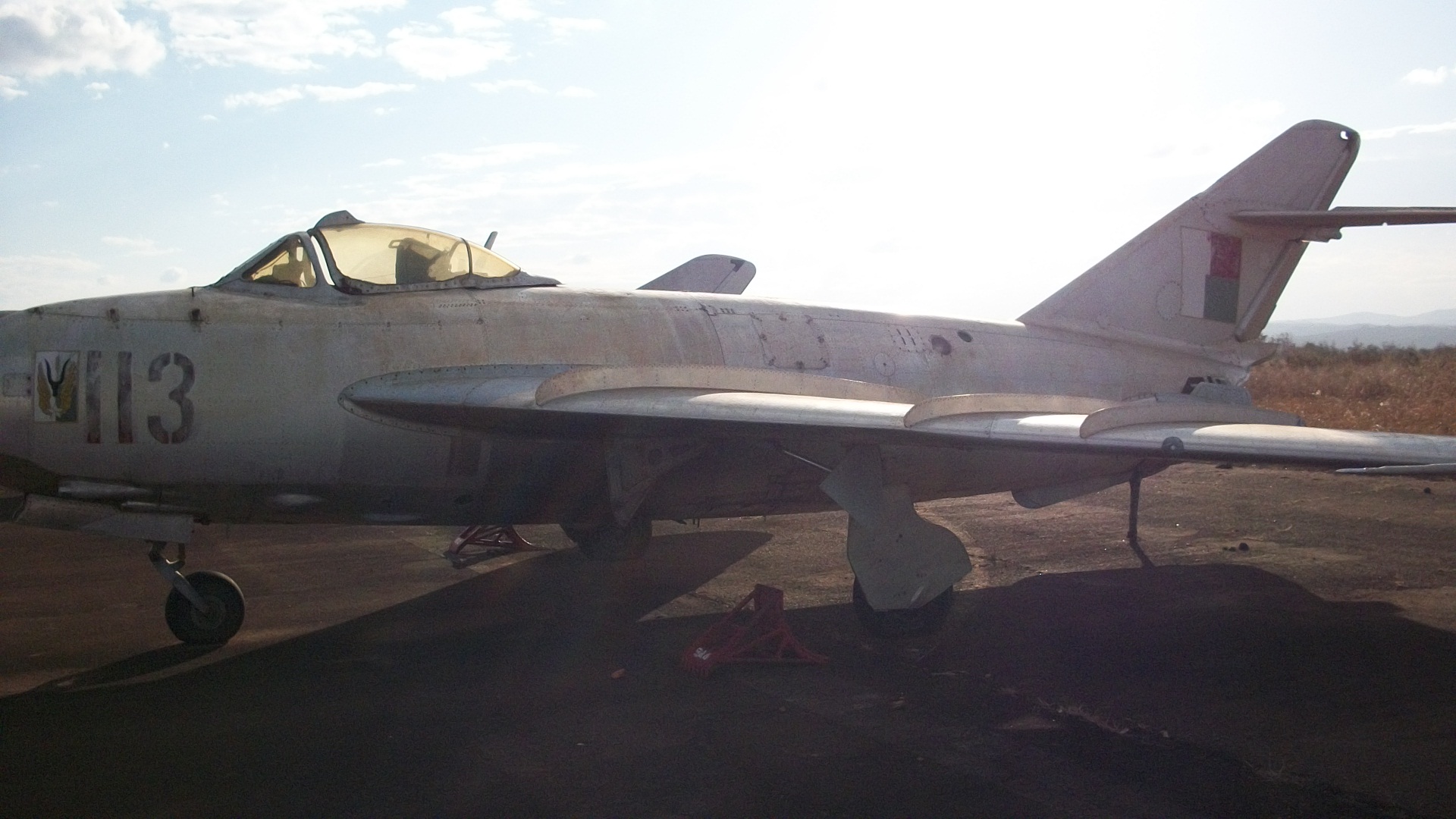 * Malagasy Air Force – 4 delivered in 1975 from North Korea.
;
* Malian Air Force
;
* Mongolian People's Army Air ForceGordon 2002, p. 89
;
*
* Malagasy Air Force – 4 delivered in 1975 from North Korea.
;
* Malian Air Force
;
* Mongolian People's Army Air ForceGordon 2002, p. 89
;
* 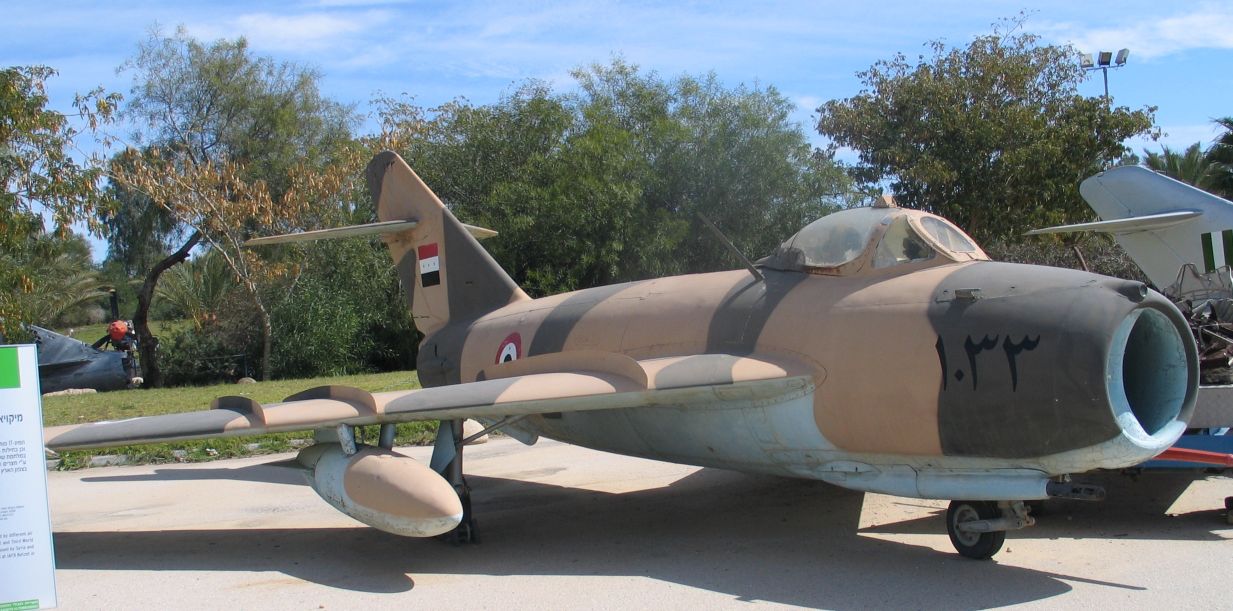 * Syrian Air Force
;
* Ugandan Air Force – Some ex-Czech; serviceability doubtful.
;
* Syrian Air Force
;
* Ugandan Air Force – Some ex-Czech; serviceability doubtful.
;
 * Formerly used for evaluation in the

MiG-17 Fresco from Global Aircraft
MiG 17: Home of a True Fighter
Lethal Snakes - Russian viewpoint Mig-17 tactics
Blueprints 3-view
{{Authority control MiG-017 1950s Soviet fighter aircraft Single-engined jet aircraft Mid-wing aircraft Aircraft first flown in 1950 Aircraft with retractable tricycle landing gear
NATO reporting name
NATO uses a system of code names, called reporting names, to denote military aircraft and other equipment used by post-Soviet states, former Warsaw Pact countries, China, and other countries. The system assists military communications by providi ...
: Fresco) is a high-subsonic fighter aircraft
Fighter aircraft (early on also ''pursuit aircraft'') are military aircraft designed primarily for air-to-air combat. In military conflict, the role of fighter aircraft is to establish air supremacy, air superiority of the battlespace. Domina ...
produced in the Soviet Union from 1952 and was operated by air forces internationally. The MiG-17 was license-built in China
China, officially the People's Republic of China (PRC), is a country in East Asia. With population of China, a population exceeding 1.4 billion, it is the list of countries by population (United Nations), second-most populous country after ...
as the Shenyang J-5 and Poland
Poland, officially the Republic of Poland, is a country in Central Europe. It extends from the Baltic Sea in the north to the Sudetes and Carpathian Mountains in the south, bordered by Lithuania and Russia to the northeast, Belarus and Ukrai ...
as the PZL-Mielec Lim-6. The MiG-17 is still being used by the North Korea
North Korea, officially the Democratic People's Republic of Korea (DPRK), is a country in East Asia. It constitutes the northern half of the Korea, Korean Peninsula and borders China and Russia to the north at the Yalu River, Yalu (Amnok) an ...
n air force in the present day and has seen combat in the Middle East
The Middle East (term originally coined in English language) is a geopolitical region encompassing the Arabian Peninsula, the Levant, Turkey, Egypt, Iran, and Iraq.
The term came into widespread usage by the United Kingdom and western Eur ...
and Asia
Asia ( , ) is the largest continent in the world by both land area and population. It covers an area of more than 44 million square kilometres, about 30% of Earth's total land area and 8% of Earth's total surface area. The continent, which ...
.
The MiG-17 was an advanced modification of the MiG-15 aircraft produced by the Soviet Union
The Union of Soviet Socialist Republics. (USSR), commonly known as the Soviet Union, was a List of former transcontinental countries#Since 1700, transcontinental country that spanned much of Eurasia from 1922 until Dissolution of the Soviet ...
during the Korean War
The Korean War (25 June 1950 – 27 July 1953) was an armed conflict on the Korean Peninsula fought between North Korea (Democratic People's Republic of Korea; DPRK) and South Korea (Republic of Korea; ROK) and their allies. North Korea was s ...
. Production of the MiG-17 was too late for use in that conflict and was first used in the Second Taiwan Strait Crisis
The Second Taiwan Strait Crisis, also known as the 1958 Taiwan Strait Crisis, was a conflict between the People's Republic of China (PRC) and the Taiwan, Republic of China (ROC). The PRC shelled the islands of Kinmen (Quemoy) and the Matsu Is ...
in 1958. While the MiG-17 was designed to shoot down slower American bombers, it showed surprising success when used by North Vietnamese pilots to combat American fighters and fighter-bombers during the Vietnam War
The Vietnam War (1 November 1955 – 30 April 1975) was an armed conflict in Vietnam, Laos, and Cambodia fought between North Vietnam (Democratic Republic of Vietnam) and South Vietnam (Republic of Vietnam) and their allies. North Vietnam w ...
, nearly a decade after its initial design. This was due to the MiG-17 being more agile and maneuverable than the American F-4 Phantom and F-105 Thunderchief
The Republic F-105 Thunderchief is an American fighter-bomber that served with the United States Air Force from 1958 to 1984. Capable of Mach 2, it conducted the majority of strike bombing missions during the early years of the Vietnam War. It ...
, which were focused on speed and long range combat, as well as the fact that MiG-17 was armed with guns, which initial models of the F-4 Phantom lacked.
Design and development
While the MiG-15bis introduced swept wings to air combat over Korea, the Mikoyan-Gurevich design bureau had already begun work on its replacement in 1949 (originally the MiG-15bis45) in order to fix any problems found with the MiG-15 in combat. The result was one of the most successful transonic fighters introduced before the advent of true supersonic types such as the Mikoyan-Gurevich MiG-19 andNorth American F-100 Super Sabre
The North American F-100 Super Sabre is an American supersonic jet fighter aircraft designed and produced by the aircraft manufacturer North American Aviation. The first of the Century Series of American jet fighters, it was the first United ...
. The design would ultimately still prove effective into the 1960s when pressed into subsonic dogfights over Vietnam against much faster planes that were not optimized for maneuvering in such slower speed, short-range engagements.
While the MiG-15 used a Mach sensor to deploy airbrakes because it could not safely exceed Mach 0.92, the MiG-17 was designed to be controllable at higher Mach numbers. Early versions that retained the original Soviet copy of the Rolls-Royce Nene
The Rolls-Royce RB.41 Nene is a 1940s British centrifugal compressor turbojet engine. The Nene was a complete redesign, rather than a scaled-up Rolls-Royce Derwent,"Rolls-Royce Aero Engines" Bill Gunston, Patrick Stephens Limited 1989, , p.111 ...
engine, the Klimov VK-1, were heavier with equal thrust. Later MiG-17s would be the first Soviet fighter application of an afterburner
An afterburner (or reheat in British English) is an additional combustion component used on some jet engines, mostly those on military supersonic aircraft. Its purpose is to increase thrust, usually for supersonic flight, takeoff, and combat ...
, which burned extra fuel in the exhaust of the basic engine to give extra thrust at a high efficiency cost.
Though the MiG-17 looks very similar to the MiG-15, it had a new thinner and more highly swept wing
A swept wing is a wing angled either backward or occasionally forward from its root rather than perpendicular to the fuselage.
Swept wings have been flown since the pioneer days of aviation. Wing sweep at high speeds was first investigated in Ge ...
and tailplane for speeds approaching Mach 1. While the F-86 introduced the "all-flying" tailplane, which made the aircraft more controllable near the speed of sound, this feature would not be adopted on MiG aircraft until the fully supersonic MiG-19. The wing sweep was 45° (like the U.S. F-100 Super Sabre) near the fuselage and 42° for the outboard part of the wing.Crosby 2002, p. 212. The stiffer wing resisted the tendency to bend its wingtips and lose aerodynamic symmetry unexpectedly at high speeds and wing loads.
Other easily visible differences to its predecessor were the addition of a third wing fence
A wing is a type of fin that produces both lift and drag while moving through air. Wings are defined by two shape characteristics, an airfoil section and a planform. Wing efficiency is expressed as lift-to-drag ratio, which compares the bene ...
on each wing, the addition of a ventral fin and a longer and less tapered rear fuselage that added about one meter in length. The MiG-17 shared the same Klimov VK-1 engine, and much of the rest of its construction such as the forward fuselage, landing gear and gun installation was carried over. The first prototype, designated I-330 "SI" by the construction bureau, was flown on 14 January 1950, piloted by Ivan Ivashchenko.
In the midst of testing, pilot Ivan Ivashchenko was killed when his aircraft developed flutter, which tore off his horizontal tail, causing a spin and crash on 17 March 1950. Lack of wing stiffness also resulted in aileron reversal which was discovered and fixed. Construction and tests of additional prototypes "SI-2" and experimental series aircraft "SI-02" and "SI-01" in 1951, were generally successful. On 1 September 1951, the aircraft was accepted for production, and formally given its own MiG-17 designation after so many changes from the original MiG-15. It was estimated that with the same engine as the MiG-15's, the MiG-17's maximum speed is higher by 40–50 km/h, and the fighter has greater maneuverability at high altitude.
Serial production started in August 1951, but large quantity production was delayed in favor of producing more MiG-15s so it was never introduced in the Korean War. It did not enter service until October 1952, when the MiG-19 was almost ready to be flight tested. During production, the aircraft was improved and modified several times. The basic MiG-17 was a general-purpose day fighter, armed with three cannons
A cannon is a large-caliber gun classified as a type of artillery, which usually launches a projectile using explosive chemical propellant. Gunpowder ("black powder") was the primary propellant before the invention of smokeless powder during t ...
, one Nudelman N-37 37 mm cannon and two 23 mm with 80 rounds per gun, 160 rounds total. It could also act as a fighter-bomber
A fighter-bomber is a fighter aircraft that has been modified, or used primarily, as a light bomber or attack aircraft. It differs from bomber and attack aircraft primarily in its origins, as a fighter that has been adapted into other roles, wh ...
, but its bomb
A bomb is an explosive weapon that uses the exothermic reaction of an explosive material to provide an extremely sudden and violent release of energy. Detonations inflict damage principally through ground- and atmosphere-transmitted mechan ...
load was considered light relative to other aircraft of the time, and it usually carried additional fuel tanks instead of bombs.
Although a canopy that provided clear vision to the rear—necessary for air-to-air combat
Air combat manoeuvring (ACM) is the Military tactics, tactic of moving, turning, and situating one's fighter aircraft in order to attain a position from which an attack can be made on another aircraft. Commonly associated with dogfighting, air c ...
( dogfighting), like the F-86—was designed, production MiG-17Fs got a cheaper rear-view periscope, which would still appear on Soviet fighters as late as the MiG-23
The Mikoyan-Gurevich MiG-23 (; NATO reporting name: Flogger) is a variable-geometry fighter aircraft, designed by the Mikoyan-Gurevich design bureau in the Soviet Union. It is a third-generation jet fighter, alongside similar Soviet aircra ...
. By 1953, pilots got safer ejection seats with protective face curtains and leg restraints like the Martin-Baker seats in the West. The MiG-15 had suffered for its lack of a radar gunsight, but in 1951, Soviet engineers obtained a captured F-86 Sabre
The North American F-86 Sabre, sometimes called the Sabrejet, is a transonic jet fighter aircraft. Produced by North American Aviation, the Sabre is best known as the United States' first swept-wing fighter that could counter the swept-wing Sov ...
from Korea, and copied the optical gunsight and SRD-3 gun ranging radar to produce the ASP-4N gunsight and SRC-3 radar. The combination would prove deadly over the skies of Vietnam against aircraft such as the F-4 Phantom, whose pilots lamented that guns and radar gunsights had been omitted as obsolescent.Davies, Peter. ''USN F-4 Phantom II Vs VPAF MiG-17: Vietnam 1965-72.'' London: Osprey, 2009. .
The second prototype variant, "SP-2" (dubbed "Fresco A" by NATO), was an interceptor
Interceptor may refer to:
Arts and entertainment
Film and television
* ''The Interceptor'', a British drama series on BBC One
* Interceptor (game show), ''Interceptor'' (game show), a British television game show that ran during 1989
* Interc ...
equipped with a radar
Radar is a system that uses radio waves to determine the distance ('' ranging''), direction ( azimuth and elevation angles), and radial velocity of objects relative to the site. It is a radiodetermination method used to detect and track ...
. Soon a number of MiG-17P ("Fresco B") all-weather fighters were produced with the RP-1 Izumrud radar and front air intake modifications.
In early 1953 the MiG-17F day fighter entered production. The "F" indicated it was fitted with the VK-1F engine with an afterburner
An afterburner (or reheat in British English) is an additional combustion component used on some jet engines, mostly those on military supersonic aircraft. Its purpose is to increase thrust, usually for supersonic flight, takeoff, and combat ...
by modifying the rear fuselage with a new convergent-divergent nozzle and fuel system. Early VK-1F engines that were specifically modified to equip the MIG-17F had issues during prolonged normal afterburner usage, due to the insufficient heat resistance of the alloys used for the external nozzle body and stator vanes. Because of this, early 1953-1955 production planes had a special afterburner unit that used a separate tank filled with 90% ethanol
Ethanol (also called ethyl alcohol, grain alcohol, drinking alcohol, or simply alcohol) is an organic compound with the chemical formula . It is an Alcohol (chemistry), alcohol, with its formula also written as , or EtOH, where Et is the ps ...
for consumption in the afterburner due to its lower combustion temperature. This engine variant was labeled VK-1F(A). Later production jets used a normal system with on-board fuel. The afterburner doubled the rate of climb and greatly improved vertical maneuvers. But while the plane was not designed to be supersonic, skilled pilots could just dash to supersonic speed in a shallow dive, although the aircraft would often pitch up just short of Mach 1. This became the most popular variant of the MiG-17. The next mass-produced variant, MiG-17PF ("Fresco D") incorporated a more powerful Izumrud RP-2 radar, though they were still dependent on Ground Control Interception to find and be directed to targets. In 1956 a small series (47 aircraft) was converted to the MiG-17PM standard (also known as PFU) with four first-generation Kaliningrad K-5 (NATO reporting name
NATO uses a system of code names, called reporting names, to denote military aircraft and other equipment used by post-Soviet states, former Warsaw Pact countries, China, and other countries. The system assists military communications by providi ...
AA-1 'Alkali') air-to-air missile
An air-to-air missile (AAM) is a missile fired from an aircraft for the purpose of destroying another aircraft (including unmanned aircraft such as cruise missiles). AAMs are typically powered by one or more rocket motors, usually solid-fuel roc ...
s. A small series of MiG-17R reconnaissance aircraft were built with VK-1F engine (after first being tested with the VK-5F engine).
5,467 MiG-17, 1,685 MiG-17F, 225 MiG-17P and 668 MiG-17PF were built in the USSR by 1958. Over 2,600 were built under licence in Poland and China.
License production
In 1955,Poland
Poland, officially the Republic of Poland, is a country in Central Europe. It extends from the Baltic Sea in the north to the Sudetes and Carpathian Mountains in the south, bordered by Lithuania and Russia to the northeast, Belarus and Ukrai ...
received a license for MiG-17 production. The MiG-17F was produced by the WSK-Mielec factory under the designation Lim-5 (an abbreviation of ''licencyjny myśliwiec'' – license-built fighter). The first Lim-5 was built on 28 November 1956 and 477 were built by 1960. Apart from Poland, a number were exported to Bulgaria, designated as MiG-17F. An unknown number were built as the Lim-5R reconnaissance
In military operations, military reconnaissance () or scouting is the exploration of an area by military forces to obtain information about enemy forces, the terrain, and civil activities in the area of operations. In military jargon, reconnai ...
variant, fitted with the AFA-39 camera. In 1959–1960, 129 MiG-17PF interceptors were produced as the Lim-5P. WSK-Mielec also developed several Polish strike
Strike may refer to:
People
*Strike (surname)
* Hobart Huson, author of several drug related books
Physical confrontation or removal
*Strike (attack), attack with an inanimate object or a part of the human body intended to cause harm
* Airstrike, ...
variants based on the MiG-17: the Lim-5M, produced from 1960; Lim-6bis, produced from 1963 (totaling 170 aircraft). Additionally some Lim-5Ps were converted in the 1970s into attack Lim-6Ms whereas other Lim-5, Lim-6bis and Lim-5P aircraft were modified for reconnaissance role as the Lim-6R, Lim-6bis R and Lim-6MR.
In the People's Republic of China
China, officially the People's Republic of China (PRC), is a country in East Asia. With population of China, a population exceeding 1.4 billion, it is the list of countries by population (United Nations), second-most populous country after ...
(PRC), an initial MiG-17F was assembled from parts in 1956, with license production following in 1957 at Shenyang
Shenyang,; ; Mandarin pronunciation: ; formerly known as Fengtian formerly known by its Manchu language, Manchu name Mukden, is a sub-provincial city in China and the list of capitals in China#Province capitals, provincial capital of Liaonin ...
. The Chinese-built version is known as the Shenyang J-5 (for local use) or F-5 (for export). Similarly the MiG-17PF was manufactured there as the J-5A (F-5A for export). Altogether 767 of these single-seater variants were built.
Operational history
MiG-17s were designed to intercept straight-and-level-flying enemy bombers, not for dogfighting with other fighters. This subsonic (Mach .93) fighter was effective against slower (Mach .6-.8), heavily loaded U.S. fighter-bombers, as well as the mainstay American strategic bombers during the MiG-17's development cycle (such as the Boeing B-50 Superfortress or Convair B-36 Peacemaker
The Convair B-36 "Peacemaker" is a strategic bomber built by Convair and operated by the United States Air Force (USAF) from 1949 to 1959. The B-36 is the largest mass-produced piston-engined aircraft ever built, although it was exceeded in spa ...
, which were both still powered by piston engines). It was not however able to intercept the new generation of British jet bombers such as the Avro Vulcan
The Avro Vulcan (later Hawker Siddeley Vulcan from July 1963) was a jet-powered, tailless, delta-wing, high-altitude, strategic bomber, which was operated by the Royal Air Force (RAF) from 1956 until 1984. Aircraft manufacturer A.V. Roe ...
and Handley Page Victor
The Handley Page Victor was a British jet-powered strategic bomber developed and produced by Handley Page during the Cold War. It was the third and final ''V bomber'' to be operated by the Royal Air Force (RAF), the other two being the Vickers ...
, which could both fly higher. The USAF's introduction of strategic bombers capable of supersonic dash speeds such as the Convair B-58 Hustler
The Convair B-58 Hustler, designed and produced by American aircraft manufacturer Convair, was the first operational bomber capable of Mach 2 flight.
The B-58 was developed during the 1950s for the United States Air Force (USAF) Strategic Air ...
and General Dynamics FB-111 rendered the MiG-17 obsolete in front-line PVO service, and they were supplanted by supersonic interceptors such as the MiG-21
The Mikoyan-Gurevich MiG-21 (; NATO reporting name: Fishbed) is a supersonic jet aircraft, jet fighter aircraft, fighter and interceptor aircraft, designed by the Mikoyan, Mikoyan-Gurevich OKB, Design Bureau in the Soviet Union. Its nicknames in ...
and MiG-23.
MiG-17s were not available for the Korean War, but saw combat for the first time over the Straits of Taiwan when the Communist PRC MiG-17s clashed with the Republic of China
Taiwan, officially the Republic of China (ROC), is a country in East Asia. The main geography of Taiwan, island of Taiwan, also known as ''Formosa'', lies between the East China Sea, East and South China Seas in the northwestern Pacific Ocea ...
(ROC, Nationalist China) F-86 Sabres in 1958.
MiG-17s downed a spy aircraft in the 1958 C-130 shootdown incident over Armenia, with 17 casualties."The Shootdown of Flight 60528."''National Vigilance Park- NSA/CSS'' via ''nsa.gov,'' 15 January 2009. Retrieved: 15 September 2012.
Vietnam War
In 1960, the first group of approximately 50 North Vietnamese airmen were transferred to the PRC to begin transitional training onto the MiG-17. By this time the first detachment of Chinese trained MiG-15 pilots had returned to North Vietnam, and a group of 31 airmen were deployed to theVietnam People's Air Force
The Vietnam People's Air Force (VPAF; ), officially the Air Defence - Air Force Service (ADAF Service; ) or the Vietnam Air Force (), is the Aerial warfare, aerial, Anti-aircraft warfare, air and Space warfare, space defence service branch of ...
(VPAF) base at Son Dong for conversion to the MiG-17. By 1962 the first North Vietnamese pilots had finished their MiG-17 courses in the Soviet Union
The Union of Soviet Socialist Republics. (USSR), commonly known as the Soviet Union, was a List of former transcontinental countries#Since 1700, transcontinental country that spanned much of Eurasia from 1922 until Dissolution of the Soviet ...
and the PRC, and returned to their units; to mark the occasion, the Soviets sent as a "gift" 36 MiG-17 fighters and MiG-15UTI trainers to Hanoi in February 1964. These airmen would create North Vietnam's first jet fighter regiment, the 921st. By 1965, another group of MiG pilots had returned from training in Krasnodar
Krasnodar, formerly Yekaterinodar (until 1920), is the largest city and the administrative centre of Krasnodar Krai, Russia. The city stands on the Kuban River in southern Russia, with a population of 1,154,885 residents, and up to 1.263 millio ...
, in the USSR, as well as from the PRC. This group would form North Vietnam's second fighter unit, the 923rd Fighter Regiment. While the newly created 923rd FR operated only MiG-17s, and initially these were the only types available to oppose modern American supersonic jets before MiG-21s and MiG-19s were introduced into North Vietnamese service (the 925 FR regiment was formed in 1969, flying MiG-19s).
American fighter-bombers had been in theatre flying combat sorties since 1961, and the U.S. had many experienced pilots from the Korean War and World War II
World War II or the Second World War (1 September 1939 – 2 September 1945) was a World war, global conflict between two coalitions: the Allies of World War II, Allies and the Axis powers. World War II by country, Nearly all of the wo ...
, such as World War II veteran Robin Olds. Untried MiGs and pilots of the VPAF would be pitted against some of the most combat experienced airmen of the U.S. Air Force (USAF) and U.S. Navy. On 3 April 1965 six MiGs took off from Noi Bai Air Base in two groups of two and four respectively, with the first acting as bait and the second being the shooters. Their target were U.S. Navy aircraft supporting an USAF 80-aircraft strike package trying to knock out the Thanh Hóa Bridge. The MiG-17 leader, Lt. Pham Ngoc Lan, attacked a group of Vought F-8 Crusader
The Vought F-8 Crusader (originally F8U) is a single-engine, supersonic, Carrier-based aircraft, carrier-based Air superiority fighter, air superiority jet aircraft designed and produced by the American aircraft manufacturer Vought. It was the ...
s of VF-211 from and damaged an F-8E flown by Lt. Cdr. Spence Thomas, who managed to land the aircraft at Da Nang Air Base
Da Nang Air Base () (1930s–1975) (also known as Da Nang Airfield, Tourane Airfield or Tourane Air Base) was a French Air Force and later Republic of Vietnam Air Force (RVNAF) facility located in the city of Da Nang, Vietnam. During the Vietnam ...
. A second F-8 was claimed by his wingman Phan Van Tuc, but this is not corroborated by USN loss listings.
On 4 April 1965, the USAF made another attempt on the Thanh Hóa Bridge with 48 Republic F-105 Thunderchief
The Republic F-105 Thunderchief is an American fighter-bomber that served with the United States Air Force from 1958 to 1984. Capable of Mach 2, it conducted the majority of strike bombing missions during the early years of the Vietnam War. It ...
s of the 355th Tactical Fighter Wing (TFW) loaded with 384 x bombs. The Thunderchiefs were escorted by a MIGCAP flight of F-100 Super Sabres from the 416th Tactical Fighter Squadron (416th TFS). Coming from above, four MiG-17s from the 921st Fighter Regiment bypassed the escorts and dove onto the Thunderchiefs, shooting two of them down; the leader Tran Hanh downed F-105D BuNo. ''59-1754'' of Major F. E. Benett, and his element leader Le Minh Huan downed F-105D BuNo. ''59-1764'' of Captain J. A. Magnusson.Toperczer 2001, pp. 30–31. The Super Sabres engaged; one AIM-9 Sidewinder was fired and missed (or malfunctioned),Anderton 1987, p. 71. and another F-100D flown by Captain Donald Kilgus fired 20 mm cannons, scoring a probable kill. Tran Hanh's wingman Pham Giay went down and was killed. No other U.S. airmen reported any confirmed aerial kills during the air battle; Tran Hanh stated that three of his accompanying MiG-17s had been shot down by the opposing USAF fighters.
Three F-100s from the MiGCAP, piloted by LtCol Emmett L. Hays, Capt Keith B. Connolly, and Capt Donald W. Kilgus, all from the 416th TFS, had engaged the MiG-17s. The four attacking MiGs from the 921st FR were flown by Flight Leader Tran Hanh, Wingman Pham Giay, Le Minh Huan and Tran Nguyen Nam. Flight Leader Tran Hanh was the only Vietnamese survivor from the air battle and believed that the others in his flight were "... shot down by the F-105s."Toperczer 2001, p. 31. Based upon the report, the USAF F-100s could have been mistaken for F-105s, and the loss of three MiG-17s was attributed to Super Sabres, the first aerial victories of any American aircraft in the war. The F-100s themselves would never again encounter MiGs, being relegated to close air support
Close air support (CAS) is defined as aerial warfare actions—often air-to-ground actions such as strafes or airstrikes—by military aircraft against hostile targets in close proximity to friendly forces. A form of fire support, CAS requires ...
. They were replaced in the MiGCAP role by faster and longer range but less manoeuvrable McDonnell Douglas F-4 Phantoms.
USAF Chief of Staff General John P. McConnell was "hopping mad" to hear that two Mach-2-class F-105s had been shot down by Korean War-era subsonic North Vietnamese MiG-17s.
In 1965, the NVAF had only 36 MiG-17s and a similar number of qualified pilots, which increased to 180 MiGs and 72 pilots by 1968. The Americans had at least 200 USAF F-4s and 140 USAF F-105s, plus at least 100 U.S. Navy aircraft (F-8s, A-4s and F-4s) which operated from the aircraft carriers in the Gulf of Tonkin, plus scores of other support aircraft. The Americans had a multiple numerical advantage.
The MiG-17 was the primary interceptor of the fledgling VPAF in 1965, responsible for their first aerial victories and seeing extensive service during the Vietnam War. Some North Vietnamese pilots preferred the MiG-17 over the MiG-21 because it was more agile, though not as fast; three of the 16 VPAF Aces
An ace is a playing card.
Ace(s), ACE(S) and variants may also refer to:
Arts, entertainment, and media Awards
* ACE Awards (Award for Cable Excellence)
Comics
* ''Ace Comics'', a 1937-1959 comic book series
* Ace Magazines (comics), a 1940- ...
of the war (credited with shooting down five or more opposing aircraft) were from MiG-17s. Those were: Nguyen Van Bay
Nguyễn (阮) (sometimes abbreviated as Ng̃) is the most common surname of the Vietnamese people.
Outside of Vietnam, the surname is commonly rendered without diacritics as ''Nguyen''.
By some estimates 30 to 39 percent of Vietnamese peopl ...
(seven victories), Luu Huy Chao and Le Hai (both with six). The rest gained ace status in MiG-21s.
MiG-17/J-5 aerial combat victories in the Vietnam War 1965–1972
This table lists VPAF and Chinese air-to-air kills. Sources include Hobson p. 271 and Toperczer (#25) pp. 88–90. VPAF flew their interceptors with guidance from ground controllers, who directed the MiGs to ambush American formations. The MIGs made fast attacks against US formations from several directions (usually the MiG-17s performed head-on attacks and the MiG-21s attacked from the rear). After shooting down a few American planes and forcing some of the F-105s to drop their bombs prematurely, the MiGs did not wait for retaliation, but disengaged rapidly. This "guerrilla warfare
Guerrilla warfare is a form of unconventional warfare in which small groups of irregular military, such as rebels, partisans, paramilitary personnel or armed civilians, which may include recruited children, use ambushes, sabotage, terrori ...
in the air" proved very successful.
The MiG-17 was not originally designed to function as a fighter-bomber, but in 1971 Hanoi directed that United States Navy warships were to be attacked by elements of the VPAF. This would require the MiG-17 to be fitted with bomb mountings and release mechanisms. Chief Engineer of the VPAF ground crews, Truong Khanh Chau, was tasked with the mission of modifying two MiG-17s for the ground attack role; after three months of work, the two jets were ready. On 19 April 1972, two pilots from the 923rd FR took their bomb laden MiG-17s and attacked the U.S. Navy destroyer
In naval terminology, a destroyer is a fast, maneuverable, long-endurance warship intended to escort
larger vessels in a fleet, convoy, or carrier battle group and defend them against a wide range of general threats. They were conceived i ...
and light cruiser
A light cruiser is a type of small or medium-sized warship. The term is a shortening of the phrase "light armored cruiser", describing a small ship that carried armor in the same way as an armored cruiser: a protective belt and deck. Prior to thi ...
. Each MiG was armed with two bombs. Pilot Le Xuan Di managed to hit the destroyer's aft 5" (127 mm) gun mount, destroying it, but inflicting no fatalities, as the crewmen had vacated the turret earlier due to a malfunction with the gun system.
From 1965 to 1972, MiG-17s from the VPAF 921st and 923rd FRs would claim 71 aerial victories against U.S. aircraft: 11 Crusaders, 16 F-105 Thunderchiefs, 32 F-4 Phantom IIs, two A-4 Skyhawks, seven A-1 Skyraiders, one C-47 cargo/transport aircraft, one Sikorsky CH-3C helicopter and one Ryan Firebee UAV., while VPAF lost 63 MiG-17s in air combat According to Russian sources, from 1965 to 1972, MiG-17s from the VPAF shot-down 143 enemy aircraft and helicopters, while VPAF lost 75 MiG-17s through all causes and 49 pilots were killed
The American fighter community was shocked in 1965 when elderly, subsonic MiG-17s downed sophisticated Mach-2-class F-105 Thunderchief fighter-bombers over North Vietnam. As a result of these experiences the U.S. Air Force initiated project "Feather Duster" aimed at developing tactics that would enable the heavier American fighters to deal with smaller and more agile opponents like the MiG-17. To simulate the MiG-17 the U.S. Air Force chose the F-86H Sabre. One pilot who participated in the project remarked that "In any envelope except nose down and full throttle", either the F-100 or F-105 was inferior to the F-86H in a dogfight.Davis, Larry H. ''Sabre-pilots.org.'' Retrieved: 19 July 2011. The project was generally successful in that the resulting tactics effectively minimized the disadvantages of the F-105, F-100 and other heavy American fighters while minimising the advantages of slower but more manoeuvrable fighters such as the F-86 and the MiG-17.
Other MiG-17 users
Twenty countries flew MiG-17s. The MiG-17 became a standard fighter in all Warsaw Pact
The Warsaw Pact (WP), formally the Treaty of Friendship, Co-operation and Mutual Assistance (TFCMA), was a Collective security#Collective defense, collective defense treaty signed in Warsaw, Polish People's Republic, Poland, between the Sovi ...
countries in the late 1950s and early 1960s. They were also bought by many other countries, mainly in Africa and Asia, that were neutrally aligned or allied with the USSR. The MiG-17 still flies today in the air forces of Democratic Republic of the Congo, Guinea, Mali, Madagascar, Sudan, and Tanzania, and by extension through the Shenyang J-5, North Korea. JJ-5s trainers are still in limited use in China as well.
Middle East
The Egyptian Air Force
The Egyptian Air Force (EAF) () is the aviation branch of the Egyptian Armed Forces that is responsible for all airborne defence missions and operates all military aircraft, including those used in support of the Egyptian Army, Egyptian Navy ...
received its first MiG-17s in 1956, deploying them against the Israeli invasion of the Sinai during the early stages of the Suez Crisis
The Suez Crisis, also known as the Second Arab–Israeli War, the Tripartite Aggression in the Arab world and the Sinai War in Israel, was a British–French–Israeli invasion of Egypt in 1956. Israel invaded on 29 October, having done so w ...
. When Britain and France launched air attacks against Egyptian air bases on 1 November 1956, Egyptian president Gamal Abdel Nasser
Gamal Abdel Nasser Hussein (15 January 1918 – 28 September 1970) was an Egyptian military officer and revolutionary who served as the second president of Egypt from 1954 until his death in 1970. Nasser led the Egyptian revolution of 1952 a ...
ordered the Egyptian Air Force not to oppose the Anglo-French air strikes, and where possible to evacuate its aircraft to Syria
Syria, officially the Syrian Arab Republic, is a country in West Asia located in the Eastern Mediterranean and the Levant. It borders the Mediterranean Sea to the west, Turkey to Syria–Turkey border, the north, Iraq to Iraq–Syria border, t ...
or Saudi Arabia, so while Egypt lost large numbers of aircraft, including MiG-17s, losses of pilots were relatively low. The losses were quickly replaced after the end of the war, and by June 1957 Egypt had about 100 MiG-17s.Gordon 2002, p. 67 Syria also operated the MiG-17, receiving 60 MiG-17Fs in 1957. The two air forces gradually switched the MiG-17 to ground-attack duties in the early 1960s, as the MiG-21 supplanted it in the interceptor role. From 1962, Egyptian forces became involved in the North Yemen Civil War
The North Yemen civil war, also known as the 26 September revolution, was a civil war fought in North Yemen from 1962 to 1970 between partisans of the Kingdom of Yemen, Mutawakkilite Kingdom and supporters of the Yemen Arab Republic. The war ...
, supporting the republican government, with Egyptian MiG-17s flying ground attack operations.
The MiG-17 formed a major part of the Arab air strength during the Six-Day War
The Six-Day War, also known as the June War, 1967 Arab–Israeli War or Third Arab–Israeli War, was fought between Israel and a coalition of Arab world, Arab states, primarily United Arab Republic, Egypt, Syria, and Jordan from 5 to 10June ...
in June 1967.Gordon 2002, p. 72 The war started with a massive airstrike by Israel against Egyptian, Jordanian, Syrian and Iraqi airbases, with more than 150 Egyptian aircraft destroyed or damaged. Egypt's surviving MiG-17s were heavily deployed in ground attacks against Israeli forces in the Sinai. The Soviet Union again replaced Egypt's losses after the war, and Egypt was soon involved in the War of Attrition
The War of Attrition (; ) involved fighting between Israel and Egypt, Jordan, the Palestine Liberation Organisation (PLO) and their allies from 1967 to 1970.
Following the 1967 Six-Day War, no serious diplomatic efforts were made to resolve t ...
, a sustained series of armed clashes on and over Sinai, with Egypt's MiG-17s continuing to be used in the ground attack role. While the MiG-17 was slower and shorter-ranged than the Sukhoi Su-7
The Sukhoi Su-7 ( NATO designation name: Fitter-A) is a swept wing, supersonic fighter aircraft developed by the Soviet Union in 1955. Originally, it was designed as a tactical, low-level dogfighter, but was not successful in this role. On the ...
that was the other main component of Egypt's ground-attack forces, the MiG-17 was more manoeuvrable and sustained lower losses. From 1970, Egypt deployed detachments of MiG-17s to Sudan to support government forces during the First Sudanese Civil War
The First Sudanese Civil War (also known as the Anyanya Rebellion or Anyanya I, after the name of the rebels, a term in the Madi language which means 'snake venom') was fought from 1955 to 1972 between the northern part of Sudan and the sout ...
. The MiG-17 continued in use in the Yom Kippur War
The Yom Kippur War, also known as the Ramadan War, the October War, the 1973 Arab–Israeli War, or the Fourth Arab–Israeli War, was fought from 6 to 25 October 1973 between Israel and a coalition of Arab world, Arab states led by Egypt and S ...
. MiG-17s were used during the Ofira Air Battle by Egypt. Egyptian and Syrian MiG-17s retired shortly after these wars.
Africa
At least 24 of them served with theNigerian Air Force
The Nigerian Air Force (NAF) is the air branch of the Nigerian Armed Forces. It is the youngest branch of the Nigerian Armed Forces, established four years after the nation became independent. As at 2021, the air force is one of the largest in A ...
and were flown by a mixed group of Nigerian and mercenary
A mercenary is a private individual who joins an armed conflict for personal profit, is otherwise an outsider to the conflict, and is not a member of any other official military. Mercenaries fight for money or other forms of payment rather t ...
pilots from East Germany, Soviet Union, South Africa, the United Kingdom, and Australia during the 1967–70 Nigerian Civil War
The Nigerian Civil War (6 July 1967 – 15 January 1970), also known as the Biafran War, Nigeria-Biafra War, or Biafra War, was fought between Nigeria and the Republic of Biafra, a Secession, secessionist state which had declared its independen ...
.
Asia
Indonesian Air Force received up to 65 MiG-17 in 1959, consisted of Chinese-built Shenyang Type 56 and Polish-built Lim-5 and Lim-5P. On 9 March 1960, an Indonesian Air Force pilot affiliated with the Permesta movement strafed several strategic locations in the capitalJakarta
Jakarta (; , Betawi language, Betawi: ''Jakartè''), officially the Special Capital Region of Jakarta (; ''DKI Jakarta'') and formerly known as Batavia, Dutch East Indies, Batavia until 1949, is the capital and largest city of Indonesia and ...
, including the presidential palace
A presidential palace is the official residence of the president in some countries. Some presidential palaces were once the official residences to monarchs in former monarchies that were preserved during those states' transition into republics. ...
, using a MiG-17 with tail number "F-1112". During the Operation Trikora in 1961–1962, MiG-17s were deployed to the frontline airfields of Amahai, Morotai and Letfuan in eastern Indonesia to provide air cover against potential attack by the Dutch. The deterioration of relationships with Eastern Bloc countries following the 30 September Movement
The Thirtieth of September Movement (, also known as G30S, and by the syllabic abbreviation Gestapu for ''Gerakan September Tiga Puluh'', Thirtieth of September Movement, also unofficially called Gestok, for ''Gerakan Satu Oktober'', or Fir ...
in 1965 and its subsequent anti-communist purge caused the Indonesian MiG-17 fleet to suffer maintenance problems due to lack of spare parts and support from foreign expert technicians. The MiG-17 along with most Eastern Bloc type aircraft still in Indonesian service were grounded in 1970. Two Lim-5 were sold to the United States in early 1970s and used by the USAF's 4477th Test and Evaluation Squadron.
Four were hurriedly supplied by the USSR to Sri Lanka
Sri Lanka, officially the Democratic Socialist Republic of Sri Lanka, also known historically as Ceylon, is an island country in South Asia. It lies in the Indian Ocean, southwest of the Bay of Bengal, separated from the Indian subcontinent, ...
during the 1971 insurgency and were used for bombing and ground attack in the brief insurgency.
Soviet Union
In 1958, a US Air Force Lockheed C-130 was shot down by four MiG-17 fighters when it flew into Soviet airspace near Yerevan, Armenia while on a Sun Valley Signal intelligence mission, with all 17 crew killed.United States
A number of U.S. federal agencies undertook a program at Groom Lake to evaluate the MiG-17 to help fight the Vietnam War, as the kill ratio against North Vietnamese MiG-17s and MiG-21s was only 2:1. The program was code-named HAVE DRILL (see also Have Doughnut), involving trials of two ex-Syrian
Syrians () are the majority inhabitants of Syria, indigenous to the Levant, most of whom have Arabic, especially its Levantine and Mesopotamian dialects, as a mother tongue. The cultural and linguistic heritage of the Syrian people is a blend ...
MiG-17F Frescos, acquired and provided by Israel, over the skies of Groom Lake. These aircraft were given USAF designations and fake serial numbers so that they may be identified in DOD standard flight logs.
In addition to tracking the dog fights staged between the various MiG models against virtually every fighter in U.S. service, and against SAC's B-52 Stratofortresses and B-58 Hustlers to test the ability of the bombers’ countermeasures systems, they also performed radar cross-section and propulsion tests that contributed greatly to improvements in U.S. aerial performance in Vietnam.
According to the Federal Aviation Administration
The Federal Aviation Administration (FAA) is a Federal government of the United States, U.S. federal government agency within the United States Department of Transportation, U.S. Department of Transportation that regulates civil aviation in t ...
, there are 17 privately owned MiG-17s in the US. Several MiG-17s have been seized due to questions over the legality of their import into the country.
Variants
;I-330 (''Samolet'' SI)
:Prototype.
;MiG-17 (''Samolet'' SI, "Fresco A")
:Basic fighter version powered by VK-1 engine.
;''Samolet'' SI-10
:Single MiG-17 modified with new Fowler flaps, leading-edge slats, and other improvements to enhance handling.
;''Samolet'' SI-16
:Testbed for the 57 mm N-57 autocannon.
;''Samolet'' SI-19
:Testbed for the TRS-190 rocket on modified APU-4 pylons.
;MiG-17A
:Fighter version powered by VK-1A engine with longer lifespan.
;MiG-17AS
:Multirole conversion, fitted to carry unguided rockets and the K-13 air-to-air missile.
;''Samolet'' SP-2
:Experimental variant with an afterburning VK-1F engine and a ''Korshun'' interception radar.
;MiG-17P (''Samolet'' SP-7, "Fresco B")
:All-weather fighter version equipped with Izumrud radar. 225 built.
;MiG-17F (''Samolet'' SF, "Fresco C")
:Basic fighter version powered by VK-1F engine with afterburner. 1,685 built.
;I-340 (''Samolet'' SM-1)
:Experimental twin-engined variant powered by two Mikulin AM-5 engines. Developed into the Mikoyan-Gurevich MiG-19.
;MiG-17F (''Samolet'' SR-2)
:Reconnaissance variant of the similarly-designated MiG-17F fighter. Sometimes mistakenly referred to as ''MiG-17R''.
;MiG-17PF (''Samolet'' SP-7F, "Fresco D")
:All-weather fighter version equipped with Izumrud radar, 3 x 23 mm NR-23 cannons and VK-1F engine. 668 built.
;MiG-17PM/PFU (''Samolet'' SP-6, "Fresco E")
:Fighter version equipped with radar and K-5 (NATO: AA-1 "Alkali") air-to-air missiles.
;''Samolet'' SP-8
:Testbed for the SRD-3 ''Grad'' radar.
;''Samolet'' SP-9
:Testbed for the RP-2U ''Izumrud'' radar and the K-5M missile.
;''Samolet'' SP-10
:MiG-17PF converted to a testbed for a pair of unidentified 23 mm guns and the ARS-57 rocket.
;''Samolet'' SN
:Experimental variant with twin side intakes, no central intake, and nose redesigned to allow 23 mm cannons to pivot to engage ground targets.
;M-17
:Target UAV, converting program for MiG-17 with service life at its end (1968).
;Lim-5
:Polish variant of MiG-17
; Lim-6
:Polish attack variant of MiG-17
;S-104
:Czechoslovak variant of MiG-17
; Shenyang J-5
:Chinese variant of MiG-17
Some withdrawn aircraft were converted to remotely controlled targets.
Operators
Current operators
; * North Korean Air Force – 106 Shenyang F-5s and 135 Shenyang FT-5s are in service. However, reports of dire levels of serviceability suggest an airworthiness rate of less than 50%.Former operators
; * Afghan Air Force received its first MiG-17s in 1957, and operated at least 90.'' Flight Magazine'' 1990 or ''The Encyclopaedia of World Air Forces'' Remained mostly grounded by the end of 1980. ; * Albanian Air Force – operated both Soviet-built MiG-17F and Chinese-built F-5s.Gordon 2002, p. 74 ; *Algerian Air Force
The Algerian Air Force (, ) is the aerial arm of the Algerian People's National Army.
History
The Algerian Air Force was created to support the fight of the People's National Army against the French occupying forces. It came as part of the ...
– operated 60 MiG-17Fs from the 1960s. Some remained in service as trainers in the late 1980s.Gordon 2002, p. 75
;
* Angolan Air Force
;
* Bulgarian Air Force – operated MiG-17Fs, 17-PFs and 17-Rs.
;
* Burkina Faso Air Force
;
* Royal Cambodian Air Force – 16 aircraft, including five MiG-17s and 11 Shenyang J-5s were received from the Soviet Union and China in 1967–1968, later all were destroyed on the ground in 1971.
**
*** Khmer Air Force
** Democratic Kampuchea
*** Kampuchean Revolutionary Army
;
* People's Liberation Army Air Force
The People's Liberation Army Air Force, also referred to as the Chinese Air Force () or the People's Air Force (), is the primary aerial warfare service of the People's Liberation Army. The PLAAF controls most of the PLA's air assets, includi ...
- They were operated under the designation J-4'' against MiG-17s provided by the Soviet Union, until they were replaced by the J-5, a license-built version of the MiG-17, at which point they were discontinued.
* People's Liberation Army Naval Air Force
;
* Congolese Air ForceGordon 2002, p. 79
;
* Cuban Revolutionary Air and Air Defense ForceGordon 2002, pp. 79, 81 - They remained in service until they were replaced by the MiG-23 when the Soviet Union provided the MiG-17AS and MiG-17F.
;
* Czechoslovak Air Force
The Czechoslovak Air Force (''Československé letectvo'') or the Czechoslovak Army Air Force (''Československé vojenské letectvo'') was the air force branch of the Czechoslovak Army formed in October 1918. The armed forces of Czechoslovakia c ...
Gordon 2002, pp. 81–82
;
* Air Forces of the National People's ArmyGordon 2002, p. 82
;
* Egyptian Air Force
The Egyptian Air Force (EAF) () is the aviation branch of the Egyptian Armed Forces that is responsible for all airborne defence missions and operates all military aircraft, including those used in support of the Egyptian Army, Egyptian Navy ...
Gordon 2002, p. 86
;
* Ethiopian Air Force
The Ethiopian Air Force (ETAF) () is the air service branch of the Ethiopian National Defence Force. The ETAF is tasked with protecting the national air space, providing support to ground forces, as well as assisting civil operations during wa ...
;
* Guinea Air Force
;
* Guinea-Bissau Air Force – Operated two MiG-17Fs
;
* Hungarian People's Army Air ForceGordon 2002, p. 87
;
* Indonesian Air Force
The Indonesian Air Force (, sometimes shortened as IDAF / IdAF) is the Air force, aerial branch of the Indonesian National Armed Forces. The Indonesian Air Force is headquartered in Jakarta, Indonesia, and is headed by the Chief of Staff of th ...
;
* Iraqi Air Force
;
* Malagasy Air Force – 4 delivered in 1975 from North Korea.
;
* Malian Air Force
;
* Mongolian People's Army Air ForceGordon 2002, p. 89
;
* Royal Moroccan Air Force
The Royal Moroccan Air Force (; ; ) is the air force of the Moroccan Armed Forces.
History
The Moroccan air force was formed on 14 May 1956 as the Sherifian Royal Aviation ().
Its modern installations and bases were inherited from France (Bass ...
;
* Mozambique Air Force
;
* Nigerian Air Force
The Nigerian Air Force (NAF) is the air branch of the Nigerian Armed Forces. It is the youngest branch of the Nigerian Armed Forces, established four years after the nation became independent. As at 2021, the air force is one of the largest in A ...
;
* Yemen Arab Republic Air Force – 13 MiG-17s donated by the USSR in November 1967.
;
* Polish Air Force
The Polish Air Force () is the aerial warfare Military branch, branch of the Polish Armed Forces. Until July 2004 it was officially known as ''Wojska Lotnicze i Obrony Powietrznej'' (). In 2014 it consisted of roughly 26,000 military personnel an ...
Gordon 2002, p. 90
* Polish Navy
;
* Romanian Air Force
;
* Somali Aeronautical Corps – In 1967, 30 MiG-17 and MiG-17F were delivered by the Soviet Union. In 1991 the Air Force was dissolved.
;
* People's Democratic Republic of Yemen Air Force – First ten MiG-17Fs delivered from the USSR in January 1969. Eight additional aircraft were delivered in 1971.
;
* Soviet Air Forces
The Soviet Air Forces (, VVS SSSR; literally "Military Air Forces of the Union of Soviet Socialist Republics"; initialism VVS, sometimes referred to as the "Red Air Force") were one of the air forces of the Soviet Union. The other was the Sovie ...
* Soviet Air Defense Forces
The Soviet Air Defence Forces (; ) was the air defence branch of the Soviet Armed Forces.
Formed in 1941, it continued being a service branch of the Russian Armed Forces after 1991 until it was merged into the Russian Air Force, Air Force in 1998 ...
* Soviet Naval Aviation
Soviet Naval Aviation (AV-MF, ) was the naval aviation arm of the Soviet Navy.
Origins
The first naval aviation units in Russia were formed in 1912–1914 as a part of the Baltic Fleet and the Black Sea Fleet. During World War I, the hydro ...
;
* Sri Lanka Air Force
The Sri Lanka Air Force (SLAF; ; ) is the air force, air arm and the youngest of the Sri Lanka Armed Forces. It was founded in 1951 as the Royal Ceylon Air Force (RCyAF) with the assistance of the Royal Air Force (RAF). The SLAF played a major r ...
removed out of service after the 1971 Communist JVP Insurrection. Now preserved in SLAF Ratmalana museum.
;
* Syrian Air Force
;
* Ugandan Air Force – Some ex-Czech; serviceability doubtful.
;
* Formerly used for evaluation in the United States Air Force
The United States Air Force (USAF) is the Air force, air service branch of the United States Department of Defense. It is one of the six United States Armed Forces and one of the eight uniformed services of the United States. Tracing its ori ...
, however in January 2014 a camouflaged example was seen operating near Edwards AFB, possibly as a training vehicle at the USAF Test Pilot School where MiG-15s are routinely operated.
;
* Vietnam People's Air Force
The Vietnam People's Air Force (VPAF; ), officially the Air Defence - Air Force Service (ADAF Service; ) or the Vietnam Air Force (), is the Aerial warfare, aerial, Anti-aircraft warfare, air and Space warfare, space defence service branch of ...
Specifications (MiG-17F)
See also
References
Bibliography
* Anderton, David A. ''North American F-100 Super Sabre.'' Oxford, UK: Osprey Publishing Limited, 1987. . * Belyakov, R.A. and J. Marmain. ''MiG: Fifty Years of Secret Aircraft Design''. Shrewsbury, UK: Airlife Publishing, 1994. . * Butowski, Piotr (with Jay Miller). ''OKB MiG: A History of the Design Bureau and its Aircraft''. Leicester, UK: Midland Counties Publications, 1991. . * Conboy, Kenneth. ''The War in Cambodia 1970-75''(Men-at-Arms series 209). Oxford, UK: Osprey Publishing Ltd, 1989. . * * Crosby, Francis. ''Fighter Aircraft''. London: Lorenz Books, 2002. . * Davies, Peter E. ''North American F-100 Super Sabre.'' Ramsbury, Wiltshire, UK: The Crowood Press, 2003. . * Gordon, Yefim. ''Mikoyan-Gurevich MiG-17: The Soviet Union's Jet Fighter of the Fifties.'' Hinckley, UK: Midland Publishing, 2002. . * Gunston, Bill. ''The Osprey Encyclopedia of Russian Aircraft 1875–1995''. London: Osprey, 1995. . * Hobson, Chris. ''Vietnam Air Losses, United States Air Force, Navy and Marine Corps Fixed-Wing Aircraft Losses in Southeast Asia 1961-1973.'' Midland Publishing (2001) England. . * Koenig, William and Peter Scofield. ''Soviet Military Power''. Greenwich, Connecticut: Bison Books, 1983. . * Michel III, Marshall L. ''Clashes: Air Combat Over North Vietnam 1965-1972.'' Annapolis, Maryland, USA: Naval Institute Press, 2007, First edition 1997. . * Nicolle, David. "Bearing the Brunt: Thirty Years if MiG-17 Service with the Egyptian and Syrian Air Forces". '' Air Enthusiast'', November–December 1995, No. 60. pp. 12–27. . * Olynyk, Dr. Frank. ''US Post World War 2 Victory Credits''. Self-published, 1999. * Olds, Christina and Rasimus, Ed. ''Fighter Pilot; Robin Olds, Memoirs of Legendary Ace Robin Olds.'' 2010, St. Martin's Griffin, New York. . * * Robinson, Anthony. ''Soviet Air Power''. London: Bison Books, 1985. . * Sweetman, Bill. ''Modern Fighting Aircraft: Volume 9: MiGs.'' New York: Arco Publishing, 1984. . * Sweetman, Bill and Bill Gunston. ''Soviet Air Power: An Illustrated Encyclopedia of the Warsaw Pact Air Forces Today''. London: Salamander Books, 1978. . * Toperczer, István. ''MiG-17 And MiG-19 Units of the Vietnam War (Osprey Combat Aircraft #25)''. Oxford, UK: Osprey Publishing Limited, 2001. . * Wilson, Stewart. ''Combat Aircraft since 1945''. Fyshwick, Australia: Aerospace Publications, 2000. . *External links
MiG-17 Fresco from Global Aircraft
MiG 17: Home of a True Fighter
Lethal Snakes - Russian viewpoint Mig-17 tactics
Blueprints 3-view
{{Authority control MiG-017 1950s Soviet fighter aircraft Single-engined jet aircraft Mid-wing aircraft Aircraft first flown in 1950 Aircraft with retractable tricycle landing gear