
Shrubland
Shrubland, scrubland, scrub, brush, or bush is a plant community characterized by vegetation dominated by shrubs, often also including grasses, herbs, and geophytes. Shrubland may either occur naturally or be the result of human activity, but in the latter case the terms shrubbery or bushes are more commonly used. It may be the mature vegetation type in a particular region and remain stable over time, or it may be a transitional community that occurs temporarily as the result of a disturbance, such as fire. A stable state may be maintained by regular natural disturbance such as fire or browsing.
Shrubland may be unsuitable for human habitation because of the danger of fire. The term was coined in 1903.
Shrubland species generally show a wide range of adaptations to fire, such as heavy seed production, lignotubers, and fire-induced germination.
Botanical structural form
In botany and ecology a shrub is defined as a much-branched woody plant less than 8 m high, us ...
Biome
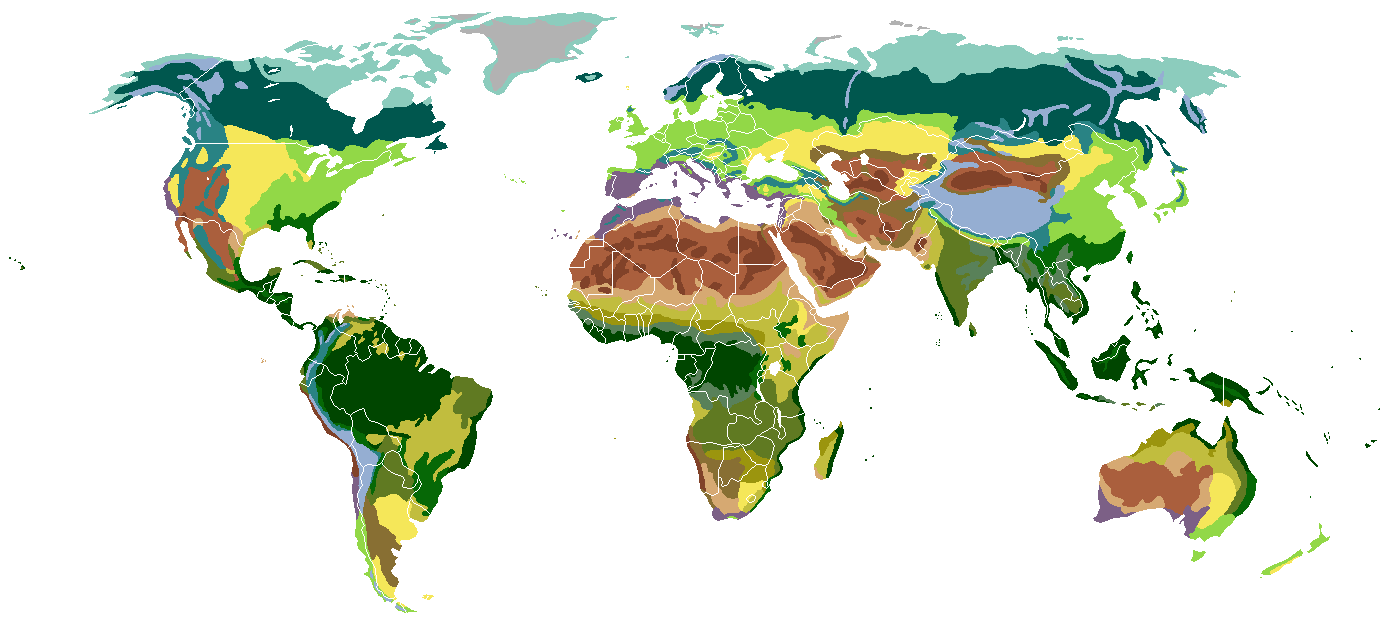
A biome ( ) is a distinct geographical region with specific climate, vegetation, animal life, and an ecosystem. It consists of a biological community that has formed in response to its physical environment and regional climate. In 1935, Tansley added the climatic and soil aspects to the idea, calling it ''ecosystem''. The International Biological Program (1964–74) projects popularized the concept of biome.
However, in some contexts, the term ''biome'' is used in a different manner. In German literature, particularly in the Walter terminology, the term is used similarly as '' biotope'' (a concrete geographical unit), while the biome definition used in this article is used as an international, non-regional, terminology—irrespectively of the continent in which an area is present, it takes the same biome name—and corresponds to his "zonobiome", "orobiome" and "pedobiome" (biomes determined by climate zone, altitude, or soil).
In the Brazilian literature, the term ''biome ...
Vegetation
Vegetation is an assemblage of plants and the ground cover they provide. It is a general term, without specific reference to particular taxa, life forms, structure, spatial extent, or any other specific botanical or geographic characteristics. It is broader than the term ''flora'' which refers to species composition. Perhaps the closest synonym is '' plant community'', but "vegetation" can, and often does, refer to a wider range of spatial scales than that term does, including scales as large as the global. Primeval redwood forests, coastal mangrove stands, sphagnums, desert soil crusts, roadside weed patches, wheat fields, cultivated gardens and lawns; all are encompassed by the term "vegetation".
The vegetation type is defined by characteristic dominant species, or a common aspect of the assemblage, such as an elevation range or environmental commonality. The contemporary use of "vegetation" approximates that of ecologist Frederic Clements' term '' earth cover' ...

Australia
Australia, officially the Commonwealth of Australia, is a country comprising the mainland of the Australian continent, the island of Tasmania and numerous smaller islands. It has a land area of , making it the sixth-largest country in the world, and is the world's flattest and driest inhabited continent. It is a megadiverse country, and its size gives it a wide variety of landscapes and climates, including deserts in the interior and tropical rainforests along the coast.
The ancestors of Aboriginal Australians began arriving from Southeast Asia 50,000 to 65,000 years ago, during the Last Glacial Period. By the time of British settlement, Aboriginal Australians spoke more than 250 distinct languages and had one of the oldest living cultures in the world. Australia's written history commenced with Dutch exploration of most of the coastline in the 17th century. British colonisation began in 1788 with the establishment of the penal colony of New South Wales. B ...
-->
Vegetation
Vegetation is an assemblage of plants and the ground cover they provide. It is a general term, without specific reference to particular taxa, life forms, structure, spatial extent, or any other specific botanical or geographic characteristics. It is broader than the term ''flora'' which refers to species composition. Perhaps the closest synonym is '' plant community'', but "vegetation" can, and often does, refer to a wider range of spatial scales than that term does, including scales as large as the global. Primeval redwood forests, coastal mangrove stands, sphagnums, desert soil crusts, roadside weed patches, wheat fields, cultivated gardens and lawns; all are encompassed by the term "vegetation".
The vegetation type is defined by characteristic dominant species, or a common aspect of the assemblage, such as an elevation range or environmental commonality. The contemporary use of "vegetation" approximates that of ecologist Frederic Clements' term '' earth cover' ...

Plant
Plants are the eukaryotic organisms that constitute the kingdom Plantae . They are predominantly photosynthetic or came from photosynthetic ancestors, meaning that they obtain their energy from sunlight by using the green pigment chlorophyll in their chloroplasts to produce sugars from carbon dioxide and water. Over the course of time, some plants have evolved to be parasitic, meaning they take energy from other organisms. Except for glaucophytes, some green algae and a few red algae, most plants are multicellular.
Historically, as in Aristotle's biology, the plant kingdom encompassed all living things that were not animals, and included algae and fungi. Definitions have narrowed since then; current definitions exclude fungi and some of the algae. By the definition used in this article, plants form the clade Viridiplantae (green plants), which consists of the green algae and the embryophytes or land plants ( hornworts, liverworts, mosses, lycophyte ...
Canopy
Canopy may refer to:
Plants
* Canopy (botany), aboveground portion of plant community or crop (including forests)
* Canopy (grape), aboveground portion of grapes
Religion and ceremonies
* Baldachin or canopy of state, typically placed over an altar or throne
* Chuppah, a canopy used in Jewish wedding ceremonies
* Umbraculum, a canopy awarded by the pope to basilicas
* Vapor canopy, a creationist idea that earth was surrounded by a "canopy" of waterAs a proper nameTransportation
* Canopy (aircraft), transparent enclosure over aircraft cockpit
* Camper shell, or canopy, a raised, rigid covering for the rear bed of a pickup truck
* Honda Canopy, a three-wheeled automobile from Honda
Brands and organizations
* Canopy (hotel), a brand within the corporate structure of Hilton Worldwide
* Canopy Biosciences, American biotechnology company
* Canopy Group, U.S. investment firm
* OP Canopy, Canadian Forces Operation
Computing
* Enthought Canopy, a Python distribution and analys ...
_(cropped).jpg)
Species
A species () is the basic unit of classification and a taxonomic rank of an organism, as well as a unit of biodiversity. It can be defined as the largest group of organisms in which any two individuals of the appropriate sexes or mating types can produce fertile offspring, typically by sexual reproduction. Other ways of defining species include their karyotype, DNA sequence, morphology, behaviour, or ecological niche. In addition, palaeontologists use the concept of the chronospecies since fossil reproduction cannot be examined. The most recent rigorous estimate for the total number of species of eukaryotes is between 8 and 8.7 million. About 14% of these had been described by 2011. All species are given a two-part binomial name. The first part is the name of the genus to which the species belongs. The second part is called the specific name or the specific epithet (in botanical nomenclature, also sometimes in zoological nomenclature). For example, '' Boa con ...

Prince
A prince is a male ruler (ranked below a king, grand prince, and grand duke) or a male member of a monarch's or former monarch's family. ''Prince'' is also a title of nobility (often highest), often hereditary, in some European states. The female equivalent is a princess. The English word derives, via the French word ''prince'', from the Latin noun , from (first) and (head), meaning "the first, foremost, the chief, most distinguished, noble ruler, prince".
In a related sense, now not commonly used, all more or less sovereign rulers over a state, including kings, were "princes", they were members of the princely class, in the language of international politics and diplomacy. Princes was thus a collective noun, that applied to the group of sovereign monarchs, even if they used another title, for example king or duke. Many of these were Princes of the Holy Roman Empire.
Historical background
The Latin word (older Latin *prīsmo-kaps, ), became the usual title of th ...