|
Megas Archon
The title of ''megas archōn'' (; "grand archon") was a Byzantine court title during the 13th–14th centuries. History and functions The title of ''megas archōn'' appears originally as a translation of foreign titles, with the meaning of " grand prince"; thus in the middle of the 10th century Emperor Constantine VII Porphyrogennetos calls the Magyar ruler Árpád as "great prince of '' Tourkia'' ungary () in chapter 40 of his ''De Administrando Imperio''. The Nicaean emperor Theodore II Laskaris () first established it as a specific court rank, originally designating the highest-ranking officer of the emperor's retinue. By the time pseudo-Kodinos wrote his ''Book of Offices'' in the mid-14th century, however, it had become a purely honorific dignity without any duties attached. In the ''Book of Offices'', the post is listed in the 35th place of the imperial hierarchy, between the '' prōtospatharios'' and the '' tatas tēs aulēs'', but other contemporary lists of offic ... [...More Info...] [...Related Items...] OR: [Wikipedia] [Google] [Baidu] [Amazon] |
Archon
''Archon'' (, plural: , ''árchontes'') is a Greek word that means "ruler", frequently used as the title of a specific public office. It is the masculine present participle of the verb stem , meaning "to be first, to rule", derived from the same root as words such as monarch and hierarchy. Ancient Greece In the early literary period of ancient Greece, the chief magistrates of various Greek city states were called ''archontes''. The term was also used throughout Greek history in a more general sense, ranging from "club leader" to "master of the tables" at '' syssitia'' to "Roman governor". In Athens, a system of three concurrent archons evolved, the three office holders being known as ''archon eponymos'' (), the '' polemarch'' (), and the '' archon basileus'' (). According to Aristotle's '' Constitution of the Athenians'', the power of the king first devolved to the archons, and these offices were filled from the aristocracy by elections every ten years. During this period, the ... [...More Info...] [...Related Items...] OR: [Wikipedia] [Google] [Baidu] [Amazon] |
Constantine Margarites
Constantine Margarites () was a senior military officer and courtier of the Empire of Nicaea in the mid-13th century. His life is only known from the brief, and very hostile, references to him in the ''History'' of George Akropolites. Akropolites disparages Margarites, as well as many other of the low-born "new men" who rose to prominence as favourites of Theodore II Laskaris (ruled 1254–58), as opposed to the traditional aristocracy which customarily monopolized high offices. According to Akropolites, Margarites was born in the theme of Neokastra in northwestern Asia Minor, a "peasant born of peasants, reared on barley and bran and knowing only how to grunt". He joined the thematic army and rose to the rank of ''tzaousios''. His skill impressed the Nicaean emperor John III Vatatzes (r. 1222–54), who placed him in his own bodyguard, and later raised him to the post of ''megas tzaousios''. Apparently on his accession, John's son Theodore II Laskaris made him ''archon tou allagiou ... [...More Info...] [...Related Items...] OR: [Wikipedia] [Google] [Baidu] [Amazon] |
Thrace
Thrace (, ; ; ; ) is a geographical and historical region in Southeast Europe roughly corresponding to the province of Thrace in the Roman Empire. Bounded by the Balkan Mountains to the north, the Aegean Sea to the south, and the Black Sea to the east, it comprises present-day southeastern Bulgaria (Northern Thrace), northeastern Greece (Western Thrace), and the European part of Turkey (East Thrace). Lands also inhabited by ancient Thracians extended in the north to modern-day Northern Bulgaria and Romania and to the west into Macedonia (region), Macedonia. Etymology The word ''Thrace'', from ancient Greek ''Thrake'' (Θρᾴκη), referred originally to the Thracians (ancient Greek ''Thrakes'' Θρᾷκες), an ancient people inhabiting Southeast Europe. The name ''Europe'' (ancient Greek Εὐρώπη), also at first referred to this region, before that term expanded to include its Europe, modern sense. It has been suggested that the name ''Thrace'' derives from the na ... [...More Info...] [...Related Items...] OR: [Wikipedia] [Google] [Baidu] [Amazon] |
Epi Tou Stratou
The title of ''epi tou stratou'' (; "the one in charge of the army") was a Byzantine The Byzantine Empire, also known as the Eastern Roman Empire, was the continuation of the Roman Empire centred on Constantinople during late antiquity and the Middle Ages. Having survived the events that caused the fall of the Western Roman E ... military position attested during the 14th century. History and functions According to the ''Book of Offices'' of Pseudo-Kodinos, written shortly after the mid-14th century, the ''epi tou stratou'' was a subaltern official of the '' megas domestikos'', the commander-in-chief of the Byzantine army. On campaign, he scouted ahead of the army to find a suitable camping place, but his choice had to be confirmed by the ''megas domestikos''. Most of the holders were military commanders, and their actual responsibilities were wider than implied by Pseudo-Kodinos; according to Rodolphe Guilland, in reality it appears that the office was simply conferred ... [...More Info...] [...Related Items...] OR: [Wikipedia] [Google] [Baidu] [Amazon] |
Roger De Flor
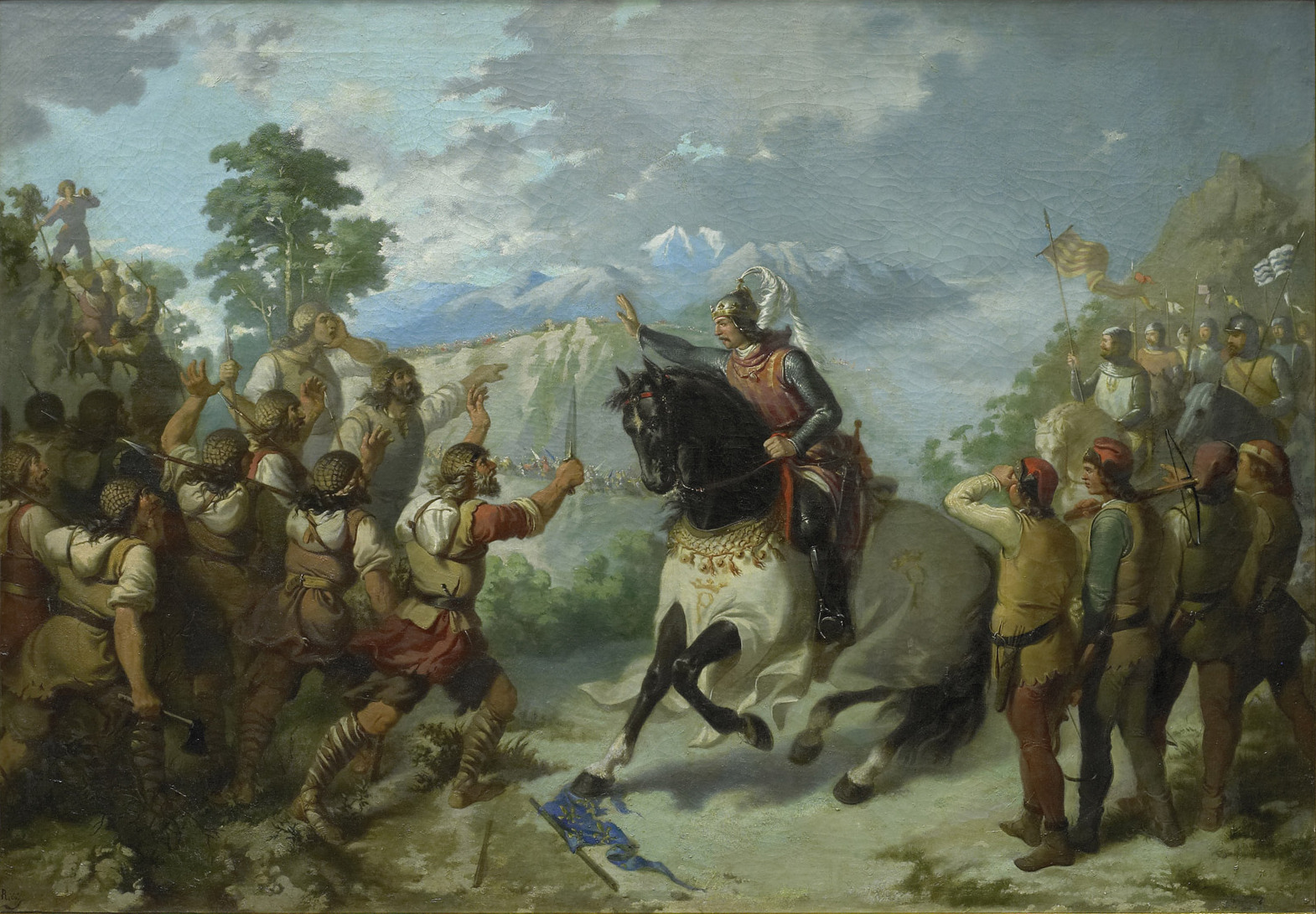
Roger de Flor (c. 1267 – 30 April 1305), also known as Ruggero/Ruggiero da Fiore or Rutger von Blum or Ruggero Flores, was an Italian military adventurer and condottiere active in Aragonese Sicily, Italy, and the Byzantine Empire. He was the commander of the Great Catalan Company and held the title Count of Malta. Biography Roger de Flor was born in Brindisi in the Kingdom of Sicily, the second son of an Italian noblewoman of Brindisi and a German people, German falconry, falconer named Richard von Blum (''Blume'' means flower in German language, German) in the service of Emperor Frederick II, Holy Roman Emperor, Frederick II. Richard von Blum was killed fighting at the Battle of Tagliacozzo in 1268. At eight years old Roger de Flor was sent to sea in a galley belonging to the Knights Templars. He entered the order and became captain of a galley called "El falcó". After rescuing wealthy survivors during the Siege of Acre (1291), siege of Acre by the Mamluk Sultan Al-Ashr ... [...More Info...] [...Related Items...] OR: [Wikipedia] [Google] [Baidu] [Amazon] |
Asia Minor
Anatolia (), also known as Asia Minor, is a peninsula in West Asia that makes up the majority of the land area of Turkey. It is the westernmost protrusion of Asia and is geographically bounded by the Mediterranean Sea to the south, the Aegean Sea to the west, the Turkish Straits to the northwest, and the Black Sea to the north. The eastern and southeastern limits have been expanded either to the entirety of Asiatic Turkey or to an imprecise line from the Black Sea to the Gulf of Alexandretta. Topographically, the Sea of Marmara connects the Black Sea with the Aegean Sea through the Bosporus and the Dardanelles, and separates Anatolia from Thrace in Southeast Europe. During the Neolithic, Anatolia was an early centre for the development of farming after it originated in the adjacent Fertile Crescent. Beginning around 9,000 years ago, there was a major migration of Anatolian Neolithic Farmers into Neolithic Europe, Europe, with their descendants coming to dominate the continent a ... [...More Info...] [...Related Items...] OR: [Wikipedia] [Google] [Baidu] [Amazon] |
Catalan Company
The Catalan Company or the Great Catalan Company (; , , , or ) was a company of mercenaries led by Roger de Flor in the early 14th century and hired by Byzantine Emperor Andronikos II Palaiologos to combat the increasing power of the Anatolian beyliks. It was formed by '' almogavar'' veterans of the War of the Sicilian Vespers, who had remained unemployed after the signing in 1302 of the Peace of Caltabellotta between the Crown of Aragon and the French dynasty of the Angevins. Origin The military demands of the Reconquista stimulated the formation of the elite light infantry known as the '' almogavars'' on the Iberian peninsula during the 13th century. These troops were used quite effectively by the Crown of Aragon for other imperial ventures in the Mediterranean, particularly the War of the Sicilian Vespers. They were typically organised in companies (''societates'') of 20 to 50 men, following a chief of recognized military skill. The signing of the Peace of Caltabellotta i ... [...More Info...] [...Related Items...] OR: [Wikipedia] [Google] [Baidu] [Amazon] |
Manuel Philes
Manuel Philes (; –1345) was a Byzantine poet from Ephesus. He was "the most prolific author of the late Byzantine period". Biography At an early age, he moved to Constantinople, where he was the pupil of George Pachymeres, in whose honour he composed a memorial poem. Philes appears to have travelled extensively, and his writings contain much information concerning the imperial court and distinguished Byzantines. He participated in an embassy to the "Tauroscythians" (Tatars) in 1293 to arrange the marriage of Maria, daughter of Andronikos II Palaiologos, to Toqta, the khan of the Golden Horde The Golden Horde, self-designated as ''Ulug Ulus'' ( in Turkic) was originally a Mongols, Mongol and later Turkicized khanate established in the 13th century and originating as the northwestern sector of the Mongol Empire. With the division of .... He then was on a mission to recruit Georgian archers in 1305 and 1306. Having offended one of the emperors, probably Andronikos II, by in ... [...More Info...] [...Related Items...] OR: [Wikipedia] [Google] [Baidu] [Amazon] |
Cyclades
The CYCLADES computer network () was a French research network created in the early 1970s. It was one of the pioneering networks experimenting with the concept of packet switching and, unlike the ARPANET, was explicitly designed to facilitate internetworking. The CYCLADES network was the first to make the hosts responsible for the reliable delivery of data, rather than this being a centralized service of the network itself. Datagrams were exchanged on the network using transport protocols that do not guarantee reliable delivery, but only attempt best-effort. To empower the network leaves the hosts to perform error-correction, the network ensured end-to-end protocol transparency, a concept later to be known as the end-to-end principle. This simplified network design, reduced network latency, and reduced the opportunities for single point failures. The experience with these concepts led to the design of key features of the Internet Protocol in the ARPANET project. The network ... [...More Info...] [...Related Items...] OR: [Wikipedia] [Google] [Baidu] [Amazon] |
Rhodes
Rhodes (; ) is the largest of the Dodecanese islands of Greece and is their historical capital; it is the List of islands in the Mediterranean#By area, ninth largest island in the Mediterranean Sea. Administratively, the island forms a separate municipality within the Rhodes (regional unit), Rhodes regional unit, which is part of the South Aegean Administrative regions of Greece, administrative region. The principal town of the island and seat of the municipality is the Rhodes (city), city of Rhodes, which had 50,636 inhabitants in 2011. In 2022, the island had a population of 125,113 people. It is located northeast of Crete and southeast of Athens. Rhodes has several nicknames, such as "Island of the Sun" due to its patron sun god Helios, "The Pearl Island", and "The Island of the Knights", named after the Knights Hospitaller, Knights of Saint John of Jerusalem, who ruled the island from 1310 to 1522. Historically, Rhodes was famous for the Colossus of Rhodes, one of the Sev ... [...More Info...] [...Related Items...] OR: [Wikipedia] [Google] [Baidu] [Amazon] |
Kephale (Byzantine Empire)
In the late Byzantine Empire, the term ''kephale'' () was used to denote local and provincial governors. It entered use in the second half of the 13th century, and was derived from the colloquial language. Consequently, it never became an established title or rank of the Byzantine imperial hierarchy, but remained a descriptive term.. In essence, the ''kephalē'' replaced the Komnenian-era '' doux'' as the civil and military governor of a territorial administrative unit, known as a ''katepanikion'' (κατεπανίκιον, ''katepaníkion''),Not to be confused with the very different katepanates of the 10th-11th centuries. but also termed a ''kephalatikion'' (κεφαλατίκιον, ''kephalatíkion''). In size, these provinces were small compared to the earlier '' themata'', and could range from a few villages surrounding the ''kephales seat (a ''kastron'', "fortress"), to an entire island. This arrangement was also adopted by the Second Bulgarian Empire (as , ''kefaliya'') an ... [...More Info...] [...Related Items...] OR: [Wikipedia] [Google] [Baidu] [Amazon] |