|
Paris De Grassis
Paris de Grassis (also Paride de' Grassi, c. 1470 – 10 June 1528) was the master of ceremonies to Pope Julius II and Pope Leo X. He joined the Office of Ceremonies in May 1504 as a participating ceremonialist, progressed to role of president of the Office when he became bishop of Pesaro in 1513, and continued as president until he died in 1528. De Grassis' diary covers his work at the papal court from 1504 to 1521. Biography He was born at Bologna into a lesser patrician family. During his lifetime the family would rise in status from its professional roots in the law faculty at the University and in the College of Notaries to fill important offices in the Bolognese senate, as well as in the Bolognese church and at the papal court. His father, Baldassare, had been a member of College of Notaries since 1464, while other uncles graduated from the University of Bologna with doctorates in canon and civil law, taught at the same university, and sometimes served as canons in the B ... [...More Info...] [...Related Items...] OR: [Wikipedia] [Google] [Baidu] [Amazon] |
Roman Catholic Archdiocese Of Pesaro
The Archdiocese of Pesaro () is a Latin Church, Latin diocese of the Catholic Church in central Italy. Its see at Pesaro was elevated to the status of metropolitan archiepiscopal see in 2000. Its suffragans are the Diocese of Fano-Fossombrone-Cagli-Pergola and the Archdiocese of Urbino-Urbania-Sant'Angelo in Vado.David M. Cheney, ''Catholic-hierarchy.org''"Archdiocese of Pesaro" Retrieved: 4 May 2023. History The first bishop, Florentius, is said to have governed this see in the middle of the second century, while the bishop, Decentius, according to tradition, suffered martyrdom under Diocletian. Bishop Heradianus was at the Council of Sardica in 343.Benigni, Umberto. "Diocese of Pesaro." The Catholic Encyclopedia Vol. 11. New York: Robert Appleton Company, 1911. 31 May 2021 Other bishop ... [...More Info...] [...Related Items...] OR: [Wikipedia] [Google] [Baidu] [Amazon] |
Frederick III, Holy Roman Emperor
Frederick III (German language, German: ''Friedrich III,'' 21 September 1415 – 19 August 1493) was Holy Roman Emperor from 1452 until his death in 1493. He was the penultimate emperor to be Coronation of the Holy Roman Emperor, crowned by the pope, and the last to be crowned in Rome. He was the fourth King of the Romans and the first Holy Roman Emperor from the House of Habsburg, which was to retain the title with one gap until it was declared at an end by Francis II, Holy Roman Emperor, Emperor Francis II, in 1806. Prior to his imperial coronation, he was duke of the Inner Austrian lands of Duchy of Styria, Styria, Duchy of Carinthia, Carinthia and Duchy of Carniola, Carniola from 1424, and also acted as regent over the Duchy of Austria from 1439. He was imperial election of 1440, elected and crowned King of Germany in 1440. His reign of 53 years is the longest in the history of the Holy Roman Empire or the German monarchy. Upon his death in 1493 he was succeeded by his son Max ... [...More Info...] [...Related Items...] OR: [Wikipedia] [Google] [Baidu] [Amazon] |
Romagna
Romagna () is an Italian historical region that approximately corresponds to the south-eastern portion of present-day Emilia-Romagna, in northern Italy. Etymology The name ''Romagna'' originates from the Latin name ''Romania'', which originally was the generic name for "land inhabited by Romans", and first appeared on Latin documents in the 5th century AD. It later took on the more specific meaning of "territory subjected to Eastern Roman rule", whose citizens called themselves Romans (''Romani'' in Latin; , '' Rhomaîoi'' in Greek). Thus the term ''Romania'' came to be used to refer to the territory administered by the Exarchate of Ravenna in contrast to other parts of northern Italy under Lombard rule, named ''Langobardia'' or ''Lombardy''. Location and boundaries Romagna is traditionally limited by the Apennines to the south-west, the Adriatic to the east, and the rivers Reno and Sillaro to the north and west. To the southeast, the valley formed by the River Conca has ... [...More Info...] [...Related Items...] OR: [Wikipedia] [Google] [Baidu] [Amazon] |
Roman Curia
The Roman Curia () comprises the administrative institutions of the Holy See and the central body through which the affairs of the Catholic Church are conducted. The Roman Curia is the institution of which the Roman Pontiff ordinarily makes use in the exercise of his supreme pastoral office and universal mission in the world: thus curialism refers traditionally to an emphasis on the supreme authority of the Holy See within the Catholic Church. It is at the service of the Pope and Bishops in the Catholic Church, bishops, fulfilling their function with an Gospel, evangelical spirit, working for the good and at the service of Communion of saints, communion, unity and edification of the Universal Church and attending to the demands of the world in which the Church is called to fulfill its duty and mission (''Praedicate evangelium'', article 1). The structure and organization of responsibilities within the Curia are at present regulated by the apostolic constitution issued by Pope F ... [...More Info...] [...Related Items...] OR: [Wikipedia] [Google] [Baidu] [Amazon] |
Fifth Council Of The Lateran
The Fifth Council of the Lateran, held between 1512 and 1517, was the eighteenth ecumenical council of the Catholic Church and was the last council before the Protestant Reformation and the Council of Trent. This was the first time since 1213 that the Papal States would host an ecumenical council. It is so far the last time that Rome’s Lateran Palace (which had hosted 4 ecumenical councils in the past) has been the venue for such a event. It was convoked by Pope Julius II with a political motive of restoring peace between warring Catholic rulers and to re-assert the authority of the Pope. After Pope Leo X took over in 1513, the Council attempted various institutional, dogmatic and social welfare reforms. Institutional reforms were intended to improve unity, reduce nepotism, absenteeism, disinterest, luxury and simony for high church officials, improve the training and regulation of priests, to strengthen the position of bishops over friars, and to assert the independence of ... [...More Info...] [...Related Items...] OR: [Wikipedia] [Google] [Baidu] [Amazon] |
Alexander VI
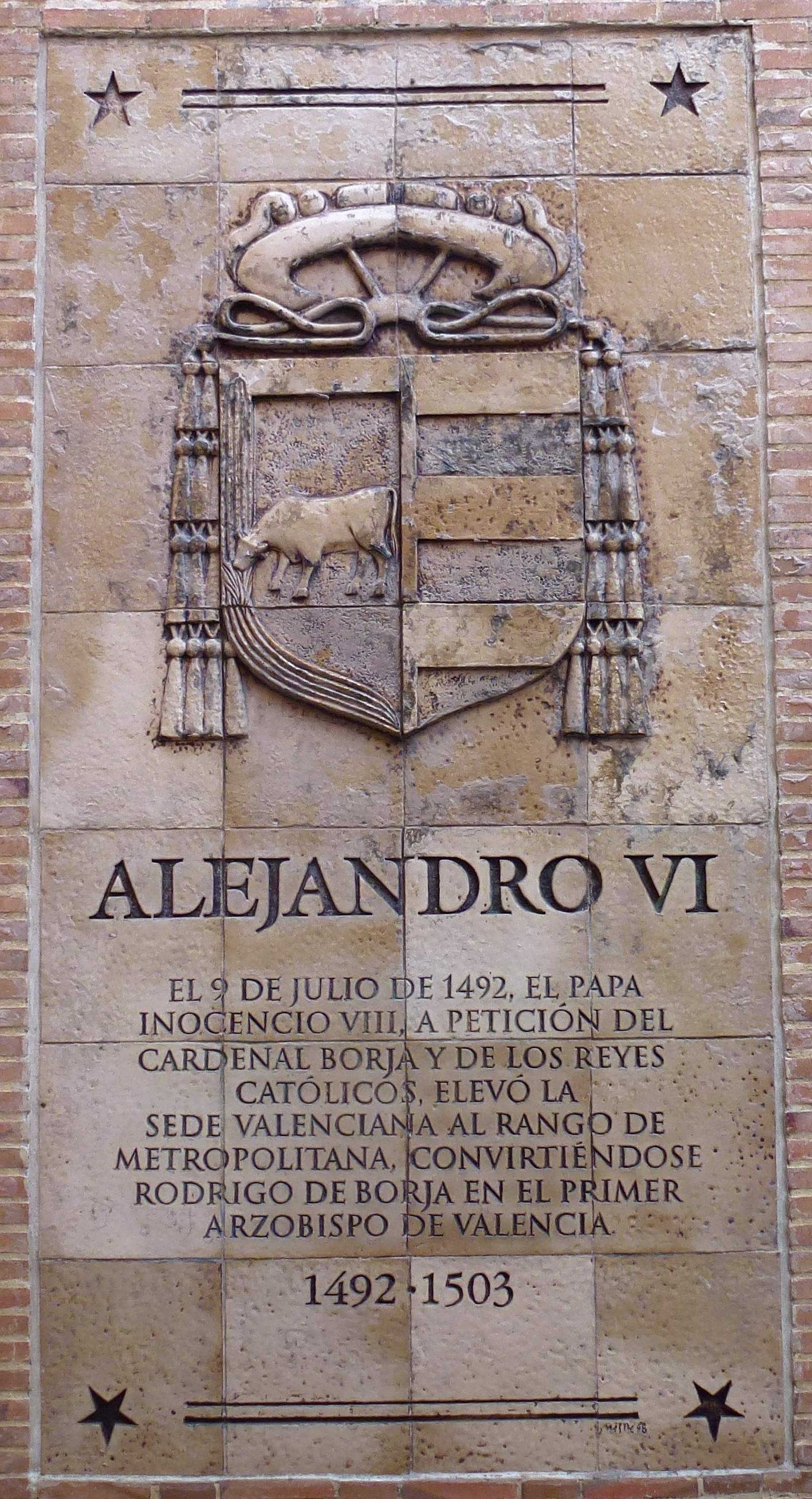
Pope Alexander VI (, , ; born Roderic Llançol i de Borja; epithet: ''Valentinus'' ("The Kingdom of Valencia, Valencian"); – 18 August 1503) was head of the Catholic Church and ruler of the Papal States from 11 August 1492 until his death in 1503. Born into the prominent House of Borgia, Borja family in Xàtiva in the Kingdom of Valencia under the Crown of Aragon, he was known as Roderic de Borja, and he is commonly referred to by the Italianized form as Rodrigo Borgia. He studied law at the University of Bologna. He was ordained deacon and made a Cardinal (Catholic Church), cardinal in 1456 after the election of his uncle as Pope Callixtus III, and a year later he became Apostolic Chancery, vice-chancellor of the Catholic Church. He proceeded to serve in the Roman Curia under the next four popes, acquiring significant influence and wealth in the process. In 1492, Rodrigo was elected pope, taking the name Alexander VI. Alexander's Inter caetera, papal bulls of 1493 confirm ... [...More Info...] [...Related Items...] OR: [Wikipedia] [Google] [Baidu] [Amazon] |
Innocent VIII
Pope Innocent VIII (; ; 1432 – 25 July 1492), born Giovanni Battista Cybo (or Cibo), was head of the Catholic Church and ruler of the Papal States from 29 August 1484 to his death, in July 1492. Son of the viceroy of Naples, Cybo spent his early years at the Neapolitan court. He became a priest in the retinue of Cardinal Calandrini, half-brother to Pope Nicholas V (1447–55); Bishop of Savona under Pope Paul II; and with the support of Cardinal Giuliano Della Rovere he was made a cardinal by Pope Sixtus IV. After intense politicking by Della Rovere, Cybo was elected pope in 1484. King Ferdinand I of Naples had supported Cybo's competitor, Rodrigo Borgia. The following year, Pope Innocent supported the barons in their failed revolt. During his papacy, Pope Innocent issued a papal bull on witchcraft named Summis desiderantes affectibus. In March 1489, Cem, the captive brother of Bayezid II, the sultan of the Ottoman Empire, came into Innocent's custody. Viewing his br ... [...More Info...] [...Related Items...] OR: [Wikipedia] [Google] [Baidu] [Amazon] |
Sixtus IV
Pope Sixtus IV (or Xystus IV, ; born Francesco della Rovere; (21 July 1414 – 12 August 1484) was head of the Catholic Church and ruler of the Papal States from 9 August 1471 until his death in 1484. His accomplishments as pope included the construction of the Sistine Chapel and the creation of the Vatican Library. A patron of the arts, he brought together the group of artists who ushered the early Renaissance into Rome with the first masterpieces of the city's new artistic age. Sixtus created the Spanish Inquisition through the Papal bull ''Exigit Sinceræ Devotionis'' (1478), and annulled the Pontifical decrees of the Council of Constance. He was noted for his nepotism and was personally involved in the infamous Pazzi conspiracy, a plot to remove the House of Medici, Medici family from power in Florence. Early life Francesco was a member of the Della Rovere family, a son of Leonardo Beltramo di Savona della Rovere and Luchina Monteleoni. He was born in Celle Ligure, a ... [...More Info...] [...Related Items...] OR: [Wikipedia] [Google] [Baidu] [Amazon] |
Johann Burchard
Johann Burchard, also spelled Johannes Burchart or Burkhart (c.1450–1506) was an Alsatian-born priest and chronicler during the Italian Renaissance. He spent his entire career at the papal Courts of Sixtus IV, Innocent VIII, Alexander VI, Pius III, and Julius II, serving as papal Master of Ceremonies, a position from which he was able to observe most of the important events of the period. Early life As his surname suggests Burkhardt was a German born at Niederhaslach in Alsace, (today the Bas-Rhin in France). Of humble origins, he was educated by the collegial chapter of St. Florent in Niederhaslach. He took the degree Doctor of Canon Law (''Decretorum Doctor'', as he proclaims in his preface to his ''Ordo Missae''), and then, on 4 June 1477, was able to purchase the bourgeois citizenship of Strasbourg. He eventually became secretary to Jean Wegeraufft, the Vicar General of the Bishop of Strasbourg, Ruppert von Simmern. Suspected of trafficking in dispensations from publishi ... [...More Info...] [...Related Items...] OR: [Wikipedia] [Google] [Baidu] [Amazon] |
Palazzo Grassi, Bologna
The Palazzo Grassi is Gothic-style, 13th-century palace located on Via Marsala #14 in Bologna, region of Emilia Romagna, Italy. The palace in 2015 houses the Circolo Ufficiali dell'Esercito, a private Officer's club. History The palace once belonged to the Canonici family, but was acquired by the Grassi family in 1466, and remained with their descendants until 1848. In 1478, the family was honored with the title of ''Conti Palatini del Sacro Romano Impero'' by Frederick III, Holy Roman Emperor Frederick III (German language, German: ''Friedrich III,'' 21 September 1415 – 19 August 1493) was Holy Roman Emperor from 1452 until his death in 1493. He was the penultimate emperor to be Coronation of the Holy Roman Emperor, crowned by the p .... In 1865, the palace was acquired by the military. It underwent a number of renovations, with the latest in the 20th century, and in 1935 it became the home of the Circolo club. The palace still retains a wooden portico columns for part of th ... [...More Info...] [...Related Items...] OR: [Wikipedia] [Google] [Baidu] [Amazon] |
Journal Of Early Modern History
The ''Journal of Early Modern History'' is a peer-reviewed academic journal focusing on the early modern period. It is the official journal of the University of Minnesota Center for Early Modern History, and is published by Brill since 1997. The editor iMolly A. Warshof the University of Pittsburgh The University of Pittsburgh (Pitt) is a Commonwealth System of Higher Education, state-related research university in Pittsburgh, Pennsylvania, United States. The university is composed of seventeen undergraduate and graduate schools and colle .... References External links * History journals Academic journals established in 1997 English-language journals Bimonthly journals Brill Publishers academic journals {{history-journal-stub ... [...More Info...] [...Related Items...] OR: [Wikipedia] [Google] [Baidu] [Amazon] |
Senator
A senate is a deliberative assembly, often the upper house or Legislative chamber, chamber of a bicameral legislature. The name comes from the Ancient Rome, ancient Roman Senate (Latin: ''Senatus''), so-called as an assembly of the senior (Latin: ''senex'' meaning "the elder" or "old man") and therefore considered wiser and more experienced members of the society or ruling class. However the Roman Senate was not the ancestor or predecessor of modern parliamentarism in any sense, because the Roman senate was not a de jure legislative body. Many countries have an assembly named a ''senate'', composed of ''senators'' who may be election, elected, appointed, have inheritance, inherited the title, or gained membership by other methods, depending on the country. Modern senates typically serve to provide a chamber of "sober second thought" to consider legislation passed by a lower house, whose members are usually elected. Most senates have asymmetrical duties and powers compared w ... [...More Info...] [...Related Items...] OR: [Wikipedia] [Google] [Baidu] [Amazon] |